
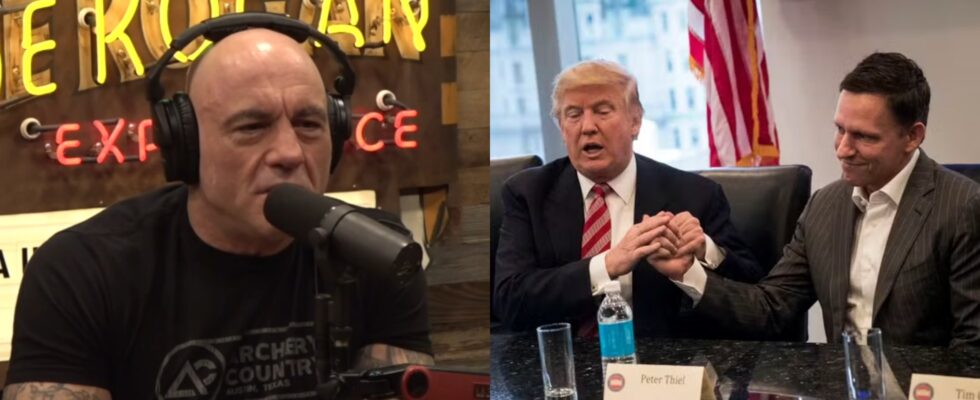
There is a pattern on the Joe Rogan Experience that his own audience has started to notice, and Tim Dillon just walked into JRE studios and made it impossible to ignore.
When Tim sat down with Rogan, he did something that a string of guests before him had attempted with varying degrees of success. He named names. He described the system. He talked about Palantir, the data company co-founded by Peter Thiel, and laid out exactly what is at stake when government databases covering health, criminal justice, and tax records get merged under a single private platform.
“My worry is that in the guise of going against China, we’re going to become China,” Dillon said. It is a clean, direct observation, and it landed in that studio like a stone through glass.
What makes this moment so revealing is not just what Tim said. It is how Rogan responded, which was essentially to sit there and accept it. Rogan hosted the co-founder and chairman of Palantir Technologies for three and a half hours on JRE and the word Palantir was never mentioned once.
His own episode description names the guest’s role at Palantir. Then when Theo Von raised Palantir months later, Rogan acted as though he had never encountered the name before in his life. And now Tim Dillon has to explain the whole thing to him again from scratch.
Rogan opened the conversation with the AI race talking point, describing it as a Manhattan Project style competition where the future of the United States depends on getting there first. Those are not original thoughts. Those are the exact talking points that guests like Marc Andreessen and Peter Thiel have been placing on that podcast for two years. Tim flipped it in a single sentence.
The bunker question is where Rogan fully exposed himself. After Tim described being invited to meet with Thiel and turning it down, Rogan asked him whether his opinions would change if he received a bunker invitation.
Rogan asked, “Have you gotten any invites to any bunkers? Do you think you’d feel differently if you did?”
That question is not casual curiosity. It is a confession. It is Rogan, probably without realizing it, revealing the framework through which his own perspective shifted. The obvious follow-up question is whether Joe’s own views changed when the billionaires started letting him into their circles, and the last two years of JRE make that answer fairly clear.
Tim Dillon is not a perfect messenger. Not long ago he was flown to Washington by J.D. Vance, fed talking points about the Epstein files over a seafood tower, and repeated them back on his own podcast. His audience called him out for it.
But then something shifted. He read the room, recognized the pattern, and changed course. That is the difference between him and Rogan right now. Tim saw where things were heading and pulled back. Rogan has not.
The guests keep coming into that studio and saying what Rogan’s audience has been asking him to say for months. Theo Von said it. Duncan Trussell said it. Now Tim Dillon said it, and he said it in detail, clearly, and without flinching.
Every time, Rogan either redirects, shuts it down, or plays confused. This time, he had nowhere to go. He just sat there and nodded, which at this point might be the most honest thing he has done in a long time.
