
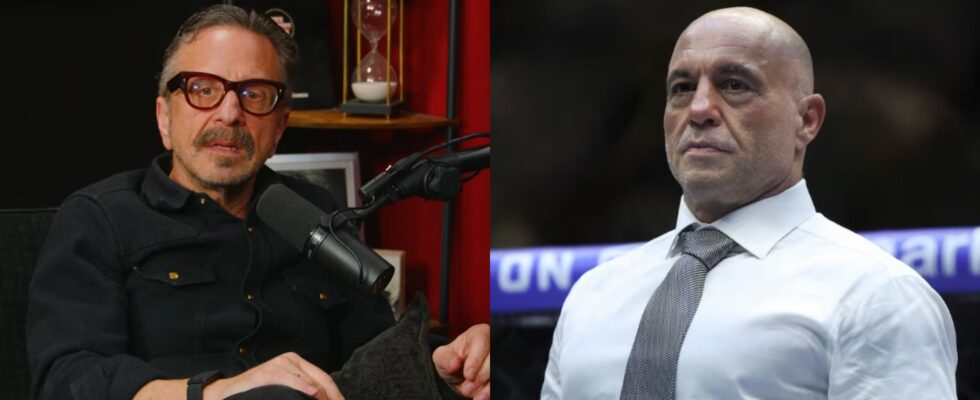
In a recent episode of the Kat Bird Pod, comedian Marc Maron sat down with host Kat Bird for conversation that touched on his career, his creative philosophy, and the state of comedy today.
During the conversation, Bird showed Maron an old photo from the Comedy Store featuring several comedians.
“How old is that?” Maron asked. “That looks like, uh, we got Dean Del Rey,” Bird replied.
“Oh, it’s not that old,” Maron responded.
Bird then began pointing out familiar faces in the photo. “Rogan. Burr. You know, all your faves,” she said.
“Yeah,” Maron replied simply.
During the conversation, Maron also looked back on his career before the internet transformed the business, he explained that traditional television appearances rarely translated into meaningful audience growth.
“I lived in a world where my needle didn’t move for 40 years,” Maron said. “No matter how many Conan’s I did, it didn’t matter. I wasn’t getting an audience. I wasn’t building an audience.”
He contrasted that era with today’s creator economy, where comedians have unprecedented access to audiences but are also expected to constantly feed the algorithm.
“Well, just this constant need to create content in order to move your needle at all,” Maron said. “Because now there are no gatekeepers and there is no collective way of experiencing anything.”
He argued that comics now spend enormous amounts of time making content simply to remain visible.
“Half your life is creating content. What a f***ing nightmare,” he said.
For stand-up comedians, he believes the problem runs even deeper.
“And then, like, creating comedy content, but you don’t want to dip into your jokes, so you’re forced to act like you want to talk to those people all the time,” Maron added.
While platforms like podcasting have created opportunities that didn’t exist earlier in his career, Maron also sees them as demanding an endless cycle of content production that can distract from the craft itself.
Later, Maron reflected on the changing nature of stand-up itself. He suggested that audiences have become less interested in intellectually demanding material, arguing that “thinky comedy” is gradually disappearing.
He said, “Some people don’t know how to process thinky comedy sometimes. And it’s like that whole world of that is going away. There wasn’t that much of it to begin with.”
“But if you challenge people like either intellectually or about their beliefs or you talk about stuff, you know, other than dumb kind of provocative stuff, you know, whatever bulls**t goes on, roast, they have to think differently and they don’t know how to do it really. But like I can’t I can’t wait for them anymore. ”
Comparing his own approach with what dominates today’s comedy landscape, he described the country’s most popular comedy as “fundamentally non-challenging, non-dirty family fare.”
