
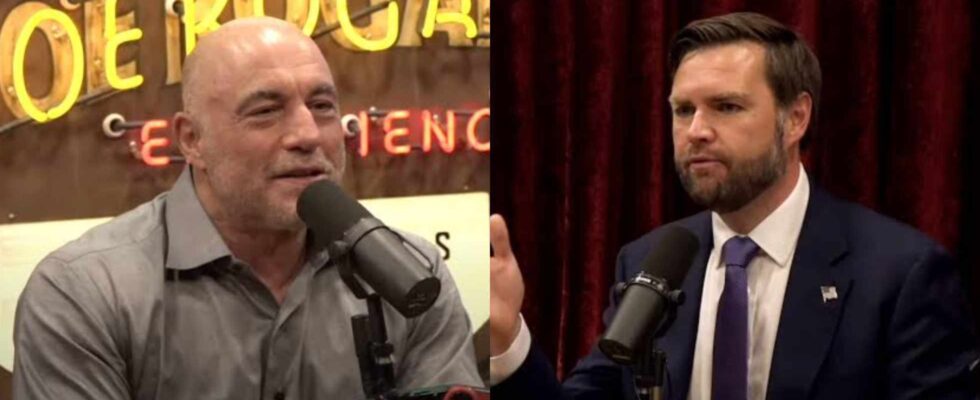
Vice President JD Vance walked into a room full of Republican Jewish donors on Monday night expecting friendly territory, and mostly got it, but not before Republican Jewish Coalition National Chairman Norm Coleman put him on the spot over some of his most famous podcast friends.
The exchange happened during a closed-door, off-the-record conversation at the RJC’s National Leadership Summit in Las Vegas, a session that was obtained on recording even though it was kept away from press cameras. For most of the evening, Vance and Coleman traded warm banter about the U.S.-Israel relationship, the midterms, energy policy, and Vance’s own religious journey. But partway through, Coleman shifted into territory that clearly required Vance to defend some uncomfortable company he keeps.
“You mentioned Fuentes, podcasters. A few names: Tucker Carlson, Megyn Kelly, Joe Rogan, Nick Fuentes. They have platformed anti-semites,” Coleman said. “How do you draw the line in terms of… because they’re powerful. Those podcasters, they touch a lot of voices. How do you draw the line in terms of whether you fig ht with the platforms that you appear on and you podcast? How do you do that today?”
It was a direct challenge, one that forced Vance to explain why he continues showing up on shows hosted by men who have given airtime to figures like Nick Fuentes, the white nationalist podcaster who has drawn scrutiny for years over his open animus toward Jewish people.
Vance did not dodge the question, but he also made clear he was not going to lump Rogan in with Fuentes.
“I mean, look, and I recognize that not everyone in this room is going to agree with me on this, but I take two basic approaches to it,” Vance said. “One area where I really do draw the line is on people who engage in what I call this blood libel attitude. And like I recognize a lot of people in this room might disagree with things that Tucker Carlson or Megyn Kelly or Joe Rogan has said, but I think just to hone in on Fuentes and Rogan, I think these are two very, very different categories of people, both with their within their reach, but also within the ideas that are in their actual head.”
He was blunt about where his personal sympathies land. “I’m biased, I like Joe Rogan,” Vance said, “but I think it’s a mistake to sort of say we’re going to write Joe Rogan off because he said something that we don’t like. I think the best approach is to actually go in there, and talk to him, and make the arguments as best as you can.”
From there, Vance pivoted into something closer to a campaign strategy memo, describing an internal effort inside the administration to measure exactly how much political reach Rogan commands compared to other shows. He said the team looked specifically at how the podcast landscape might shape the outcome of Michigan Senate candidate Mike Rogers’ race and others like it around the country.
“We actually looked at, Joe Rogan, what is his audience among the people that we want to vote for Mike Rogers?” Vance said. “And what we found is that if you look at all the other podcasters, their reach was five to ten percent of what we would call persuadable voters, those voters in the middle who really are gettable. With Rogan, it’s something like 35 to 40 percent.”
For Vance, that number settled the matter. Rather than treating Rogan’s platform as a liability because of who else has appeared on it, he framed engagement as the whole point.
“I do not think that Joe Rogan and Nick Fuentes are the same, just substantively, but as a political matter, I think that we have got to be willing to go everywhere and bring our message anywhere and to any person,” he said.
“And that means sometimes going into a podcast where you’re going to talk, last time I was on Joe Rogan, we talked about UFOs for like an hour, right? But you got to meet people where they are and make the arguments as best as you can, and that is I think ultimately how you win the political debate. It’s not by shunning people, and that’s the approach that I try to take.”
He did draw a couple of lines he said he would not cross, regardless of reach or persuadable-voter math.
“Talk to as many people as possible, but obviously I’m not going to go talk to a guy who’s attacked my wife or who’s said that H*tler was a good guy,” he said. “But outside of some pretty bright lines, I try to talk to as many people as I can.”
The podcast question came only after a longer stretch in which Vance and Coleman worked through what both described as a rising tide of antisemitism, one they argued is showing up on both ends of the political spectrum.
Coleman pressed Vance on a Florida congressional race in which a candidate who had appeared alongside Fuentes managed to win a majority of college precincts against Republican Mario Diaz-Balart, a result Coleman used to argue that Republicans are at risk of losing younger voters to the same fringe currents Vance was being asked to account for.
Vance’s answer leaned heavily on data his staff had compiled comparing antisemitic sentiment among white Americans in 2025 against 1985. “What I found was very interesting, which is that the rising antisemitism you see, and I’m not saying you don’t see it among some podcasters, you obviously do, I mean, you know, the Fuentes character who, you know, really does hate Jews, and also by the way really hates me and my family, so you’re in good company, right, he like that is real, but it’s not common among most of our fellow citizens,” he said.
His conclusion was that the more significant driver was immigration policy, arguing that newer arrivals sometimes carry “ancient ethnic hatreds” from abroad rather than acquiring them domestically. “If you want to bring your ethnic hatreds anywhere, don’t come to the United States of America, you’re not welcome,” he said.
He also invoked the late conservative commentator Charlie Kirk, whom Vance helped transport for burial last year, recalling a line Kirk had used even while disagreeing with parts of the administration’s Middle East approach. “Jew hatred is corrosive to the soul,” Vance said, repeating Kirk’s phrase as something he said he keeps returning to.
