
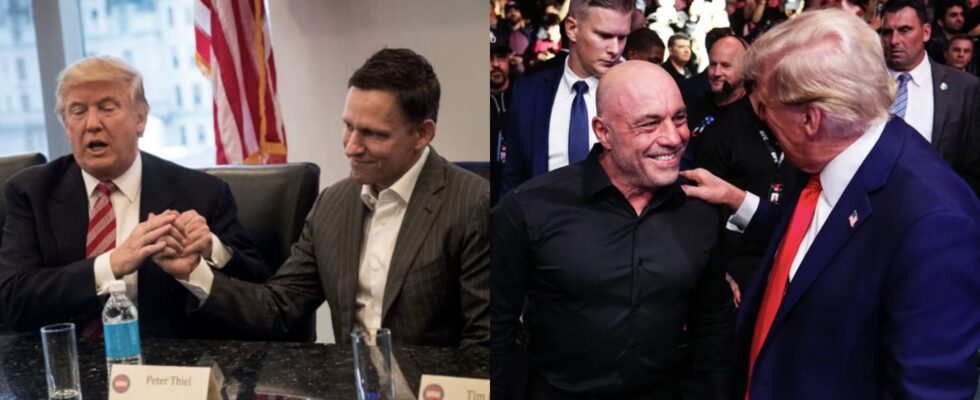
The fracture lines within Donald Trump’s coalition are becoming impossible to ignore. What began with billionaire Peter Thiel’s private criticism of the Iran conflict has evolved into a public reckoning, with prominent comedians now voicing their own disillusionment with the administration’s direction.
Thiel’s comments, delivered at a private lecture in Nashville on October 12 marked a significant departure for one of Trump’s earliest supporters in Silicon Valley.
“I’m skeptical of [the war], I think we should not have done it,” Thiel stated plainly. “There were a lot of mistakes that were made.”
The remarks carry particular weight given Thiel’s history. He was the first major technology investor to back Trump in 2016 and spoke at that year’s Republican National Convention. He also served as the largest financial backer of super PACs supporting Vice President JD Vance’s Senate campaign in 2022.
Now as Trump’s approval reportedly sits at 30 percent, cultural figures who once gave the president a hearing are speaking out with similar frustration.
Joe Rogan, whose podcast reaches millions of listeners addressed his own changing view during a recent conversation on the Joe Rogan Experience MMA Show with UFC heavyweight Sean Sharaf. When asked directly about his perspective on Trump after initially supporting him, Rogan was candid about what went wrong.
“The no new wars thing is the one that messed up a lot of people,” Rogan explained. “No one thought that we were going to go into this prolonged war with Iran that who knows how long that’s going to take and what that’s for.”
Rogan pointed to conflicting narratives about the justification for military action. While some officials claimed Iran was advancing toward weapons capability and needed to be stopped, Rogan cited experts who disagreed.
“There’s a lot of other people that know a lot about nuclear weapons and say not only is it incredibly difficult to develop a nuclear weapon, but they weren’t even close to doing it,” he said.
His fundamental position remained clear: “I don’t like any of that. I don’t like any people being sent over to a foreign country for a war that most people don’t want.”
Rogan’s disillusionment reflects a broader pattern he has observed across administrations. He noted that President Obama’s campaign platform once emphasized protecting whistleblowers, yet his administration pursued figures like Edward Snowden and Chelsea Manning.
“I have never been impressed with any single individual politician who comes along and changes everything,” Rogan reflected. “They all say they’re going to do something and they never wind up doing exactly what they’re doing.”
Comedian Tim Dillon offered an even sharper assessment during a recent episode of The Tim Dillon Show. His commentary followed footage from a Trump rally where a protester wearing a “Release the Epstein Files” shirt was physically attacked by audience members.
“Trump now is playing to the lowest caliber of human being in our country,” Dillon stated, observing how someone advocating for transparency regarding Jeffrey Epstein was met with hostility from the crowd.
Dillon described watching people he knew personally become absorbed into what he called “the MAGA cult,” losing friendships in the process. “You couldn’t get them back. Like they were gone and you could just see it in their eyes where it was like, ‘Oh, you’re gone. You can’t come back. You are gone.'”
He argued that supporters have been systematically abandoned through policies favoring technology billionaires and Middle East military engagement. “He has sold these people out, especially the younger people behind him,” Dillon observed.
The disconnect struck Dillon as particularly notable given that the movement began with theories about elite wrongdoing, yet now deflects questions about those very subjects. “It has now become the defend… they’re telling just young children to shut up,” he said, referencing the administration’s current stance.
Libertarian comedian Dave Smith speaking on Triggernometry, framed the Iran conflict as potentially marking the end of MAGA as a political force.
“Donald Trump launched a war of choice,” Smith said, arguing that the administration had not offered a coherent plan and had justified the conflict with claims about an imminent Iranian nuclear threat that the public does not believe.
Smith said the conflict has driven up costs and hurt the economy, particularly affecting farmers, truckers and other workers through higher fuel prices. For Smith, the political danger is that Trump has prioritized military action over the issues that built his coalition: lower prices, fewer foreign entanglements and a government more responsive to ordinary Americans.
While Smith argued that opposition to certain policies remains popular even if Trump has disappointed supporters, his central warning was direct: a political project built on rejecting costly foreign conflicts may not survive a president who chooses one.
Thiel’s lecture meanwhile, went beyond simple criticism of the conflict. He issued extensive warnings about what he described as the unchecked power of the International Criminal Court, drawing on comments from Bush-era figures.
“I read the Cheney family’s Trump derangement syndrome as an attempt to buy favor with the [International Criminal Court] and avoid prosecution. Probably too late,” Thiel said. “And I have come to suspect that the threat of an ICC arrest warrant is the sword of Damocles hanging over the Trump administration as it tries to prosecute this war in Iran.”
He also discussed meeting with Israeli Prime Minister Benjamin Netanyahu in early 2024, after the October 7 attack, where he said he asked the leader about his plans in Gaza. Thiel said Netanyahu told him, “I can’t just Dresdenize it,” referring to the Allied bombing of the German city during World War II that resulted in roughly 25,000 deaths.
Despite his criticism of the Iran conflict, Thiel made clear his continued support of Trump in the full lecture and suggested he wanted to protect the president. Yet his willingness to break publicly on this issue represents one of the most significant examples to date of a fierce Trump ally expressing deep concerns about the administration’s foreign policy choices.
The timing carries political significance. Thiel’s comments became public less than two weeks before midterm elections in which Republicans are working to maintain power in Congress. Representatives for both Thiel and the White House did not respond to requests for comment.
