
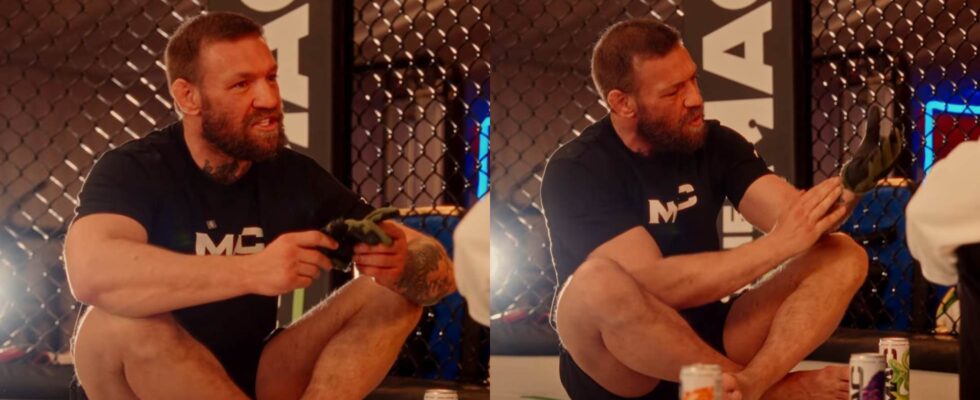
Three forty in the morning is an unusual hour to receive a piece of history. But for MMA icon Conor McGregor, the setting suited the moment just fine.
Retired Navy SEAL Rob O’Neill, the operator publicly credited with neutralizing Osama bin Laden during Operation Neptune Spear in 2011, sat across from the UFC star in a late-night meeting and placed an unlikely artifact in his hands. It was the left glove O’Neill wore during the mission that altered the course of the global war on terror.
When O’Neill reached the top floor of bin Laden’s compound in Abbottabad, Pakistan, his left hand was the one closest to the leader. The glove had been carefully modified before the mission, its material trimmed down for speed, dexterity, and fast-roping capability.
“These are the gloves that were used on the mission?” McGregor asked O’Neill.
O’Neill replied, “I wore that glove. And I haven’t washed it, so there might be DNA on it.”
O’Neill used his right hand to take bin Laden down. “I figured I put a man down with my right hand, you put a man down with your left hand,” O’Neill said, “and this is a token of our relationship, our friendship, our brotherhood right here, brother.”
McGregor returns to the UFC on July 11th in Las Vegas, where he faces former featherweight champion Max Holloway in his first competitive bout in five years. He has spoken openly about how his preparation has matured over that time, now built as much around contingencies as around the optimal game plan.
“I work backwards towards the perfect scenario,” McGregor said. “If the ankle goes, if the knee goes, if the shoulder goes, what’s my response? Because the match’s not over.”
O’Neill found a direct echo in his own experience. Even before the Neptune Spear mission launched, the possibility of a helicopter going down inside the compound had been briefly acknowledged. When one actually did, the team reverted to fundamentals.
“As soon as you get in there, it’s like, okay, what’s the basics?” O’Neill said. “He goes left, I go right. He goes right, I go left. Get back into it. Get back in the fig ht.”
O’Neill’s account of what unfolded inside that Abbottabad compound has not gone without challenge. Fellow SEAL Team 6 operator Matt Bissonette, writing as Mark Owen in “No Easy Day,” presented a different sequence of events, describing himself as second in the stack and suggesting the point man had already fired before anyone entered the room.
Investigative reporter Matthew Cole, writing for The Intercept in 2017, attributed the neutralizing action to an operator identified only as “Red,” and characterized O’Neill’s role as follow-up security measures taken after the fact.
Discrepancies extend to details as specific as bin Laden’s beard. O’Neill has consistently described it as short and gray. Bissonette has said it was pitch black and freshly dyed. With no post-raid imagery ever made public by the government, neither account can be independently confirmed.
The dispute sharpened significantly in 2023 when retired Delta Force operator Brent Tucker stated on a podcast that O’Neill was not responsible for taking bin Laden down.
“No, he didn’t k*ll Bin Laden,” Tucker said. “It’s the worst kept secret in all special operations.” That statement, amplified by its spread across social media platforms, eventually led O’Neill to file a $25 million defamation lawsuit in November 2025 against Tucker and several podcast hosts.
Admiral William McRaven, the commanding officer of Neptune Spear, provided a written statement crediting O’Neill. SEAL dog handler Will Cheney’s recollection also aligns with O’Neill’s version of events.
The central question of what occurred on that third floor more than a decade ago has never been formally resolved, and with the defamation lawsuit still advancing through the courts, it is unlikely to be settled quietly.
