
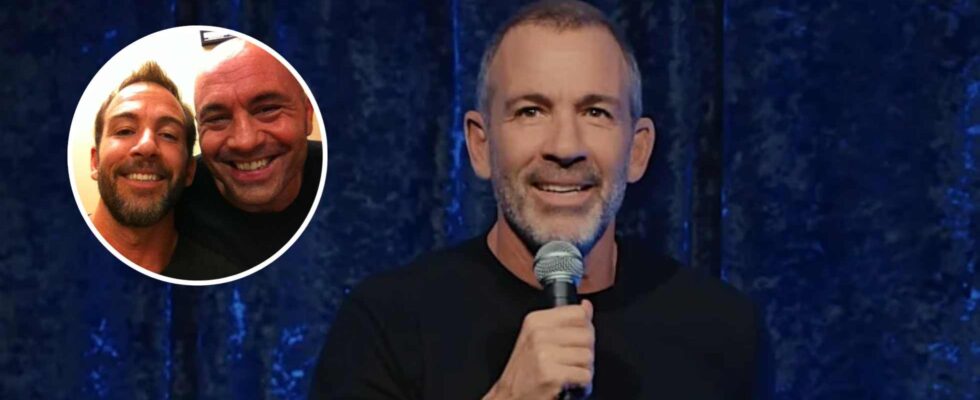
Bryan Callen has spent six years since his cancellation finding new ways to make people uncomfortable, and if recent podcast clips are any indication, he has no plans to stop. The comedian and actor, long known as a fixture in Joe Rogan’s circle, continues to surface in conversations for all the wrong reasons, offering takes on s3xual misconduct, age gaps, and consent that leave his hosts visibly struggling to keep up.
In one widely discussed exchange, Callen attempted to contextualize the behavior of powerful men in the 1990s who were seen publicly with teenage girls.
“If you were like some famous actor and you show up with a top model who happened to have been 16, 17 back in the day, in the ’90s, I guarantee nobody said anything,” he said.
His co-host pushed back, and Callen doubled down, arguing the behavior was simply a product of its time rather than something worthy of condemnation.
He extended this logic even further when discussing the modeling industry.
He said, “The majority of those girls who were models, who came to New York as young as 13, I promise you, probably 50 to 60% of them have a story about how they were 16 dating a 32-year-old, how they were 16 dating a 45-year-old. You know why? Because it was accepted.”
The statement drew an immediate and baffled reaction from everyone in the room.
His views on consent in the moment were equally eyebrow-raising. Callen described pushing past a woman’s initial reluctance as simply part of passion.
He stated, “I’ve been making out with a woman before and I’ve gone places and I’ve had her take my hand and go, ‘No.’ I go, ‘Okay, not tonight.’ Or by the way, give me a couple more minutes to kiss you and move around. I’m going to break these walls down.”
He framed this as universal male behavior, adding, “Every guy does that and you’re a liar if you say otherwise. It’s just called being a man and I’m proud of it.”
Callen also blamed what he calls a “progressive liberal feminist agenda” for being overly controlling, arguing it strips spontaneity and biology from relationships. He suggested that the s3xual space is “very unpredictable” and that part of attraction is a man simply going for it.
What makes all of this particularly notable is the context surrounding it. Callen has faced allegations spanning nearly two decades and has been largely frozen out of Hollywood as a result.
Rather than reflecting on why that happened, he frames his situation as a due process crisis. “The minute you’re accused of something, it doesn’t matter. Due process is dead for a lot of people,” he said.
Meanwhile, his podcasting career has collapsed from nearly a million views per episode to a fraction of that, sustained largely by what observers describe as hate-watchers.
Even his co-hosts have begun openly questioning his motivations, with one asking on air, “Why are you still doing it? And if it’s just for money, then we should have a talk.”
Callen himself has admitted things are difficult. “I’m having a hard time. I’m not sure how to get out of it,” he said recently.
But given the takes he keeps offering, the path out does not appear to be getting any clearer.
