
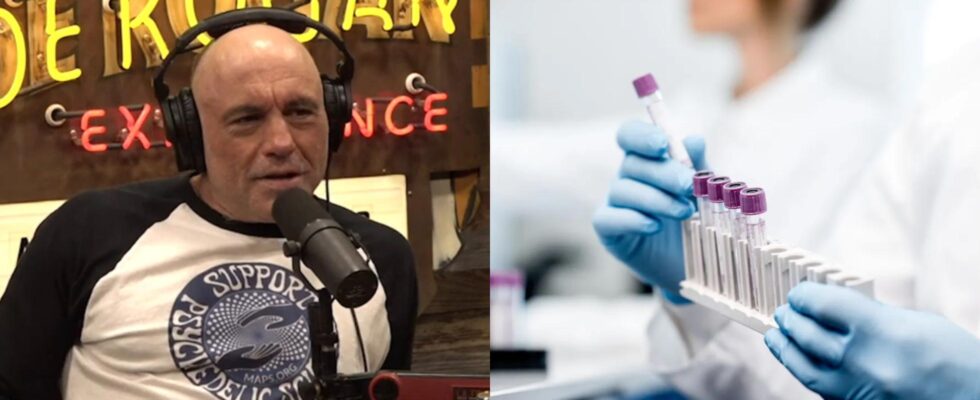
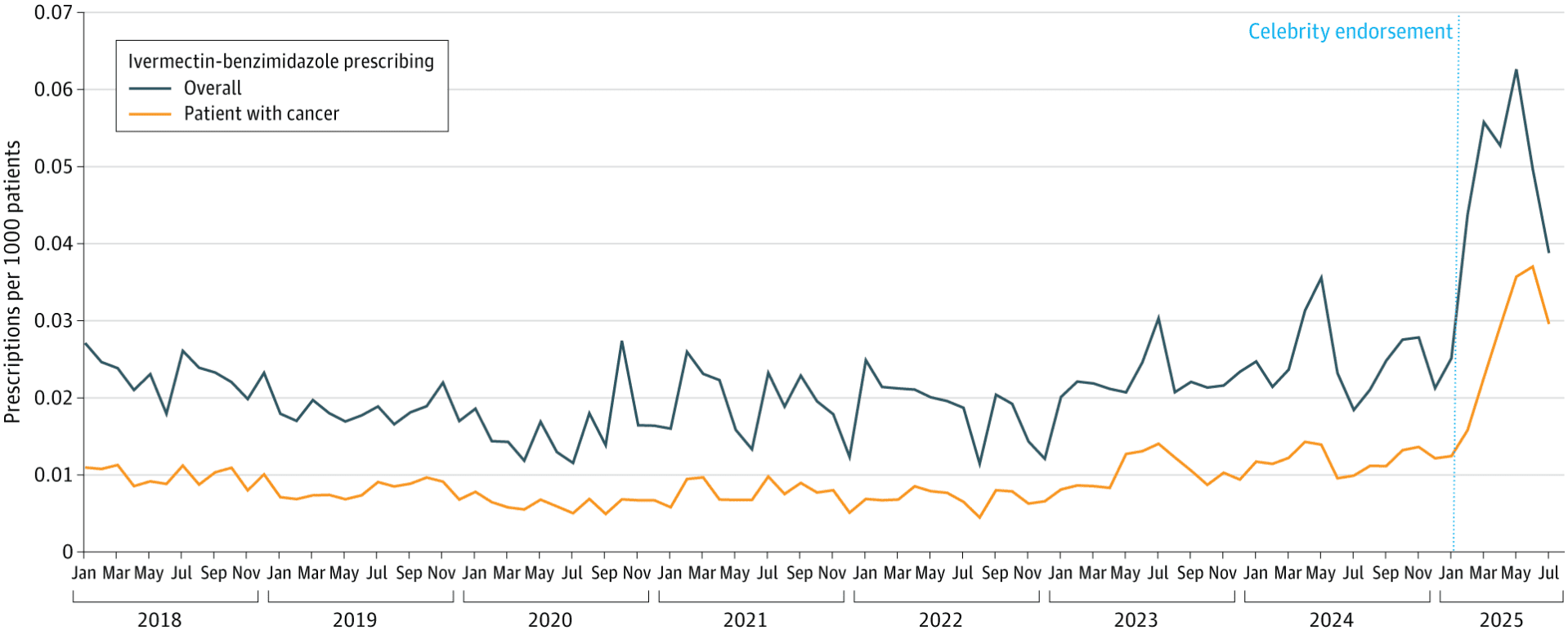
A new study published in the Journal of the American Medical Association has found that prescriptions for ivermectin doubled in the months following a January episode of The Joe Rogan Experience, in which Rogan and actor Mel Gibson discussed it as a potential cancer treatment.
The study tracked prescriptions for ivermectin and fenbendazole between January and July of 2025, finding that overall prescription rates doubled over the seven-month period following the episode compared to the same timeframe the year before. Among cancer patients specifically, prescription rates rose to more than two and a half times what they had previously been.
During the episode, which has since accumulated over 13 million views on YouTube alone, Gibson told Rogan: “I have three friends. All three of them had stage four cancer. All three of them don’t have cancer right now at all.”
He went on to say they had taken ivermectin, fenbendazole, hydroxychloroquine, and methylene blue. Rogan responded: “I’m hearing that a lot.”
Increases in prescriptions were most pronounced among white patients and those in the South.
The episode’s reach extended beyond social media. The state of Florida reportedly directed a portion of its cancer research funding toward ivermectin following the clip’s spread online.
The problem, according to researchers and physicians, is that no clinical trials have demonstrated these d**gs are safe or effective for treating cancer in humans. While animal studies have shown they may inhibit tumor growth, the National Cancer Institute has not yet completed trials on ivermectin as a cancer treatment.
One doctor who spoke with The New York Times explained that “greater than 90% of the time, these medications don’t seem to either benefit patients or don’t seem to be safe for patients” once they move from preclinical phases to human trials.
That same doctor cautioned that even when a d**g shows results in animals at high doses, it “could be toxic to humans or even interfere with already proven cancer treatments.”
Researchers flagged particular concern that cancer patients may be delaying or walking away from traditional treatments in favor of unproven alternatives, losing vital time.
One oncologist described the situation as “a perfect storm of fear, urgency, uncertainty, information overload,” making patients especially open to misinformation. Another physician was direct: “We are not mice, and anecdotal data of 1 or 2 patients is not evidence.”
The study states that these observational design means a definitive cause-and-effect link cannot be established. Regardless, the timing of the prescription surge, coming after a single podcast episode, illustrates the real-world consequences of celebrity health endorsements at a moment when institutional trust is already fragile.
Rogan himself has previously acknowledged his own limitations as a source, having stated: “I’m not a doctor. I’m a f***ing idiot,” and separately, “I’m not a respected source of information, even for me.”
