
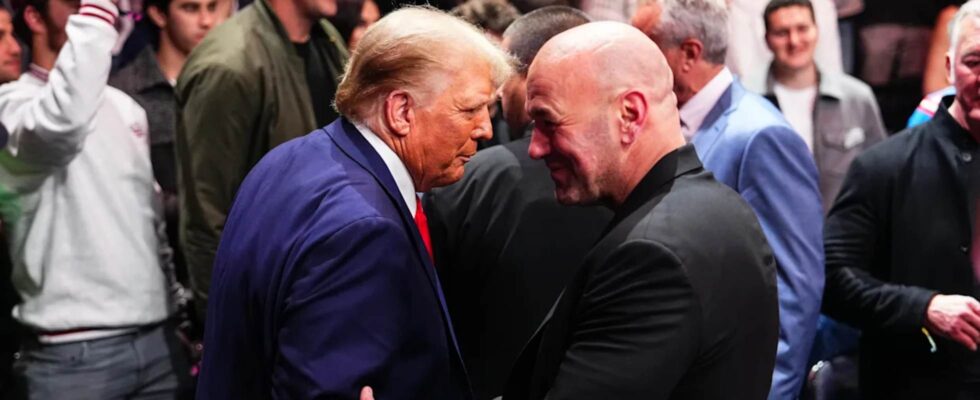
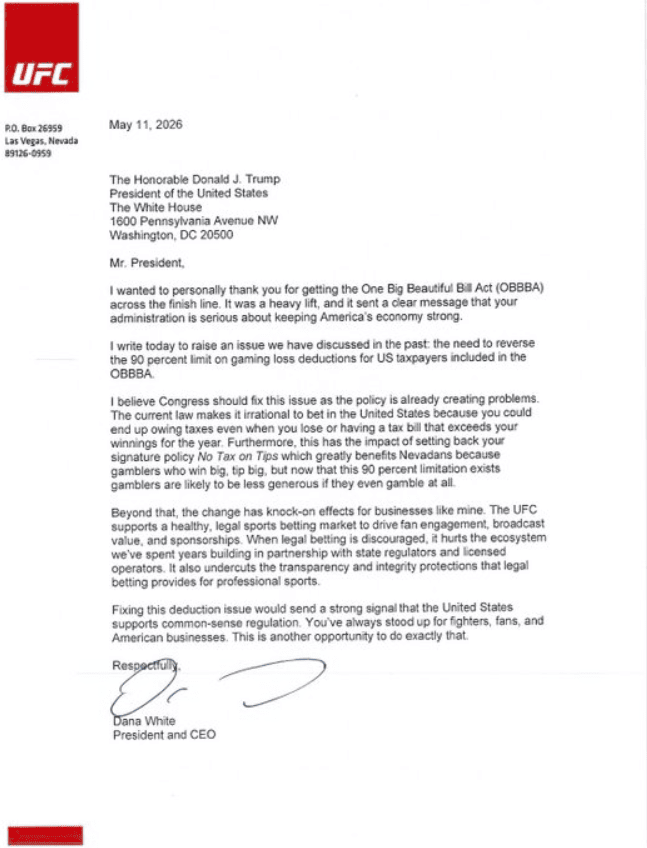
Dana White has stepped into a policy debate that has stirred up the legal sports betting world. He sent a letter to the White House earlier this month calling on President Donald Trump to reverse a tax rule that caps gambling loss deductions at just 90 percent of total losses.
According to sources, the letter landed at a moment when Nevada’s congressional delegation had spent nearly a year trying to build legislative momentum for a similar rollback, with little to show for it. White’s entry into the conversation appears to have changed the calculus almost immediately.
The rule itself was folded into a tax and spending package last year and has since drawn sharp criticism from across the legal gambling industry. A bettor who wins $500,000 and loses $500,000 within the same tax year could still face a bill as though they had earned $50,000 in net income, despite having broken even.
Industry organizations including the American Gaming Association have been pushing hard to eliminate the measure, and Nevada legislators such as Rep. Dina Titus and Sen. Catherine Cortez Masto have made repeated public attempts to generate traction for a legislative fix. Those efforts have stalled.
“The [gambling deduction] change has knock-on effects for businesses like mine,” White wrote in his May 11 letter. “The UFC supports a healthy, legal sports betting market to drive fan engagement, broadcast value and sponsorships. When legal betting is discouraged, it hurts the ecosystem we’ve spent years building in partnership with state regulators and licensed operators.”
White, a longtime recreational gambler whose MMA organization is headquartered in Las Vegas, views the policy as a threat that extends well beyond individual bettors. His argument centers on the idea that squeezing legal operators and their customers does not eliminate gambling activity; it redirects it toward unregulated platforms where consumer protections are minimal and tax revenue disappears entirely.
Following news of the letter, betting markets tracking the probability of the deduction cap being repealed before 2027 reportedly moved from roughly 19 percent to above 30 percent.
White’s relationship with Trump makes his involvement particularly relevant. The president attends UFC events regularly and tends to receive a warm reception from the crowds in attendance. White delivered a speech at the 2024 Republican National Convention and is currently helping to organize a UFC event planned for the White House lawn this summer, one that parent company TKO Group Holdings reportedly expects will not be profitable financially. Trump also carries his own history with the gambling industry through his former casino interests.
When Trump was asked about the deduction cap back in December, he offered nothing definitive, saying only, “I don’t know. I’m gonna have to think about that.” White’s letter appears designed to move the president past that uncertainty and toward a clear public position.
Despite the often polarizing nature of White’s public persona, his intervention in this case earned straightforward praise from both Nevada legislators. Cortez Masto was direct in her response, writing on X: “I agree with Dana White. The President needs to join us and fix this now.”
