
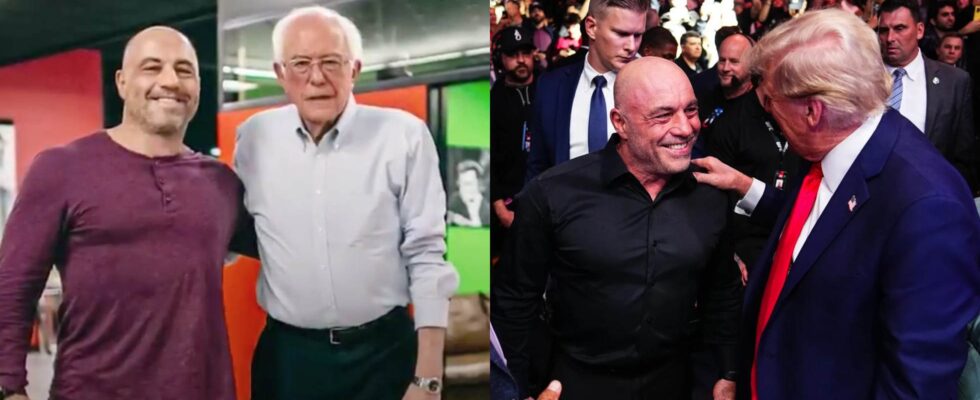
For years, Joe Rogan positioned himself as someone sympathetic to economic arguments about wealth inequality. He welcomed Bernie Sanders onto his podcast multiple times, nodded along to progressive ideas about taxing the wealthy, and even stated on camera that he had no problem giving up more of his money as someone who had made a lot of it, if it would benefit the greater good of mankind.
That was then.
On a recent episode of Secular Talk, host Kyle Kulinski broke down how dramatically Rogan has shifted. He pointed to a clip where Rogan accused Bernie Sanders of quietly abandoning his stance on taxing millionaires now that Sanders himself has become one.
“Bernie Sanders used to rally against millionaires,” Rogan said on his podcast. “It used to be millionaires. ‘Oh, these millionaires, that’s the problem, they’re not paying their fair share.’ And now it’s billionaires. Why? Because Bernie’s a millionaire now.”
Kulinski strongly rejected that characterization.
“You are completely and utterly full of it,” he said. “Every single tax proposal Bernie has ever put out there also raises taxes on millionaires. He still supports raising taxes on millionaires. He just supports raising it on billionaires more.”
According to Kulinski, Sanders’ change in emphasis had less to do with protecting himself and more to do with responding to critics.
“The reason he adjusted his language from saying millionaires and billionaires to just billionaires is because people like you go out there and say, well, maybe you shouldn’t tax the millionaires more, because I’m actually a millionaire and I don’t want to pay more taxes,” Kulinski said.
“So he has to adjust to people like you and your low IQ interpretation of what he’s saying.”
Kulinski also pointed to Rogan’s current social circle as a possible explanation for the shift. He noted that Rogan now regularly associates with figures such as Peter Thiel, Elon Musk, and Mark Andreessen, while also having exchanged messages with JD Vance and Donald Trump.
For Kulinski, the contrast between Rogan’s current position and his past comments was difficult to ignore.
In older footage, Rogan took a very different tone on the issue of taxation.
“I do not have a problem with giving up more of my money as a person who has made a lot of money, if I know that it is going to benefit the greater good of mankind,” Rogan said.
Kulinski’s broader argument was that Rogan’s evolution on the issue did not happen in isolation. Instead, he suggested it coincided with Rogan’s growing wealth, his massive Spotify deal, and his increasing proximity to billionaire entrepreneurs and right-wing political figures.
What Kulinski once viewed as a sincere openness to progressive economic policies has, in his view, been replaced by criticism and ridicule of those same ideas, often in conversations with guests such as Ben Shapiro and Steven Crowder.
Summing up his position, Kulinski said Rogan went from being “forthrightly, making an argument for raising taxes on millionaires and billionaires, to mocking the idea of raising taxes on millionaires and billionaires.”
