
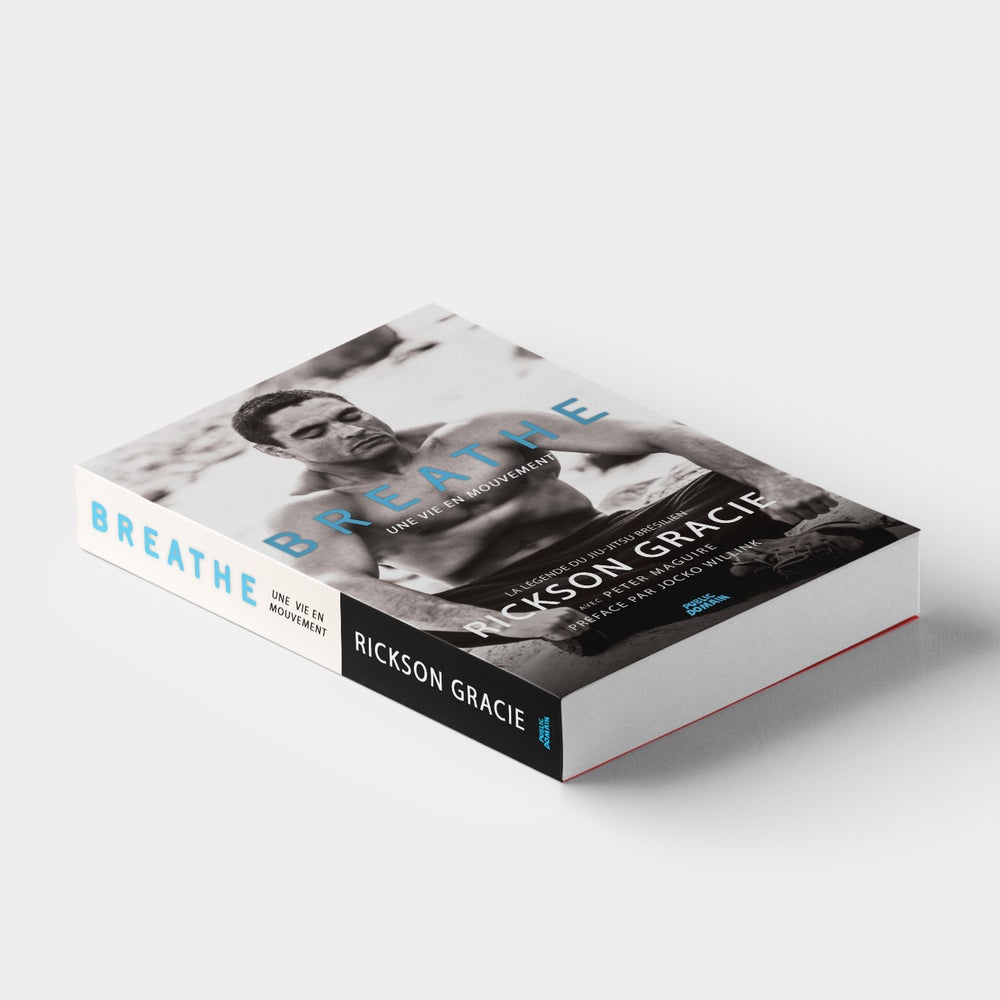
For many fans around the globe, Rickson Gracie is regarded as the father of mixed martial arts. With the inception of mixed martial arts in the 80s, Rickson was considered to be the best fighter in the Gracie family. His biography comes on the heels of Netflix ordering a documentary about his life, set to release in 2021.
Rickson Gracie has been creating a publicity buzz this week, appearing on both Joe Rogan’s “Experience” and Jocko Willink’s podcast. He was there promoting his book, Breathe. The book is available on Amazon for $17.99 for the Kindle version and $23.49 for the hardcover. In terms of value, it depends largely on the reader’s interest in Gracie family lore. It’s difficult to imagine someone picking up this book without prior exposure to jiu-jitsu.
The book is divided into 10 chapters, starting with the origins of the Gracie clan in Scotland. While some of the Scottish Gracies migrated to the US (and fought with the Confederacy), Rickson’s lineage comes from George Gracie, who arrived in Rio de Janeiro in 1826 from Scotland. Although the Gracies take pride in their military history, Rickson’s ancestor quickly climbed the social ladder by marrying into high society.
From the outset, the content feels somewhat embellished. I would be curious to see a fact-check on some of the historical details in the book. The Maeda segment, in particular, could be interesting to compare with Robert Drysdale’s book; however, I have not been able to do that yet, but I might in the future.
The book’s narrative sometimes contradicts itself. For instance, Rickson details how Carlos Gracie got the idea:
“(Carlos) had a revelation: a fighter who used technique, strategy, and intelligence could defeat a fighter who had only size and strength.”
Only to follow that with:
“Because Hélio did not have the option of using power, he had to rely on leverage, sensitivity, and timing to compensate for his lack of strength. I know this might sound like an exaggeration, but Hélio Gracie was to Jiu-Jitsu what Albert Einstein was to physics.”
Rickson seems to gloss over many personal failings in the book but is not as forgiving when it comes to Carlos Gracie or even his brother, Rorion Gracie.
Carlos Gracie is portrayed as eccentric, somewhat unhinged, and irrational. This is where the first revelation of the book comes: Carlos Gracie had become determined to sire as many children as possible to create a clan of fighters. Hélio Gracie supported this goal, but because his wife was infertile, Carlos concocted a plan for Hélio to impregnate their African-Brazilian babysitter while his wife pretended to carry the pregnancies. This arrangement produced Rorion, Relson, and Rickson.
The book is filled with esoteric anecdotes. Various members of the Gracie family, including Rickson, believe in reincarnation and have been exposed to aspects of the occult and elaborate superstitions. Rickson frequently glosses over disturbing incidents, focusing instead on the warrior spirit and bravery. In one instance, Rickson describes witnessing Hélio being shot in the leg and beaten with the butt of a gun, but he quickly dismisses the altercation:
“Even though the goons had threatened to kill my dad if he went to the police, after he got his wounds treated, Hélio went straight to the police station and reported the crime. In the end, he and the councilman reached an uneasy peace.”
Interwoven throughout the anecdotes are Rickson’s philosophical teachings on how to approach various aspects of jiu-jitsu, including introducing children to BJJ. This is particularly interesting, considering everything he describes as undesirable seems to mirror what his own son, Kron, experienced.
“If you push kids too hard, too young, they will quit forever. Parents should never burden their kids with their unfulfilled ambitions, frustrations, anxiety, or any other form of emotional baggage. The parents’ support must be consistent. The most important thing is that the child gets the experience—win, lose, or draw—without judgment.”
Mind you, these are the words of a man who once clucked like a chicken at his son’s opponent during a BJJ competition.
Another significant revelation in the book is that 13-year-old Rickson was a member of a gang involved in the narcotics trade, even after being confronted by his family. This chapter of his life is largely glossed over.
Many of the anecdotes in the book feel like stories crafted to impart specific lessons rather than a cohesive life story. Considering many readers will be uncritical fans of Rickson Gracie’s ethos, it’s clear why this approach works. However, the book would likely be stronger if it didn’t gloss over so many eyebrow-raising moments.
Rickson is less forgiving toward his brother, Rorion Gracie (father to Rener, Ryron, and Ralek). Rorion, the first Gracie to move to the US and promote Brazilian Jiu-Jitsu, helped Rickson relocate to California by sorting out the legal paperwork. As Rickson didn’t speak English at the time, he relied heavily on Rorion for things like account deposits. But as Rickson’s following grew, he noticed his checks stayed the same.
“I was supposed to give my brother all of the money I made teaching, and he was supposed to pay all of my expenses. But as my following grew larger and the checks got bigger, I was not seeing any more money. Our relationship hit a new low when he told me that he might take away my green card if I didn’t follow his orders.”
Around the same time, Rorion attempted to trademark “Gracie Jiu-Jitsu” to prevent other family members from profiting off the name. For Rickson, this is just a side note in a larger narrative about the family’s dynamics.
The book also includes familiar stories of how Royce Gracie became the family’s UFC representative. While Hélio stayed in Rio, Rorion had his full backing to put financial pressure on Rickson, eventually selecting Royce to represent the family instead of Rickson.
Tensions grew when Rickson’s ex-wife became his manager. Rorion forbade most of the family from cornering Rickson in Japan, leaving only Royler to support him. Rickson’s ex-wife, however, secured lucrative payments from Japan, significantly higher than what the UFC was offering at the time.
After Royce struggled to compete in the UFC, Hélio intervened, pressuring Rickson to represent the family once again:
“When Kim and I met with my dad, Rorion, and Art Davie in Los Angeles, I told them I would be happy to fight for a million dollars. When Art tried to justify the UFC’s paltry pay scale, I told him that was his problem, not mine. Finally, my dad played the Gracie card and told me that in his day, he fought for family honor, not money.”
This led to a conflict between Rickson and Hélio, though the book does not elaborate on it. We only learn later that they reconciled after the tragic death of Rickson’s firstborn son.
The book’s final significant revelation is Rickson’s belief that his 19-year-old son, Rockson Gracie, was murdered. In 2001, Rockson went to New York and stopped returning his family’s calls. He was eventually identified by his tattoo, “Rickson Gracie #1 Dad,” by his cousin Renzo. While the timeline is unclear, Rickson believes foul play was involved, citing that Rockson’s suitcase was mailed to the family about a month later, along with a drawing of a grim reaper on a pile of skulls.
Ultimately, Breathe makes a good gift for martial arts fans. However, you can’t help but feel that there were plenty of interesting and complex dynamics to uncover. Instead, the book offers a collection of anecdotes strung together by the ethos of the warrior spirit.
