
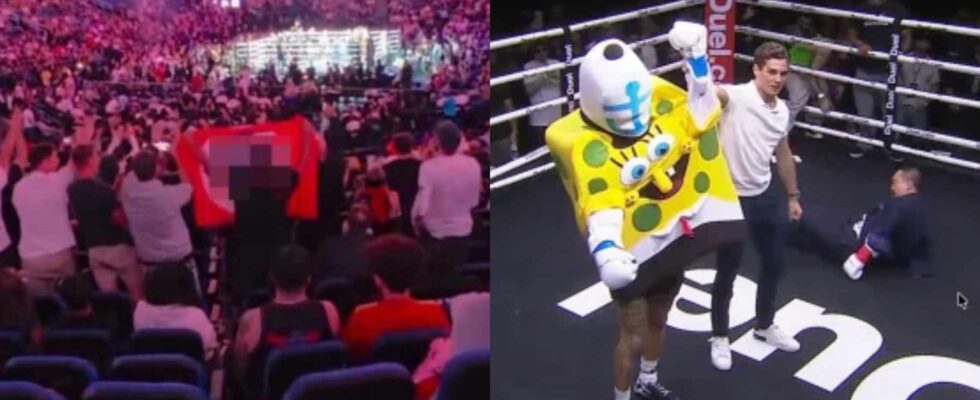
A Florida state lawmaker has put the Florida Athletic Commission on notice, asking the agency to strip the promoter license tied to the August 29 Duel Arena show at Orlando’s Kia Center and to open a review of how the event was run.
According to sources, State Rep. Anna V. Eskamani sent a formal letter to FAC Chair Tina Pike and Executive Director Timothy Shipman, making her the first sitting legislator to publicly call for the license to be pulled.
She gave the commission until Monday, September 14, to respond in writing, though that date functions as a requested deadline rather than a binding legal one. Any actual revocation would still have to go through the standard regulatory process of notice, a hearing and formal findings.
The license in question belongs to Ryan Toole Inc., which does business as Duel Arena and is listed as the permit holder on the commission’s own event calendar. Eskamani is citing Florida Statute 548.071, which allows the FAC to revoke a license for violations of the athletic commission chapter or for unprofessional and unethical conduct.
Her letter goes further than the promotional entity itself, asking regulators to also suspend or revoke the licenses of any principals connected to the show, the matchmaker of record, and any licensed official or participant who took part in a contest that was not authorized. She’s also asking the commission to bar Duel Arena, its leadership or any successor company from receiving future permits in Florida.
Money is part of the backdrop here too. The event was bankrolled and branded by Duel.com, an offshore crypto casino started by Ossi Ketola, which does not carry a Florida license of its own.
Eskamani has been careful to separate her personal objections to the show’s imagery from the regulatory case she’s building.
“I vehemently oppose these images and this rhetoric; this letter focuses on examples of violations of Florida law that merit clear license suspension and revocation,” she wrote, framing the complaint as a matter of statute rather than taste.
At the center of her argument is a mismatch between what the commission approved and what actually happened in the ring. The FAC’s official results sheet shows 10 bouts.
Eleven took place. The extra contest was a costumed match between a competitor known as FreakBob and Daniel Cao, which Eskamani says fell outside the approved card and could trigger 548.008(3)(b).
Speaking to WKMG News 6, she put it plainly: “Only ten matches were approved and there were 11, and the 11th one had a referee that was not sanctioned to be a referee.”
That referee was an internet personality who goes by Clavicular. According to Eskamani’s review of available records, no Florida license for him turned up anywhere. Four properly licensed referees, David Baggett, Isiah Cabal, Josh Rutgers and Massimo Montanini, were reportedly on hand for the event, which raises the question of why an unlicensed official worked the additional bout at all.
Eskamani pointed to 548.057(3) to argue the commission, and only the commission, has the authority to assign officials for a sanctioned contest. “The power to assign officials belongs to the Commission and to no one else,” she wrote.
The promotion has reportedly described the added segment as entertainment rather than a regulated athletic contest, a characterization Eskamani rejects outright.
“That statement is not a defense; it is an admission by a licensee,” she said, arguing that labeling something as entertainment doesn’t erase the underlying regulatory question of who authorized it and who officiated it.
A separate thread in the letter concerns an exhibition billed between Ketola and Patrick Holden, with a listed weight gap of 202 pounds (91.6 kg) to 90 pounds (40.8 kg). Eskamani isn’t arguing the mismatch was automatically improper.
Exhibitions are exempt from the usual 12-pound weight differential limit under 548.043, a carve-out she says has been stretched well past its original purpose. “The exception has swallowed the rule,” she wrote. Her sharper concern is identity: citing 548.042, which governs the use of fictitious names, she wants to know whether the person who actually competed was Ketola at all.
“If the Commission cannot say with certainty who competed on a card it permitted, that alone is disqualifying,” she said. She’s also asking who signed off on classifying the matchup as an exhibition in the first place and what medical evaluation, if any, took place beforehand.
Eskamani’s letter asks for more than a written explanation. She wants the commission to consider an emergency suspension order under 548.07, the provision reserved for situations posing an immediate and serious danger to the public. She’s also asking the FAC to check whether licensees met the reporting obligations laid out in 548.058(2), to send any conduct that may warrant prosecutorial attention to the appropriate authorities, and to flag the promotion’s offshore gaming ties to the Florida Gaming Control Commission for its own review.
Beyond that, she wants the matter placed on the agenda at the commission’s next public meeting, accompanied by a written staff report, so the issue plays out in the open. As she put it, she wants it handled “so that it is resolved on the record rather than in correspondence.” No date for that next meeting had been posted as of Monday.
Alongside the letter, Eskamani filed a public-records request covering the event’s permit file, the approved bout sheet, officials’ assignments, licensing files, weigh-in and medical documentation, any competitiveness certification, matchmaker records, and inspector or incident reports from the night. She specifically asked for whatever licensing information exists for Clavicular. On the possibility that some of what she’s asking for simply doesn’t exist in the commission’s files, she was direct: “If a record does not exist, please say so directly.”
Her letter also revives a line from Shipman’s own past testimony to the Senate Commerce Committee, in which he described Florida’s regulatory approach as a model for the sport nationally. Eskamani is treating that statement as a benchmark the commission now has to live up to. “If that is truly the case, then you will act immediately upon receipt of this letter,” she wrote.
As of Monday afternoon, the promotion had not addressed Eskamani’s letter directly. Its social media accounts instead leaned into the moment, recapping the costumed bout and teasing a possible follow-up event. One post described the August show as a “dry run and a small budget, next ones will be COLOSSAL.” Another called the unsanctioned costumed match “the true main event and last fight of the evening,” while a separate post credited Clavicular’s officiating, saying he handled it “very well, one should add.”
The account also suggested the three competitors involved in that bout could return for a second event, noting “Duel Arena 2 should see the return of all three, by popular request.” No date, venue or ticket listing for any follow-up show had surfaced, and the promotion’s Ticketmaster page showed no upcoming events.
Eskamani’s letter was also sent to DBPR Secretary Melanie Griffin, State Attorney Monique Worrell, the other members of the Florida Athletic Commission, and Orlando Mayor Buddy Dyer, spreading the pressure well beyond the commission’s own office.
Whether that pressure translates into a revocation hearing, or simply a written reply defending the August card, now sits with regulators who have just been publicly reminded of their own claim to running one of the country’s more closely watched sports oversight programs.
