

When White House press secretary Karoline Leavitt addressed reporters last Thursday, she wasn’t holding back. Following a landmark Supreme Court hearing on transgender athletes in women’s sports, Leavitt delivered pointed remarks about what she viewed as a concerning disconnect from basic biological reality.
“I think, frankly, it was quite alarming to not only hear a couple of justices grapple over that basic fundamental biological fact that men and women are different but inherently equal, but we are certainly different, and women deserve such rights,” Leavitt said during the briefing.
The comments came after Tuesday’s Supreme Court session, where justices heard arguments in two cases examining whether states can prohibit biological males from competing on female athletic teams.
Conservative activist and former collegiate swimmer Riley Gaines had questioned Leavitt about whether the Trump administration would take action against states refusing to comply with potential future rulings.
“Absolutely,” Leavitt responded. “The administration has taken action on a number of fronts against these states who are failing to uphold the president’s executive orders and this administration’s policy of simply protecting women and women’s sports and women’s private spaces.”
The press secretary’s forceful stance reflects a broader conversation happening across America about fairness in athletics.
A comprehensive meta-analysis published in February 2025 examined sex differences in grip strength from birth through age 16, providing perhaps the most definitive evidence yet that physical strength differences between males and females emerge from the very beginning of life.
Dr. James L. Nuzzo, who conducted the research using crowdfunding, analyzed data from 808 effects across 169 studies conducted in 45 countries between 1961 and 2023. The total sample included 353,676 children—178,588 boys and 175,088 girls.
The findings were unequivocal: from birth onward, boys consistently demonstrated greater grip strength than girls.
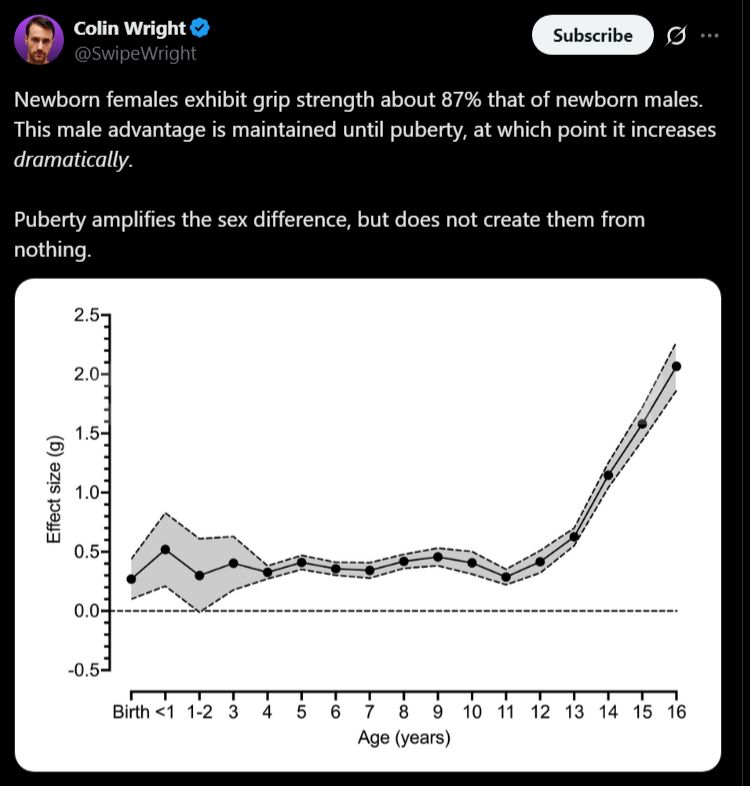
In newborns less than two days old, researchers found that boys already exhibited measurably stronger grip reflexes. While the number of studies examining infants was limited, the pattern persisted throughout early childhood and accelerated dramatically during adolescence.
Between ages 3 and 10, the research revealed that female grip strength equaled approximately 90% of male grip strength, with effect sizes classified as small to moderate. At age 11, an interesting pattern emerged. The difference temporarily decreased, likely because girls typically reach puberty before boys.
However, by age 13, as male puberty commenced, the difference widened markedly. By age 16, female grip strength equalled just 65% of male grip strength. This is a substantial gap that mirrors what researchers observe in adult populations.

The consistency of these findings across dozens of countries and spanning more than six decades suggests that environmental factors play a minimal role. Whether examining children in the United States, China, Poland, Spain, Japan, or numerous other nations, the pattern remained remarkably similar.
The research also examined whether increased female participation in sports over recent decades had narrowed the strength gap. While a slight decrease was noted among 5 to 10-year-olds after 2010, the difference among 14 to 16-year-olds remained stable since the 1960s. The implication: any environmental changes affecting younger children appear to be overwhelmed by biological factors during male puberty.
These biological realities have significant implications for the ongoing legal and cultural debates surrounding women’s sports. During Tuesday’s Supreme Court hearing, at least five of the six conservative justices indicated they would likely uphold state laws prohibiting biological males from female athletic teams, finding that such restrictions don’t violate the Constitution or Title IX.
Justice Samuel A. Alito Jr. raised a pointed question during the proceedings: “Looking to the broader issue that a lot of people are interested in, there are an awful lot of female athletes who are strongly opposed to participation by trans athletes in competitions with them. Are they bigots? Are they deluded in thinking that they are subjected to unfair competition?”
The Supreme Court is reviewing cases from Idaho and West Virginia, two of more than 24 Republican-led states that have passed such restrictions. Lower courts had previously ruled in favor of transgender athletes who challenged these bans, but the conservative-dominated high court appeared poised to reverse those decisions. A ruling is expected by early summer.
According to the court, 30 states currently have restrictions on transgender athletes participating against girls and women. However, several Democratic-led states chose not to follow President Trump’s executive order on the matter, which he signed in February 2025 under the title “Keeping Men Out of Women’s Sports.”
The administration has taken aggressive action against non-compliant states. In May, Trump threatened to pull federal funding from California, and when the state refused to comply, the Justice Department filed a lawsuit claiming California’s policies violated Title IX. Attorney General Pam Bondi also warned Minnesota and Maine that they could face similar federal challenges.
“I think the president speaks on common sense on this issue, that women’s sports and private spaces should be protected and that there are two genders, there are two sexes.That is not something we should be afraid to say in this country,” Leavitt stated.
The biological research adds quantifiable evidence to these policy discussions. The study noted that various biological factors explain why, on average, boys are stronger than girls from birth onward. These include differences in muscle mass, body composition, skeletal structure, and hormonal profiles, differences that become dramatically more pronounced after male puberty.
For upper-body muscles specifically, adult female strength is approximately 55-60% of adult male strength, a pattern that begins establishing itself in childhood and accelerates through adolescence.
As the Supreme Court prepares to issue its ruling in the coming months, the intersection of biological science, athletic fairness, and civil rights continues to generate intense debate across the nation.
What remains clear from the research is that strength differences between males and females are not social constructs but measurable physical realities that exist from the earliest moments of life.
