
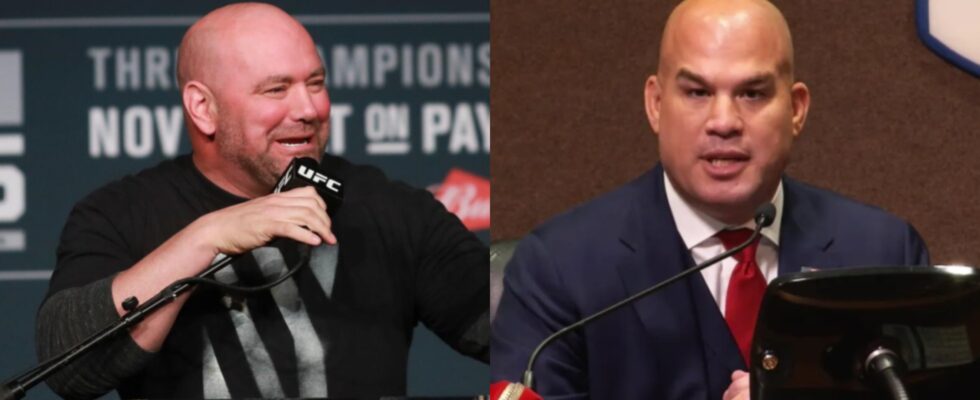
Former UFC light heavyweight champion Tito Ortiz has spent years making the case that the athletes who built the organization deserve a far greater share of the revenue they helped generate, and that position has cost him his standing with the company’s leadership.
While the UFC prepares for a high-profile event at the White House on June 14, Ortiz will be watching from Cape Coral, Florida, where he owns a restaurant.
“I’ll be here in Cape Coral at my restaurant, Tito’s Cantina. We show all the UFC event,” he said during a recent interview, noting that no invitation from the organization was forthcoming.
The rift between Ortiz and UFC CEO Dana White traces back to Ortiz’s early and vocal advocacy for better athlete pay.
“They just don’t invite me because I was one of the outspoken guys that, at the time when I competed, I thought athletes should get paid a little bit more money,” he explained.
According to Ortiz, White’s response to that kind of public pressure was not to engage with the argument but to discredit the person making it.
“He does the best in propaganda of just how you stop a guy from speaking loud,” Ortiz said. “I just call him st*pid, call him a bad businessman. And I get it. He’s trying to defend his business.”
Still, Ortiz believes the argument for better pay has only grown stronger as the UFC’s valuations have soared. The organization sold for over $4.5 billion in its first major transaction, then later secured a deal with Paramount worth $7.7 billion. Against figures like those, Ortiz says the people who performed in the octagon and drew the audiences should have lasting financial security.
“Us athletes, we only have our window of opportunity in life. Longevity in the sport is only so long,” he said. “We shouldn’t have to worry about bills after competing for a company for 16 years. They made over $4.5 billion when they sold the company the first time, and then they signed a deal with Paramount for $7.7 billion.”
He continued, “Us athletes shouldn’t have anything to worry about. We should have retirement. We should have things like that just to take care of us for the rest of our lives because we gave so much for this company to be where it is today.”
The pay gap inside the current structure reflects just how wide the divide is between those at the top and those at the bottom of a card. Ortiz said that per-event pay currently ranges from as little as $3,000 to as much as $3 million, with the upper end reserved primarily for main event competitors and champions.
He noted, however, that earnings often come down to name recognition as much as title status.
“Usually the main events or the champions. Sometimes not even the champions,” he said. “It just depends on the people that are able to be outspoken and have a loud voice. A lot of fans know.”
Ortiz worked throughout his career to build exactly that kind of mainstream profile. He was among the first UFC athletes to travel overseas with the USO, appeared on MTV, and took part in Celebrity Apprentice, efforts he credits with keeping his name relevant long after many of his peers faded from public memory.
“A lot of things I did were a lot of very mainstream,” he said. “So I think that’s why a lot of fans know who Tito Ortiz is. And UFC can’t erase me.”
Despite the complicated history with White, Ortiz stops short of dismissing the UFC President’s role in elevating the sport.
“I don’t want to be erased,” he said, acknowledging that his work to grow the organization was never meant to minimize what others contributed. “We have a love-hate relationship, I guess you can say, but I’m very thankful for what he’s done for the UFC to what it is today.”
