
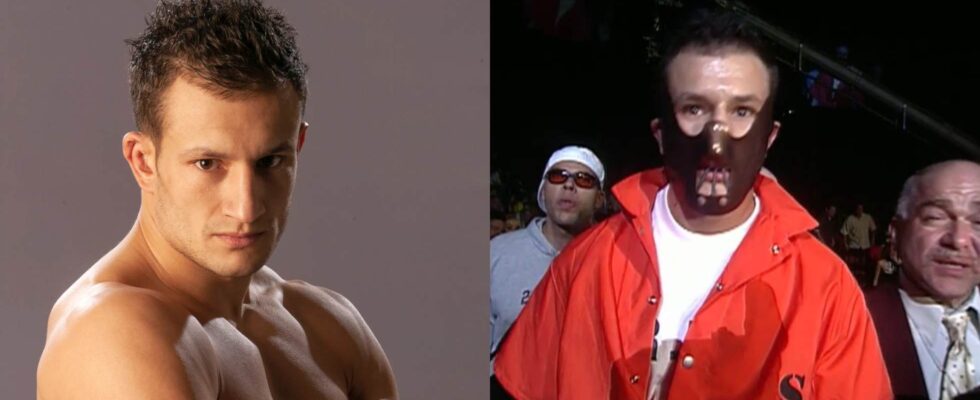
During a recent episode of the MMA History Podcast, the topic of discussion was former MMA athlete Lee Murray’s place in Cage Rage history.
“Lee Murray was also a constant presence around the promotion along with the wild figures from the circle he became infamous for,” one of the hosts said. “In fact, Lee had his final MMA match in Cage Rage before stepping away from the sport to focus exclusively on high-profile bank heists.”
When the discussion turned to Murray personally, Cage Rage co-founder Andy Geer described the relationship he had with the former MMA star.
“He was a friend,” Geer said. “I say friend, it’s not like I didn’t socialize with him on a week-by-week basis, but we knew each other from around the shows. We knew each other from the gyms.”
Despite Murray’s later notoriety, Geer’s memories of him remained positive.
“He was a nice guy,” he said. “He was always very polite and very respectful to Dave and I.”
Geer also made it clear that he believes Murray’s prison sentence has gone on long enough.
“He should be out,” one of the hosts said. “He served his time. He should be out.”
One of the hosts then pointed out that, despite the scale of Murray’s crim es, nobody was physically harmed during the robbery.
“No one even got hurt. There was no violence at all,” Geer said. “Obviously a few people were a bit shook up.”
Geer argued that Murray’s punishment has been disproportionate. “I think it’s nearly 20 years he’s done,” he said.
He continued by criticizing how authorities handled Murray’s case.
“The British justice system has put him away even though he’s in Morocco,” Geer said. “You can go back through history and see that they decide to make examples of some people, and Lee unfortunately is one of them.”
Reflecting on Murray’s commercial value to Cage Rage, particularly ahead of his match against Anderson Silva at Cage Rage 8, Geer recalled how much attention and revenue he generated for the promotion.
“Lee Murray also sold a lot of tickets, which he handed over in cash,” Geer said. “He more than covered his own cost. He put us into profit, but the cost of that fig ht was much more.”
According to Geer, the event’s value extended far beyond ticket sales.
“The benefits of that fig ht were much more than just the ticket on the door,” he explained. “Because then we got to sell the DVD, we got to sell TV. That fight really put us on the international stage.”
Geer also spoke highly of Murray’s dedication as a figh ter, separating his athletic commitment from the criminal lifestyle that eventually defined his public image.
“Lee was a decent guy,” Geer said. “Despite how he made his living, he was a true athlete, a sportsman.”
He contrasted Murray with others he encountered in the sport.
“Unlike some of the guys who didn’t have conventional jobs, they still drank al**hol or had a bit of c**aine on a Saturday and weren’t real true athletes,” he said. “But Lee genuinely was, and very rarely did I see him with as much as a bottle of beer in his hand.”
Summing up Murray’s physical gifts, Geer added: “He was a natural athlete. Personally, I think he should have been competing at a lighter weight, but he was pumped up a little.”
