
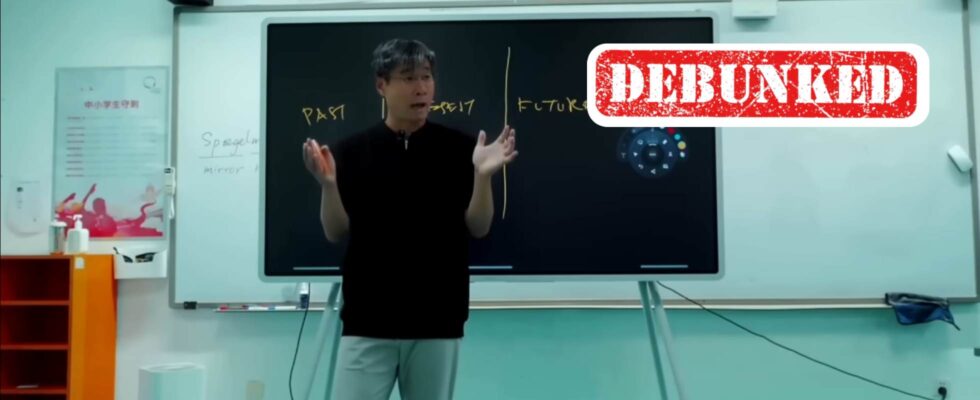
Professor Jiang, a game theorist and YouTube personality behind the channel Predictive History, has amassed nearly 2 million subscribers by claiming to predict future geopolitical events through historical analysis.
His popularity surged after he predicted a Trump presidency victory and a U.S.-Iran conflict. But archaeologist Flint Dibble, host of Archaeology with Flint Dibble, has taken a closer look at the historical claims underlying Jiang’s viral fame, and the picture is not flattering.
Dibble’s first concern is with Jiang’s credentials. Despite being widely referred to as “Professor Jiang,” the man teaches at Moonshot Academy, a middle school in Beijing. He has never taught at a university level and holds no advanced degrees. His bachelor’s degree is in English literature.
The core of Jiang’s method, which he calls “predictive history,” borrows the concept of “psychohistory” from Isaac Asimov’s science fiction Foundation series. Rather than relying on documentary or archaeological evidence, Jiang applies game theory and religious frameworks to historical events.
In one lecture, he argued that the Battle of Cannae in 216 BC, where Hannibal devastated a Roman army, never occurred. He extended this further to claim Hannibal himself never existed, and ultimately that all of Roman history is fabricated.
Dibble dismantled these claims point by point. The Greek historian Polybius, who was alive during the Second Punic War, wrote a detailed account of it. Roman analyst Lucius Cincius Alimentus was actually captured by Hannibal, making him a primary source.
Archaeological evidence supports the written record: the town of Cannae shows signs of abandonment matching the historical timeline, coins minted by Capua as an independent power date to Hannibal’s presence in Italy, and dung residue in the Alps documents his army’s crossing.
Jiang’s theories grow stranger from there. He has argued that Egyptian pyramids were energy storage devices rather than tombs, that evolution is not credible, and that ancient priests used ritualistic trauma and dissociation to control pharaohs.
He acknowledged in interviews that his approach is speculative rather than historical: “I don’t actually use documentary evidence in my classes. I use a lot of first-principal thinking.”
More seriously, Dibble highlighted that Jiang has pushed antisemitic conspiracy theories about secret organizations controlling global power, and has publicly cast doubt on the Holocaust, stating “we don’t actually have any concrete evidence for the Holocaust.”
Dibble noted the considerable physical, photographic, documentary, and survivor evidence that contradicts this claim directly.
Perhaps the most telling admission from Jiang is how he describes his own process: “I’m always accessing a higher force and I’m receiving this information that I can then articulate to you in class.”
Dibble’s conclusion is direct: Jiang is not a historian, not a professor, and not a reliable source on any topic he covers. He is, as Dibble put it, someone who “freely admits that he uses no evidence” and “does no research.”
