
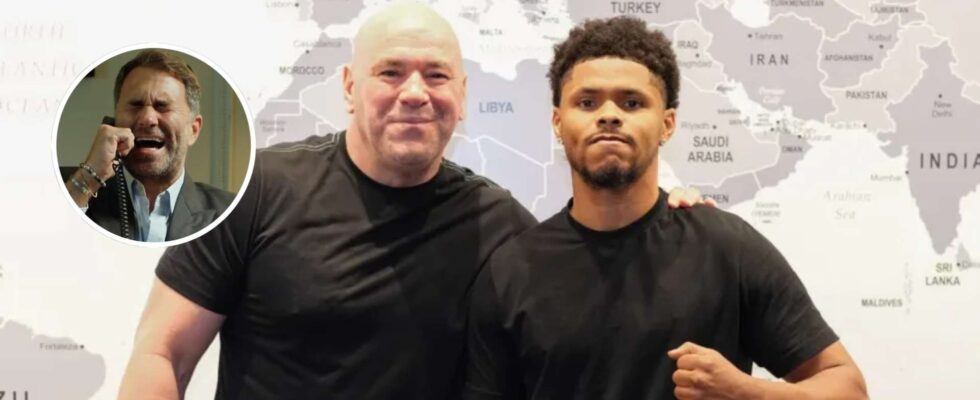
The news that Shakur Stevenson parted ways with Zuffa Boxing after just three months has exposed a critical miscalculation. While Stevenson requested his release citing incompatibility, subsequent reporting from boxing journalist Sean Zittel revealed deeper tensions.
According to sources, Zuffa offered Stevenson $7 million to face athletes like Rayo Valenzuela and Edwin De Los Santos. Stevenson countered with a demand for $15 million to compete against Manny Pacquiao. That $15 million figure didn’t materialize from thin air. It came directly from Zuffa’s own playbook.
Months earlier in a calculated move to antagonize rival promoter Eddie Hearn of Matchroom Boxing, Zuffa signed Conor Benn for precisely $15 million. Benn, who had been with Hearn throughout his career, represented a chance for Zuffa to demonstrate their financial dominance. The figure leaked quickly to the press.
But Benn isn’t a world-class athlete and his opponent Regis Prograis was competing in his final professional bout, well past his prime. This decision has created a cascade of problems that Zuffa couldn’t have anticipated. The benchmark was set, and athletes across both their boxing and MMA rosters took notice.
UFC heavyweight champion Jon Jones requested $15 million to compete on the highly anticipated White House card. He was rebuffed.
The logic was simple from his perspective: if TKO and UFC, entities with more capital than any promotional organization in combat sports history, could pay that amount for a non-elite boxer against a retiring opponent, why wouldn’t they pay it for one of MMA’s biggest names?
The discontent spread to middleweight champion Sean Strickland, who recently signed a six-bout contract to secure a title opportunity. Despite being a two-time champion and current titleholder, Strickland openly questioned why he couldn’t command compensation anywhere near what Benn received. The contract itself was coercive by design: sign long-term or forfeit your title shot.
Then came Stevenson’s turn. As arguably the best boxer on Zuffa’s roster and potentially the sport’s top pound-for-pound athlete, he recognized the precedent. If Benn warranted $15 million against a fading Prograis, why shouldn’t he receive the same for facing Pacquiao?
While Pacquiao is approaching 50 and past his prime, his career accomplishments far exceed Prograis’s. Even in a diminished state, he represents a more viable attraction than Prograis did at the absolute end of his career.
Zuffa’s predicament is understandable. Paying Stevenson $15 million to face Pacquiao carries significant financial risk with questionable return on investment. But the damage was self-inflicted.
By establishing that rate for an inferior matchup, they painted themselves into a corner. When Stevenson demanded equivalent treatment, they had no leverage to refuse without appearing hypocritical.
The Benn signing has proven disastrous beyond just setting unsustainable financial expectations. A proposed match between Benn and Ryan Garcia collapsed, and the eventual bout that aired on Paramount Plus reportedly underperformed so significantly that Zuffa has never released viewership numbers. Their UK shows have been unremarkable at best.
This stands in contrast to the narrative Zuffa and UFC leadership have cultivated for years. They’ve repeatedly suggested their success stems from superior intelligence and promotional acumen that competitors simply cannot match.
Yet when forced to operate in boxing’s more regulated environment, where athlete possess greater leverage and established labor protections exist, the results tell a different story.
The situation illuminates exactly why Zuffa has pushed so aggressively for the Muhammad Ali American Boxing Revival Act, legislation that would fundamentally restructure boxing’s regulatory framework in their favor. They’re not seeking to compete on equal footing. They’re seeking to reshape the rules entirely, recreating the conditions that allowed them to dominate MMA.
