
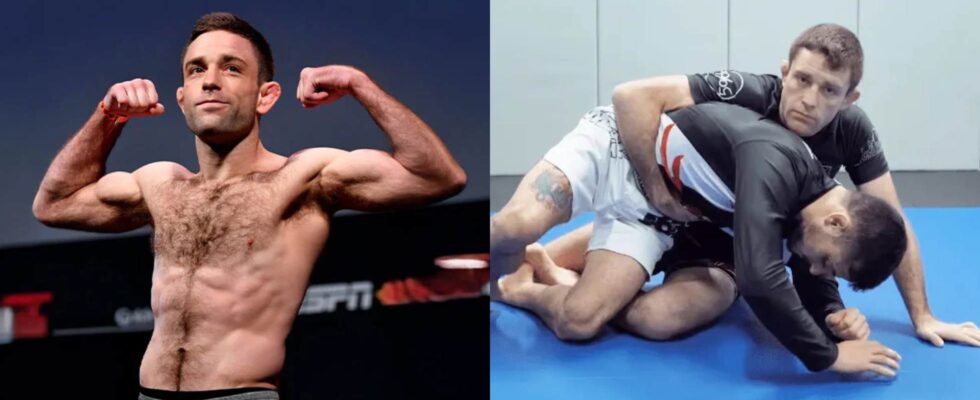
UFC veteran and submission specialist Ryan Hall made his stance on sport jiu-jitsu clear during a recent appearance on Matt Serra’s podcast. Despite building his entire combat style around grappling, Hall explained that he has always viewed jiu-jitsu as a tool rather than the end goal itself.
When Serra asked why he chose to pursue MMA instead of remaining on the tournament circuit, Hall said his motivation came from wanting to become “a real martial artist.”
“I wanted to be a real martial artist,” Hall said. “I like jiu-jitsu very much, but unless it’s a means to an end, it’s not a fig ht. I like it. I love it. It’s great. It’s fighting without punches. It’s neat. I love it. But it’s meant to get you ready for the game. It’s not the game itself, in my opinion.”
Hall then laid out his personal hierarchy when it comes to combat sports and real-world application.
“If I could choose between being good in jiu-jitsu or good in MMA, I’d pick MMA,” he explained. “If I could pick between MMA and real life, I’d pick real life.”
The longtime UFC veteran also discussed the gap between sport grappling and actual figh ting, arguing that many jiu-jitsu competitors underestimate how much physical attributes matter once strikes and real consequences are involved.
“A lot of jiu-jitsu guys don’t understand that athleticism, grit, toughness, durability, power, all of that matters so much when you make it more real,” Hall said. “It definitely matters a little bit on the mat, but the realer it gets, the more that type of stuff matters.”
At the same time, Hall pushed back against the idea that certain techniques are only effective in grappling tournaments and cannot work inside the cage. Serra praised him for successfully applying moves many considered “sport only” in MMA.
“It’s not different gravity in the cage,” Serra said. “What’s going on in there? Nothing’s different. The only thing that’s different is in your head.”
Hall agreed and replied, “Your mind makes it real, you know? It’s only different in your head. The physics aren’t different. People are like, ‘Oh, man. Could you do that in real life?’ Yeah, step outside right now.”
Still, Hall believes the structure of competitive jiu-jitsu can sometimes drift away from the realities of figh ting itself. While he acknowledged the value of the sport, he argued that its scoring systems and strategies can become overly self-contained.
“No disrespect to jiu-jitsu,” Hall explained. “It’s an important proving ground and a pretty great laboratory, but it can become so much about its own self. A lot of times you watch matches and the scores don’t reflect the action. Usually you watch a wrestling match, you can tell who’s winning and why. Jiu-jitsu sometimes, yeah, sometimes no.”
Serra also asked Hall whether he could see himself returning to pure jiu-jitsu competition once his MMA career ends. Hall’s answer was straightforward.
“Probably not,” he admitted. “Maybe I like figh ting better. It’s real.”
