
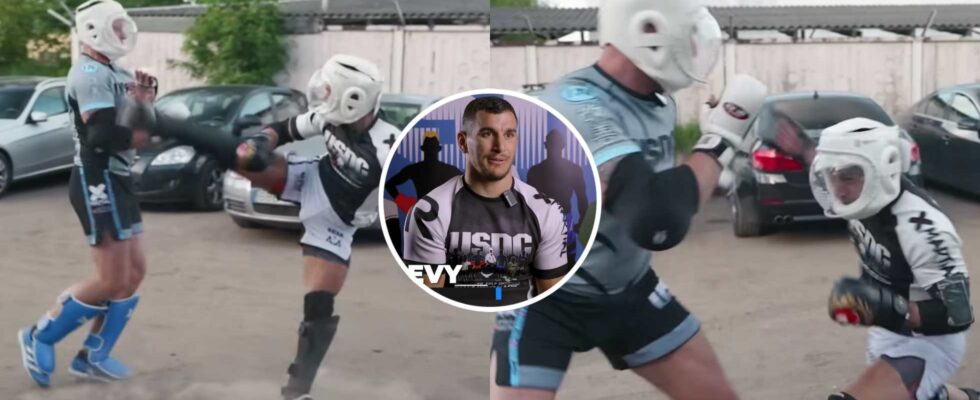
In a test of real-world self-defense skills, former UFC competitor Natan Levy demonstrated superior decision-making and tactical awareness when facing simulated home invasion scenarios, outperforming competitors from various martial arts disciplines.
The Ultimate Self Defense Championship Season 3 brought together eight elite martial artists to face realistic home invasion situations. The diverse lineup included Sensei Seth (sumo), Gabriel Varga (kickboxing champion), Josh Beam (Brazilian jiu-jitsu champion), Randy Turner (former special forces), Vilius Tarasevicius (Kudo champion), Shane Langwell (Krav Maga), Natan Levy (UFC veteran), and Adrian Cutajar (rugby athlete).
The challenge tested participants across four different home invasion scenarios, evaluating not just combat ability but critical thinking, de-escalation skills, and threat assessment. Each competitor faced situations including a suspicious person requesting entry, an unwelcome stranger brought home by a “brother,” a fake police officer attempting forced entry, and a multi-attacker armed home invasion.
Natan Levy’s performance stood out immediately in the opening scenario. When confronted by someone asking for a lighter near his apartment entrance, Levy demonstrated exceptional situational awareness.
“The moment he starts tapping his pockets and looking around, to me it seemed more like just unnatural behavior. I would not go home. I would just keep walking,” Levy explained. His instinct to avoid the situation entirely, combined with maintaining safe distance when confronted, set the standard other competitors struggled to match.
In the second scenario involving a stranger brought inside by his fictional brother, Levy’s response was textbook. He quickly removed the unwanted guest without allowing opportunity for escalation or theft, handling the situation “perfectly, not even giving the chance for the stranger to grab an improvised weapon,” according to the assessment.
Several other competitors made critical errors that Levy avoided. Kickboxing champion Gabriel Varga entered a cornered area with no escape route and failed to identify weapons as threats. Others, including Villis and Randy, made the mistake of unlocking their doors while the threat remained close, potentially allowing forced entry.
Levy’s military-style threat assessment proved invaluable in the fake police officer scenario, where he immediately called authorities to verify the legitimacy of the supposed officer at his door, preventing a potentially dangerous situation.
The final challenge—a multi-attacker armed invasion—tested whether competitors could recognize unwinnable fights. Levy successfully identified the true nature of the threat, gathered information about stolen money, and convinced his fictional brother to return it, resolving the situation without violence.
As organizer Rokas noted, the scenario was designed to test if contenders could “assess a situation in order to decide against fighting to survive.”
Levy’s consistent performance across all scenarios demonstrated that MMA training, which emphasizes both striking and grappling along with pressure testing, translates effectively to real-world self-defense situations. His ability to read body language, maintain spatial awareness, control emotional responses, and choose appropriate force levels proved superior to specialists from single disciplines.
While other competitors showed strengths in individual areas—Josh Beam’s befriending tactics, Sensei Seth’s strategic retreat, Shane Langwell’s vocal deterrence—none matched Levy’s overall consistency.
The UFC veteran’s performance validates the growing recognition that mixed martial arts training, combined with tactical awareness, provides comprehensive preparation for actual self-defense situations beyond the controlled environment of competition.
