

Ari Emanuel has never been shy about his temper, and his new memoir makes sure nobody else can be shy about it either. The book, called “Roll the Calls,” runs 417 pages and was co-written with J.R. Moehringer, the Pulitzer Prize winning writer known for shaping the as-told-to memoirs of Andre Agassi, Phil Knight and Prince Harry.
Puck’s Matthew Belloni, who has read the whole thing, put it bluntly: “Reading this book is like getting screamed at for 417 pages.” He also noted the formatting choices Emanuel and his collaborator settled on, saying “This book has a lot of ALL CAPS.”
That style is by design. Emanuel states his operating principle early and often: “From the beginning of my career, if not my life, I’ve come at things differently. Rage first, ask questions later, that’s been my philosophy.”
He expands on the idea later in the book, framing anger less as a flaw than a survival tool.
“Rage to make them hear you. Rage to keep them honest. Rage or else you’re no different from them. Rage or be complicit.”
The memoir traces Emanuel’s rise from New York to Los Angeles, where he landed in 1987 and began climbing through Creative Artists Agency, then InterTalent, then ICM, before eventually starting Endeavor.
That agency would go on to swallow William Morris in a 2009 merger, and Emanuel does not pretend the deal was won purely on merits.
He writes about outmaneuvering William Morris chief Jim Wiatt during the negotiations, and admits to feeding damaging information to the late Deadline blogger Nikki Finke as part of the campaign. His stated goal, in his own words, was to “destabilize William Morris, make everyone in that building paranoid and uncomfortable, but mainly Wiatt.”
If there is one relationship the book spends real energy dissecting, it is the one with Patrick Whitesell, who joined Emanuel in 2001 and helped build Endeavor into the agency that would eventually become WME. For years the two ran the business together, with Whitesell rising to co-CEO.
Emanuel credits him for that early stretch, but the partnership curdled over time, and the book does not soften the ending.
“Love Patrick. But he doesn’t have the drive. Doesn’t have the desire, frankly. More important, he can’t do it. Can’t keep up. I’m not sure why. The day to day, he just doesn’t seem as interested,” Emanuel writes.
He goes further, painting Whitesell as frequently unreachable: “Patrick’s always off somewhere. Often on vacation. Often just AWOL.”
According to Emanuel’s account, the breaking point came when Whitesell approached Silver Lake’s Egon Durban directly about taking the company private while TKO’s stock was under pressure, a move Emanuel describes as an attempt to “knife me in the back.” He writes with finality about where things stand now: “Once it’s finally done, Patrick and I will never speak again. Will never need to speak again. This life or the next.”
Whitesell was given the chance to respond and did not hold back.
“I’m incredibly proud of what we built together with hundreds of talented people,” he said, before turning sharper. “Ari using a memoir to rewrite history and take credit for it all won’t surprise anyone who knows him,” he added, and needled Emanuel over the project itself: “He’s not the first person to finance a memoir for mythmaking.”
Whitesell did confirm one piece of Emanuel’s version, though he framed it very differently. “The only true thing in all of this is that I did go directly to our partners because the business desperately needed a new strategy, and that ultimately led to taking the company private.”
With Whitesell out, Emanuel describes turning to Mark Shapiro, whom he calls the little brother he never had, eventually positioning him to step into the role Whitesell once held.
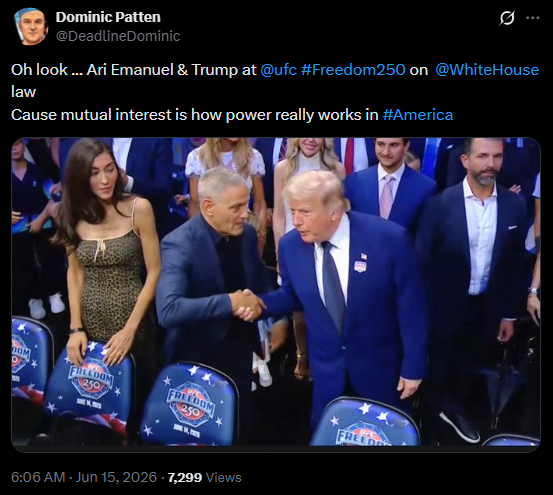
The book’s political material centers on Donald Trump, whom Emanuel represented as a client for years before cutting ties after the 2016 election. He describes the split without much ceremony: “I tell him that I’ve never dropped a client with such ease. And I tell him that I didn’t vote for him.”
Notably absent from the memoir, according to Belloni’s reading, is much discussion of Trump’s second term, a gap that stands out given how central the earlier relationship was to Emanuel’s career.
Emanuel also recounts a client he never landed. He describes pursuing Barack Obama and making his pitch directly: “I tell him I will make him a f[]ing billionaire.” Obama did not sign.
On the entertainment side, Emanuel writes about signing Oprah Winfrey as a moment that affected him personally, and he also recounts the experience of being let go by Taylor Swift, a rare instance in the book of Emanuel on the receiving end rather than delivering the blow.
There is also a physical dimension to Emanuel’s self-mythology that predates the book. He has long pointed to Ari Gold, the fictional agent on “Entourage” loosely modeled on him, as something that reshaped how people in the industry treated him.
“Ari Gold opened doors. Ari Gold made it possible for me to cold call anyone,” he writes, treating the television caricature almost as a professional asset rather than an embarrassment.
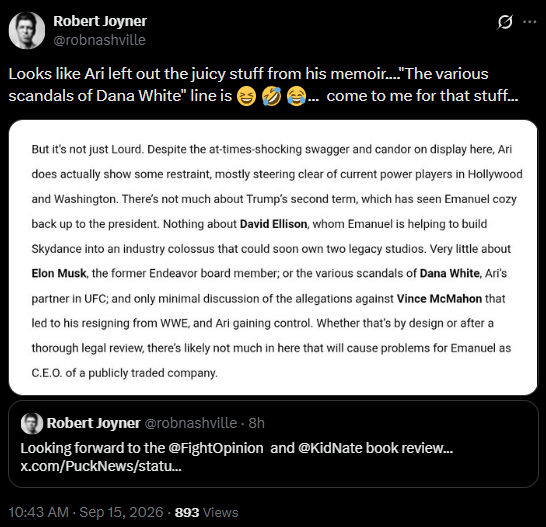
What the memoir tends to avoid is nearly as telling as what it includes. Belloni points out that Emanuel steers clear of the messier recent chapters connected to his current business, including the scandals that have surrounded Dana White and most of the allegations tied to former WWE chief Vince McMahon.
There is little on Elon Musk and little on David Ellison either, both figures who intersect with Emanuel’s world in ways the book largely sidesteps. That restraint stands out given how willing Emanuel is elsewhere to name names and assign blame.
It also leaves out extended discussion of the business relationships that now define much of TKO’s global footprint. As CEO of TKO, the company formed by combining UFC and WWE, Emanuel oversees an organization whose events and partnerships increasingly run through Saudi Arabia, where both properties have deepened their commercial ties in recent years.
Emanuel’s decision to leave those scandals largely untouched did not go unnoticed. Robert Joyner took a pointed jab at the omission on X, writing, “Looks like Ari left out the juicy stuff from his memoir…. ‘The various scandals of Dana White’ line is 😆 🤣 😂… come to me for that stuff…”
Emanuel remains active well beyond TKO’s boardroom, still connected to talent relationships and outside ventures built over four decades in the industry.
