

A Massachusetts high school has chosen to forfeit an upcoming field hockey match against a team that includes a transgender player. Dighton-Rehoboth Regional High School made the announcement, citing safety concerns that have resurfaced following a traumatic incident from the previous year.
A year ago, during a playoff game, a Dighton-Rehoboth player was seriously injured by a powerful shot from an opposing team member. The injury, which resulted in facial fractures and the loss of several teeth, was widely publicized. The player responsible for the shot was a transgender athlete from Swampscott High School. The event reignited debates surrounding fairness and safety in high school sports, particularly where gender policies are concerned.
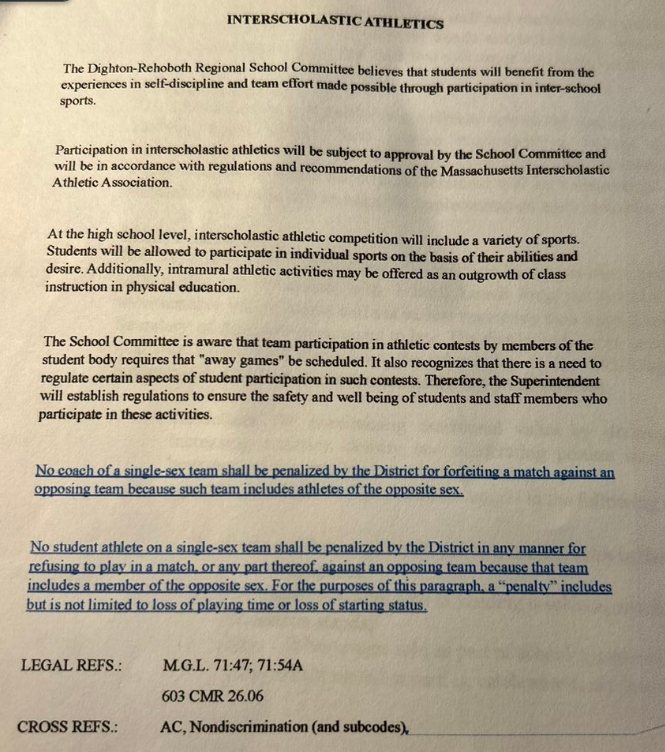
In response to the incident, Dighton-Rehoboth revised its athletic policy, which is now reflected in the statement: “No student athlete on a single-sex team shall be penalized by the District in any manner for refusing to play in a match, or any part thereof, against an opposing team because that team includes a member of the opposite sex.”
The policy signals a firm stance on player safety, with the school stating, “We stand strong in making a stance for safety over victory.” This revision comes amid continued debate about inclusivity, fairness, and the potential risks involved in allowing athletes of different genders to compete on the same teams.
The forfeit has drawn a mixed response from the community and beyond. Some argue that it is a necessary measure to protect players, while others see it as an exclusionary move that undermines efforts to create an inclusive environment for all athletes. Dighton-Rehoboth’s co-captain, Kelsey Bain, had previously spoken out in favor of reviewing existing policies after the injury to her teammate, expressing concerns about the balance between inclusivity and safety.
The Massachusetts Interscholastic Athletic Association (MIAA), which governs high school sports in the state, has a longstanding policy permitting students to participate in sports teams based on their gender identity if the sport is not available for their assigned sex. The MIAA defends this policy under the Massachusetts Equal Rights Amendment of 1976, which prohibits discrimination based on sex.
However, after last year’s incident, Superintendent Bill Runey has pushed for a reevaluation of these rules. While Runey acknowledges the importance of inclusivity, he stresses that player safety must remain a priority. He has suggested alternatives, such as forming co-ed teams or creating separate divisions, as possible solutions that could ensure both safety and inclusivity.
The decision to forfeit this match signals a critical moment in the ongoing debate over how to accommodate transgender athletes in high school sports while protecting the safety and fairness of all participants. As discussions continue, it is clear that finding a balance between inclusivity and athlete safety remains a complex and emotionally charged issue.
For now, Dighton-Rehoboth’s focus remains on prioritizing the safety of its players, a stance that has garnered both support and criticism as the school navigates this challenging situation.
