
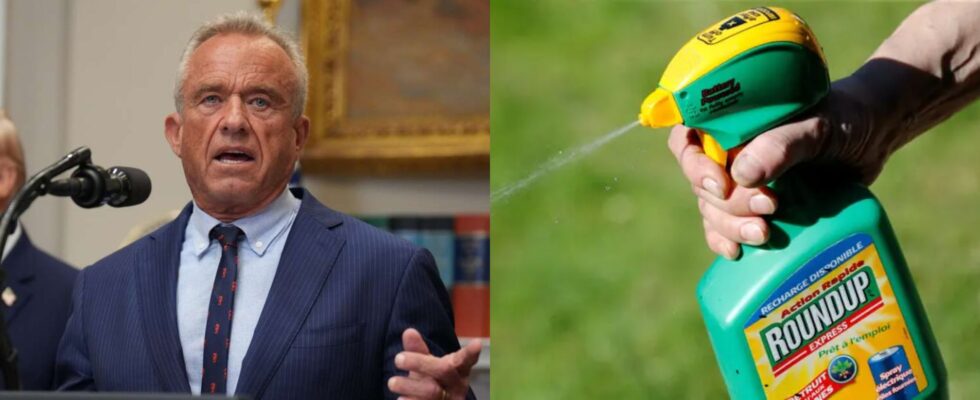
Recently, Robert F. Kennedy Jr. threw his weight behind the Trump administration’s sweeping new executive order to dramatically increase domestic glyphosate production. This happened just days after Kennedy declared on camera that the controversial herbicide causes cancer.
The February 18 executive order, framed as a national security imperative, invokes the Defense Production Act to guarantee an “adequate supply” of elemental phosphorus and glyphosate-based herbicides.
The administration argues these materials are essential to military readiness and agricultural productivity, citing phosphorus as a critical component in defense technologies ranging from semiconductors to lithium-ion batteries used in weapon systems.
Yet Kennedy’s endorsement of the policy directly contradicts his own recent statements. “Well, I believe that glyphosate causes cancer,” he stated in a video dated just one week before the executive order’s release.
The comment reflected his longtime advocacy against the herbicide, which has spawned thousands of lawsuits alleging health risks, particularly cancer.
By Thursday morning, however, Kennedy had reversed course entirely. In a statement to CNBC, he defended the president’s decision with language that could have been lifted from a White House briefing sheet.
“Donald Trump’s Executive Order puts America first where it matters most: our defense readiness and our food supply,” Kennedy said. “We must safeguard America’s national security first, because all of our priorities depend on it. When hostile actors control critical inputs, they weaken our security. By expanding domestic production, we close that gap and protect American families.”
The jarring pivot threatens to fracture the Make America Healthy Again movement that helped propel Trump to victory in 2024. MAHA is a U.S.-based political initiative spearheaded by Robert F. Kennedy Jr. as of 2025–2026.
The movement centers on what it describes as a growing chronic disease crisis in America, advocating for sweeping reforms in food safety standards, restructuring federal health agencies such as the FDA, and limiting exposure to environmental toxins.
Kennedy’s MAHA coalition united health-conscious voters, alternative medicine advocates, and critics of corporate agriculture around shared concerns about food safety and chemical exposure. Glyphosate, the active ingredient in Roundup and the most widely used herbicide in American agriculture, became a lightning rod for these concerns.
The executive order paints glyphosate as indispensable to American farming, describing it as “a cornerstone of this Nation’s agricultural productivity and rural economy.” It warns that restricting access would result in economic losses for growers and make it impossible to meet growing food demands, noting there is “no direct one-for-one chemical alternative.”
More provocatively, the order mandates that any regulations issued under its authority must not place “the corporate viability of any domestic producer of elemental phosphorus or glyphosate-based herbicides at risk.”
The United States currently imports more than 13 million lbs (6,000,000 kilograms) of elemental phosphorus annually from other countries, according to the order. With only one domestic producer unable to meet annual demand, the administration warns that further reduction in domestic production would “gravely threaten American national security” by disrupting defense supply chains.
