

In a move that has sparked outrage, the International Olympic Committee (IOC) has issued a new directive to the media, warning them against using certain terms when reporting on trans athletes competing at the upcoming Paris 2024 Olympics.
The IOC’s 33-page document has declared phrases such as ‘born male’, ‘born female’, ‘biologically male’, and ‘biologically female’ as ‘problematic language’ that should be avoided. The body also urges the press to steer clear of ‘sex change’, ‘post-operative surgery’, and ‘transsexual’, stating that these phrases can be ‘dehumanising and inaccurate’ when describing transgender sportspeople and athletes with sex variations.
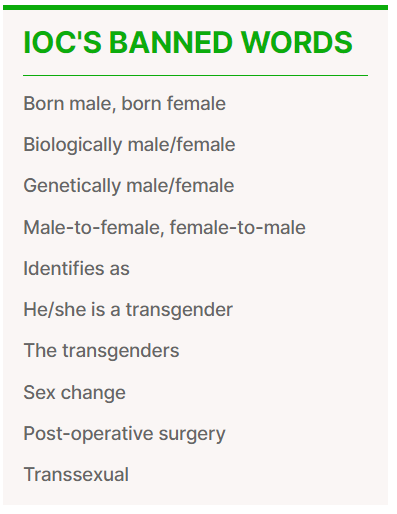
Instead, the IOC has provided alternative terms for journalists to use, including ‘girl/boy’, ‘woman/man’, ‘transgender girl/boy’, ‘transgender woman/man’, and ‘transgender person’. The document states, “It is always preferable to emphasise a person’s actual gender rather than potentially calling their identity into question by referring to the sex category that was registered on their original birth certificate.”
The move has drawn sharp criticism from prominent figures in the sporting world. Sharron Davies, an Olympic swimming silver medalist and outspoken critic of transgender women competing in female sports, told Mail Sport, “The IOC never fails to disappoint me with their utter hypocrisy. Here they are trying to curtail journalists from telling the public the truth when males are in races for females with an unfair advantage at the same time as boasting all over social media of the first games with gender equality – you couldn’t make this stuff up.”
Three-time cycling Olympian Inga Thompson also slammed the IOC on X, formerly known as Twitter, stating, “The IOC has allowed themselves to be bought because deep down, they never wanted women to be in sports. The ultimate misogynist movement perpetuated by the IOC.”
The controversy comes amid ongoing debates surrounding the participation of transgender athletes in women’s sports. Several sports, including athletics, cycling, swimming, rugby, and rowing, have banned transgender competitors from elite women’s races if they have been through male puberty, citing concerns over unfair advantages.
The IOC, however, does not have its own policy on the matter, instead shifting responsibility to individual sports to determine their own rules. This decision has been met with criticism, with some arguing that the IOC should take a more proactive stance in ensuring fairness and equality in competitive sports.
As the world prepares for the upcoming Paris 2024 Olympics, the debate over the inclusion of transgender athletes is likely to continue to be a contentious issue, with the IOC’s latest directive on language only adding fuel to the fire.
