Andrew Huberman, the Stanford neuroscientist and host of the Huberman Lab podcast, has spent years building a reputation as one of health’s most prominent voices.
Recently, Huberman confirmed that he has been on testosterone replacement therapy (TRT) for years and is actively considering a next step: replacing it with peptides entirely.
According to sources, the revelation came during an interview with six-time Mr. Olympia bodybuilding champion Dorian Yates, in which Huberman volunteered his own TRT use while asking the British legend about his experience with the therapy.
“I’m on low-dose TRT. I started when I was 45. About 125 milligrams a week,” Huberman said during the conversation.
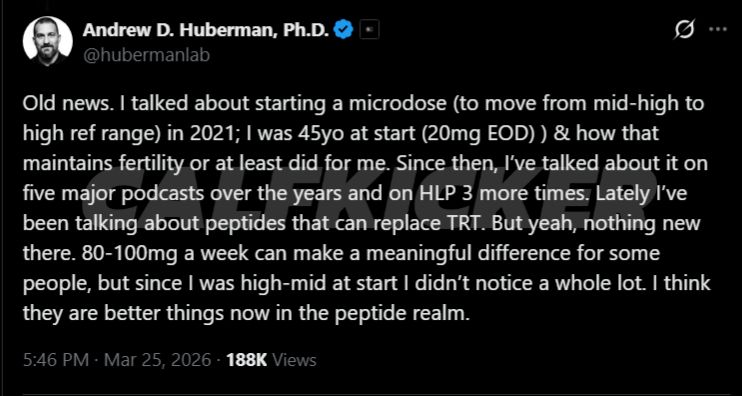
In a subsequent post on X, Huberman pushed back on the idea that the admission was news at all.
“Old news. I talked about starting a microdose (to move from mid-high to high ref range) in 2021; I was 45yo at start (20mg EOD) and how that maintains fertility or at least did for me. Since then, I’ve talked about it on five major podcasts over the years and on HLP three more times. Lately I’ve been talking about peptides that can replace TRT. But yeah, nothing new there. 80-100mg a week can make a meaningful difference for some people, but since I was high-mid at start I didn’t notice a whole lot. I think there are better things now in the peptide realm.”
That last line is the part that has turned heads. For months, Huberman has been increasingly vocal about peptides, a class of biological compou nds that have historically been associated with bodybuilding and performance enhancement but are now attracting mainstream medical interest.
His recent social media activity suggests he believes a meaningful shift is underway.
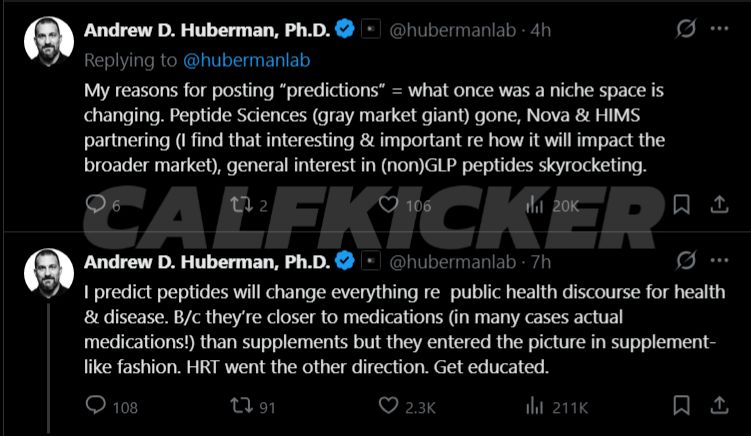
“I predict peptides will change everything re public health discourse for health and disease,” he wrote on X. “Because they’re closer to medications (in many cases actual medications!) than supplements but they entered the picture in supplement-like fashion. HRT went the other direction. Get educated.”
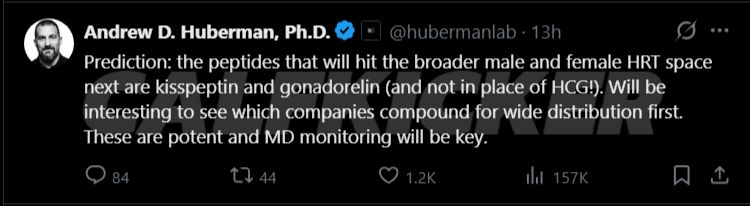
He has even gone so far as to name specific peptides he believes will define the next chapter of hormonal health.
“Prediction: the peptides that will hit the broader male and female HRT space next are kisspeptin and gonadorelin (and not in place of HCG!). Will be interesting to see which companies co*pound for wide distribution first. These are potent and MD monitoring will be key.”
To understand why this matters, it helps to understand Huberman’s explanation for why stuff like TRT and peptides carry a stigma that standard medications largely do not.
In a February post on X, he traced the disparity to what he calls an “origin story.”
“It’s how they came to be known. The port of entry for TRT and peptides was through bodybuilding. Which is known for extremes and people passing away. The port of entry for SSRIs was ‘standard’ psychiatry,” he wrote.
Huberman has elaborated on this trajectory at length on his podcast, describing a consistent pattern going back decades.
He said, “Bodybuilders always get there first. Then what happens is in Florida and the United States, doctors who work out, they go out in gyms with people who know how to gain muscle and lose fat quickly, start experimenting. Then it goes into their high-level clients. Then it shows up in Hollywood.”
According to Huberman, this pipeline has repeated itself with virtually every major performance-related stuff, from growth hormone to GLP-1 receptor agonists. He has applied the same lens to retatrutide, an experimental weight management treatment currently in Phase III clinical trials by Eli Lilly.
The d**g functions as a triple agonist targeting GLP-1, glucagon, and GIP receptors simultaneously, and trial participants experienced up to one-third body weight loss within approximately six months.
Huberman has said publicly that celebrity use of the treatment already appears widespread, though he has also been clear that he is not personally taking it.
In a February 9 post on X, he clarified: “I’ve not tried GLP-1 agonists. If I ever do I will say as I’ve always shared what I take and try and halt taking and amounts since 2021 when we launched HLP.”
The sheer volume of public interest in retatrutide, however, is something he has found difficult to ignore. “Not a week goes by where I don’t get 100 questions about Retatrutide to my phone, my personal phone, let alone email,” he noted.
Not everyone has welcomed Huberman’s recent enthusiasm for peptides warmly. On Reddit’s r/HubermanLab, the TRT revelation drew pointed backlash, with users calling him a “scam artist” and a “charlatan.” Some argued that his use of testosterone renders much of his supplement-related advice suspect.
“I think the problem is testosterone is often so effective that Huberman taking it minimizes everything he has said about all other supplements,” one user wrote. “Who cares about AG1 or valerian root or whatever when you can get some juice?”
Another simply wrote: “I am disappointed.”
People on Twitter also called Huberman out.

The frustration is rooted in logic that has shadowed many wellness influencers: if a person achieves their results primarily through medical intervention, endorsing over-the-counter supplements as contributing factors becomes difficult to justify.
Huberman has built an enormous audience, in part, on the premise that his own physique and vitality reflect the protocols he promotes. The acknowledgment of TRT cuts against that implied claim.
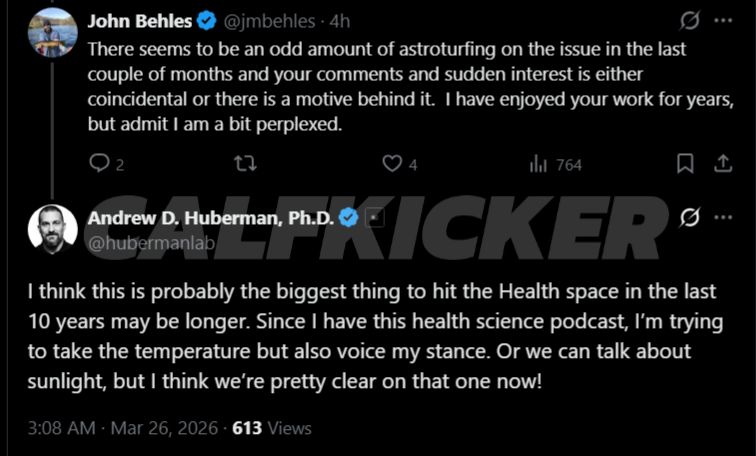
Huberman has also addressed questions about whether his recent pivot toward peptide coverage is commercially motivated.
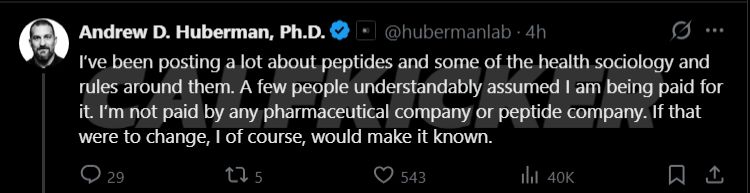
“I’ve been posting a lot about peptides and some of the health sociology and rules around them. A few people understandably assumed I am being paid for it. I’m not paid by any pharmaceutical company or peptide company. If that were to change, I of course, would make it known,” he wrote on X.
He also framed his interest in the topic as consistent with his role as a health communicator.
“I think this is probably the biggest thing to hit the Health space in the last 10 years, maybe longer. Since I have this health science podcast, I’m trying to take the temperature but also voice my stance. Or we can talk about sunlight, but I think we’re pretty clear on that one now!”