

Stanford neuroscientist Andrew Huberman has offered an explanation for why testosterone and peptides carry a social stigma that antidepressants do not, pointing to their origins in bodybuilding as the key factor shaping public perception.
In a February 13 response on X to a question about the different reactions people have to psychiatric medications versus PEDs, Huberman traced the disparity to what he calls their “origin story.”
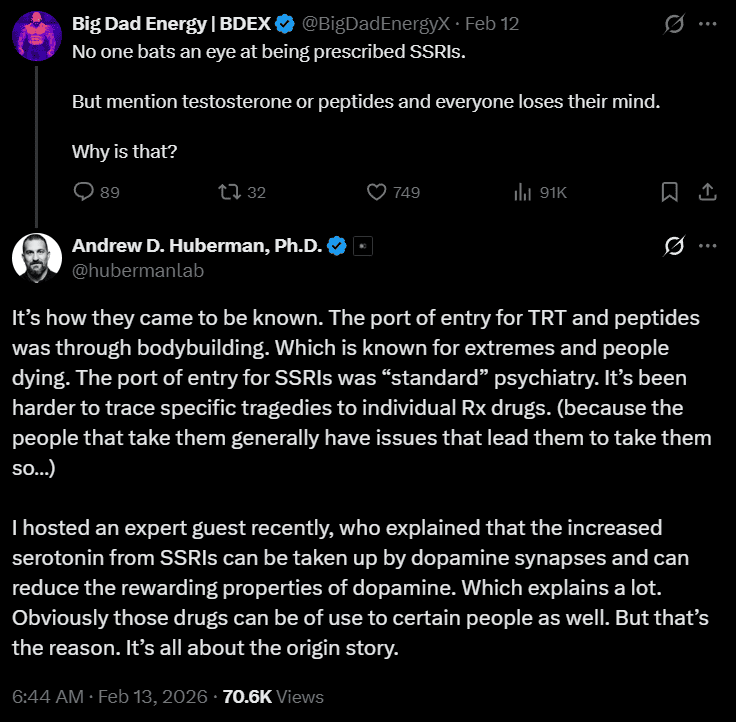
“It’s how they came to be known. The port of entry for TRT and peptides was through bodybuilding. Which is known for extrmes and people passing away,” Huberman wrote. “The port of entry for SSRIs was ‘standard’ psychiatry.”
According to Huberman, the association with bodybuilding culture has created lasting reputational consequences for these, even when used at therapeutic doses under medical supervision.
The neuroscientist suggested that prescription treatments introduced through conventional medical channels face less scrutiny because negative outcomes are harder to attribute to the treatment itself.
“It’s been harder to trace specific tragedies to individual Rx d**gs (because the people that take them generally have issues that lead them to take them so…),” he explained.
This pattern of adoption has become a recurring theme in Huberman’s recent commentary. Speaking on a podcast, he described a predictable sequence that has played out since the 1980s.
“Bodybuilders always get there first,” Huberman said. “Then what happens is in Florida and the United States, doctors who work out, they go out in gyms with people who know how to gain muscle and lose fat quickly, start experimenting. Then it goes into their high-level clients. Then it shows up in Hollywood.”
The neuroscientist has applied this framework to retatrutide, an experimental weight management treatment currently in Phase III clinical trials. Eli Lilly holds the patent for the treatment, which functions as a triple agonist targeting GLP-1, glucagon, and GIP receptors simultaneously. In clinical trials, participants experienced up to one-third body weight loss within approximately six months.
Huberman has observed the treatment’s migration from research settings to what he believes is widespread celebrity use.
“All the celebs now getting that retrutatide look,” he wrote on X. “If you want to know what will be massive on legal RX market 2 years ahead in the fat loss, muscle, vitality space… it always goes from bodybuilding (GH, TRT, GLPs, Retra.) to Hollywood to mainstream. EVERY TIME. Since the 80s.”
The neuroscientist revealed the scale of public curiosity surrounding the treatment. “Not a week goes by where I don’t get 100 questions about Retatrutide to my phone, my personal phone, let alone email,” he said.
Despite this interest, Huberman has emphasized he has not personally used it. In a February 9 post on X, he clarified: “I’ve not tried GLP1 agonists. If I ever do I will say as I’ve always shared what I take and try and halt taking and amounts since 2021 when we launched HLP.”
When asked if his comments constituted an endorsement, he responded: “I don’t know I don’t think I’m going to take it. But I’m not trying to lose fat.”
Hollywood’s approach to these treatments has drawn particular criticism from Huberman. “Everyone lies or avoids answering the question of how they got so jacked,” he noted. “They talk about eating chicken breasts, and they’re actually taking growth hormone and Cipionate and Winstrol and Retatrutide.”
Despite the absence of FDA approval for retatrutide, Huberman has observed widespread off-label use. “People are already using Retatrutide. They can buy it out there. They’re taking it at maybe a third of the dose that’s recommended in the trial, and they are seeing phenomenal results at fat loss,” he noted.
However, the neuroscientist has cautioned against unregulated sources. “I’m not suggesting any of these. Talk to your MD, and whatever you do, don’t take ‘just for research purposes peptides’ the low level LPS is no bueno and many are fake,” he wrote on X.
