

Popular neuroscientist Andrew Huberman recently clarified his personal stance on GLP-1s after his recent commentary on Hollywood’s adoption of retatrutide sparked controversy.
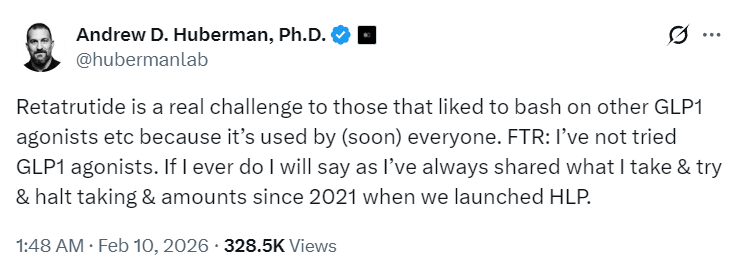
In a February 9 post on social media platform X, Huberman addressed the speculation directly: “Retatrutide is a real challenge to those that liked to bash on other GLP1 agonists etc because it’s used by (soon) everyone. FTR: I’ve not tried GLP1 agonists. If I ever do I will say as I’ve always shared what I take & try & halt taking & amounts since 2021 when we launched HLP.”
The Stanford professor’s clarification came after he described what he characterized as a recognizable pattern in how performance compounds move from bodybuilding communities to celebrity circles and eventually mainstream medical use.
“All the celebs now getting that retrutatide look,” Huberman wrote. “If you want to know what will be massive on legal RX market 2 years ahead in the fat loss, muscle, vitality space… it always goes from bodybuilding (GH, TRT, GLPs, Retra.) to Hollywood to mainstream. EVERY TIME. Since the 80s.”

When a follower asked whether this was the endorsement they had been waiting for, Huberman responded: “I don’t know I don’t think I’m going to take it. But I’m not trying to lose fat.”

His observations about the physical appearance associated with retatrutide use have generated significant discussion.
The neuroscientist also emphasized caution.
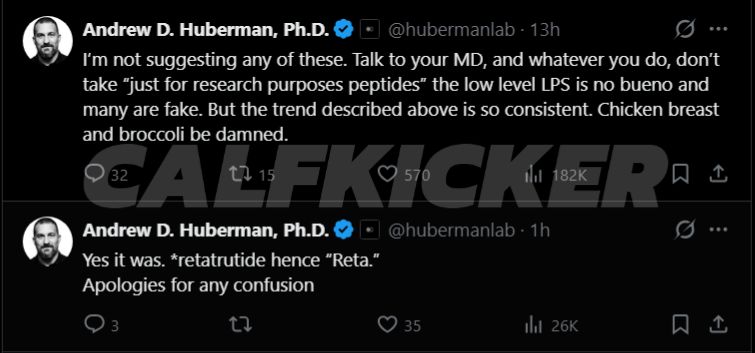
“I’m not suggesting any of these. Talk to your MD, and whatever you do, don’t take ‘just for research purposes peptides’ the low level LPS is no bueno and many are fake,” he warned. “But the trend described above is so consistent. Chicken breast and broccoli be damned.”
Retatrutide represents a significant advancement beyond earlier weight management treatments. While semaglutide targets only GLP-1 receptors and tirzepatide addresses both GLP-1 and GIP, retatrutide adds a third mechanism through glucagon agonism.
Dr. Aboud Bakri, MD, explained it’s unique profile during an appearance on the Santa Cruz Medicinals podcast.
“Retatrutide is very very effective at fat loss. Much more effective than semaglutide or tirzepatide and way less side effects,” he stated.
The medication’s benefits extend beyond simple appetite control. Dr. Bakri noted: “People are noticing that they’re even taking it while they’re bulking. Retatrutide because they’re able to partition more nutrients into the muscle instead of into the fat.”
Dr. Mike Israetel has become particularly vocal about the its potential. During an appearance on the Trensparent podcast, Israetel shared his experience with the medication.
“Tirzepatide is already a god molecule. Like, it’s amazing. I have nothing about it I don’t like. Retatrutide is like magic magic juice,” he said.
Israetel outlined a comprehensive list of benefits: “It does like 10 other things for your health and longevity. It sensitizes you to muscle growth more. It controls your appetite like a turn dial. It reduces whole body systemic inflammation. It reduces neural inflammation. It pulls out your intra-abdominal fat. Retatrutide specifically zaps liver fat like nothing they’ve ever tested. It’s a health elixir, period.”
The bodybuilding coach described remarkable changes in body composition. “You could just lose like four pounds of fat a week. Unbelievable, right? And it’ll be amazing and you feel great because dieting really wears you down and with retatrutide it doesn’t really do that, which is just totally mind-blowing.”
Despite not having FDA approval yet, retatrutide has already entered the market through research chemical companies. Dr. Bakri described the situation: “Research companies, these are companies that say not for human consumption, research only. They get retatrutide from China. Everything comes from China. They package in the United States. Lyophilize it. Put it in vials and sell it to people online as long as you check. Like this is not for human consumption.”
The medication is expected to receive FDA approval sometime in mid-2026, according to Dr. Bakri.
However, medical professionals have expressed concerns about inappropriate use, particularly among young people.
Dr. Bakri questioned the necessity of such interventions for younger individuals. “My bigger question is why is a 19-year-old even obese?” he stated.
He shared success with older patients, including a 65-year-old who lost 100 pounds (45 kg) and no longer needed planned knee replacement surgery. He also emphasized that this occurred “under clinical supervision it should be with a very smart clinical team that includes diet exercise mental wellness all these things it shouldn’t just be the GLP1 alone.”
The physician raised concerns about long-term consequences. “I’m worried that they’re going to desensitize the GLP-1 receptors. So that now when they come off, they’re going to have crazy high appetite and be eating like crazy and we’ve seen it. Like I’ve seen patients they jump off the GLP-1 three months later they’ve regained all the weight.”
Despite the medical community’s reservations about use among healthy young people, Huberman acknowledged the pattern appears inevitable. When asked whether people should simply use basic training equipment and eat whole foods instead, he responded: “Yes.”

