

Mixed martial arts has claimed the silver medal in an unexpected competition: a comprehensive study ranking hobbies by their ability to attract insufferable personalities.
According to new research examining 74 different male hobbies, MMA ranked among the most unattractive interests a man can have. As it is a part of the “manosphere” content consumption, it is considered to be a major red flag for women.
The study, which surveyed 814 participants with equal gender representation, found that a staggering percentage of women view MMA involvement as a red flag.
The topic even sparked discussion on Reddit, where users compared different hobbies. While some described hobbies like bass guitar as a laid-back, appealing interest and horse shows as less desirable, the majority agreed that the MMA community has a particularly bad reputation.


The findings align with observations from practitioners within the martial arts community itself.

“As someone who enjoys MMA, I’ve met so many assholes in the sport,” one Reddit user admitted. “Don’t get me wrong, I’ve met a lot of awesome, humble dudes who do it for the love of the game, but the crowd as a whole attracts so many insecure, impotent blowhards.”
Perhaps most tellingly, those familiar with the scene note a particular pattern: “Usually, the loudest most aggressive outside the ring are the shittiest fighters, too.”

The study revealed that women’s aversion to certain hobbies falls into three primary categories: addictive behaviors, antisocial activities, and isolating interests. MMA appears to check multiple boxes, particularly when it attracts individuals more interested in projecting toughness than developing genuine skill or discipline.
The contrast between different martial arts communities proves illuminating. One Muay Thai gym owner shared their experience with the toxic elements that can infiltrate combat sports spaces.
“Occasionally, I’ll get people in my gym that when sparring starts, they just want to hit hard,” they explained. These individuals, seeking to “test themselves” rather than learn technique, typically receive humbling lessons before disappearing—often resurfacing at MMA gyms where aggressive sparring replaces actual instruction.
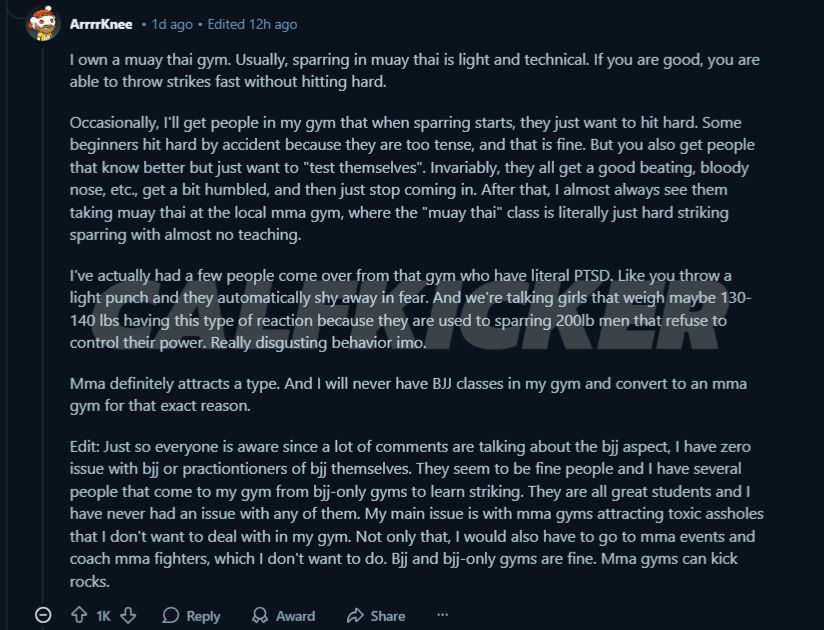
The gym owner described particularly disturbing cases of students transferring from MMA facilities with what resembles PTSD. “Like you throw a light punch and they automatically shy away in fear. And we’re talking girls that weigh maybe 130-140 lbs having this type of reaction because they are used to sparring 200lb men that refuse to control their power.”
This observation highlights a fundamental divide within martial arts culture. Traditional Muay Thai practitioners, for instance, demonstrate remarkable humility and respect—able to compete intensely then immediately embrace their opponents with genuine camaraderie.
The distinction suggests that MMA’s ranking reflects not the sport itself, but rather a subset of practitioners who prioritize aggression and ego over discipline and technique.
The phenomenon extends beyond individual behavior to community culture. Multiple martial arts veterans noted that while they’ve trained since the 1980s, certain high-profile personalities within MMA exemplify the problematic attitudes that tarnish the sport’s reputation. The list of controversial figures suggests a pattern where technical skill doesn’t necessarily correlate with character development.

Interestingly, men surveyed showed some blind spots in predicting female preferences, with an average prediction error of 12%. While they generally understood which hobbies women would find unattractive, they significantly underestimated the degree of negative perception, particularly regarding activities like MMA that can signal concerning attitudes about aggression and masculinity.
The complete list of least attractive hobbies reveals that MMA sits among other pursuits characterized by either compulsive behavior, antagonistic tendencies, or social isolation: manosphere content consumption, excessive online arguing, and similar activities that suggest problematic value systems or lifestyle choices.
In stark contrast, women showed strong preferences for hobbies demonstrating practical skills, cultural engagement, and personal development. Reading topped the attractive list at 95%, followed by learning foreign languages, traveling, and developing artistic abilities—pursuits that suggest curiosity, growth, and outward focus rather than aggression or ego.
The research comes with important caveats about demographic representation. The study skewed heavily toward highly educated, predominantly white women of higher social status, with 45% holding advanced degrees.
These demographic factors likely influence results significantly, suggesting that MMA’s poor showing may vary across different cultural backgrounds and age groups.
The gym owner who refuses to add MMA classes summarized the concern: “Mma definitely attracts a type. And I will never have BJJ classes in my gym and convert to an mma gym for that exact reason.”
