
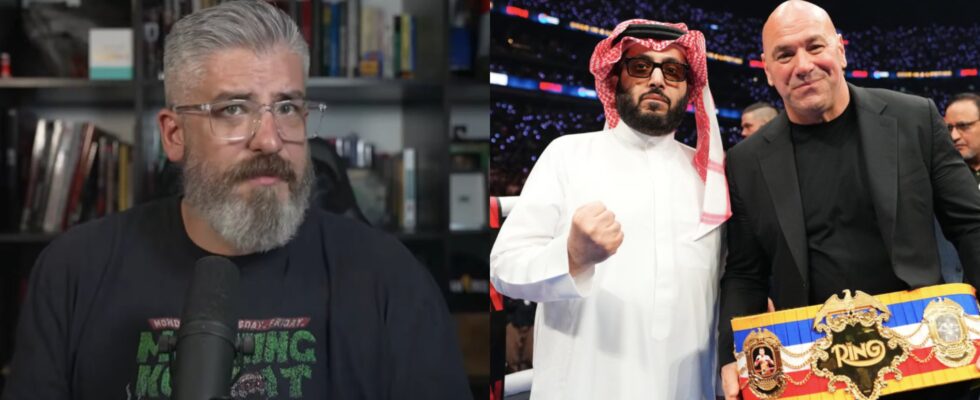
A unanimous Senate vote that many in Washington celebrated as a win for one of sports’ most iconic legacies is drawing sharp criticism from inside the combat sports world, with veteran analyst Luke Thomas calling the legislation a potential power grab dressed up in a legend’s name.
The U.S. Senate passed the Muhammad Ali American Boxing Revival Act by a vote of 100 to zero, sending a revised version of the bill to the House of Representatives. On paper, the legislation carries the weight of reform, promising improved athlete pay, expanded health care access, and a structure designed to bring marquee matchups back to a sport that has struggled for relevance.
But Thomas, who spent twenty years covering combat sports before becoming a prominent voice at CNN, is not buying the pitch.
“I will just tell you, as someone who spent two decades in combat sports, this bill is a disaster,” Thomas said on air.
His central concern points directly at TKO, the parent company of the UFC, and the people behind it. The bill would allow for the creation of Unified Boxing Organizations, or UBOs, entities that could rank athletes, promote events, and sanction bouts all under one roof. That structure mirrors how the UFC operates, and Thomas argues the resemblance is not coincidental.
“It’s basically the people behind TKO, which is the parent company of UFC. These are Trump’s friends, let’s just call them what they are,” Thomas said. “They’re trying to get legislation that would basically allow them to conduct boxing in a similar way in which they conduct business in the UFC, which is to say to have a monopoly, at least open the door to that.”
UFC president Dana White, who has well-documented ties to President Trump, operates Zuffa Boxing alongside Saudi business partner Turki Alalshikh, a recently launched boxing promotion company that analysts note could be converted into a UBO under the new framework.
The World Boxing Council’s president, Mauricio Sulaiman, issued a public warning earlier this year, writing that a “powerful entity” with deep pockets was positioning itself to dominate the sport in pursuit of profit, a concern shared by others who see the bill’s UBO structure as a vehicle for consolidation rather than competition.
The Senate version of the bill does include several athletes-friendly provisions not found in the House’s earlier draft. It caps first-time UBO contracts at three years for atheletes without prior promotional agreements, extends negotiation windows to 90 days before a contract expires rather than the original 30, and guarantees access to training and rehabilitation equipment at reasonable costs near where a boxer lives.
Muhammad Ali’s grandson, Nico Ali Walsh also played a role in shaping the Senate version after objecting to the House’s original draft over insufficient protections. His involvement gave the revised bill additional credibility among stakeholders who might otherwise have opposed it outright.
Still, Thomas sees a troubling gap between the bill’s optics and its likely consequences. He pointed out that the unanimous vote does not necessarily reflect a deep understanding of the legislation among those who cast ballots.
“I don’t think they care,” he said bluntly.
His frustration is aimed particularly at lawmakers who position themselves as advocates for labor.
“There’s a lot of people in Congress who talk a lot about taking care of workers,” Thomas said. “If you vote for this bill, you cannot possibly claim to do that.”
The two chambers now face a narrow window to reconcile the Senate and House versions before early January, when a new Congress is seated and the entire process would need to restart.
Whether the House moves quickly or allows the clock to run out may ultimately determine whether this bill reaches the president’s desk or fades away, taking the debate over who really controls boxing’s future with it.
The Senate has passed legislation – including and especially by Dems – that would help TKO (the UFC’s parent company) monopolize the sport of boxing.
by
u/edoyon2016 in
MMAFightFans
