

Bryan Johnson has already made headlines for timing his nighttime erections, injecting Botox into his manhood, and microdosing Cialis as part of what he calls a “longevity protocol.”
Now the 47-year-old tech entrepreneur and self-appointed human guinea pig has a new data point to report. In a post that has since racked up over 700,000 views on X, Johnson disclosed the results of what he described as the most rigorously documented psilocybin experiment ever conducted on a human subject, that human subject being himself.
The headline finding was straight: “Two doses of magic mushrooms degraded my sp**m count from the 99.6th percentile to the 77.7th.”
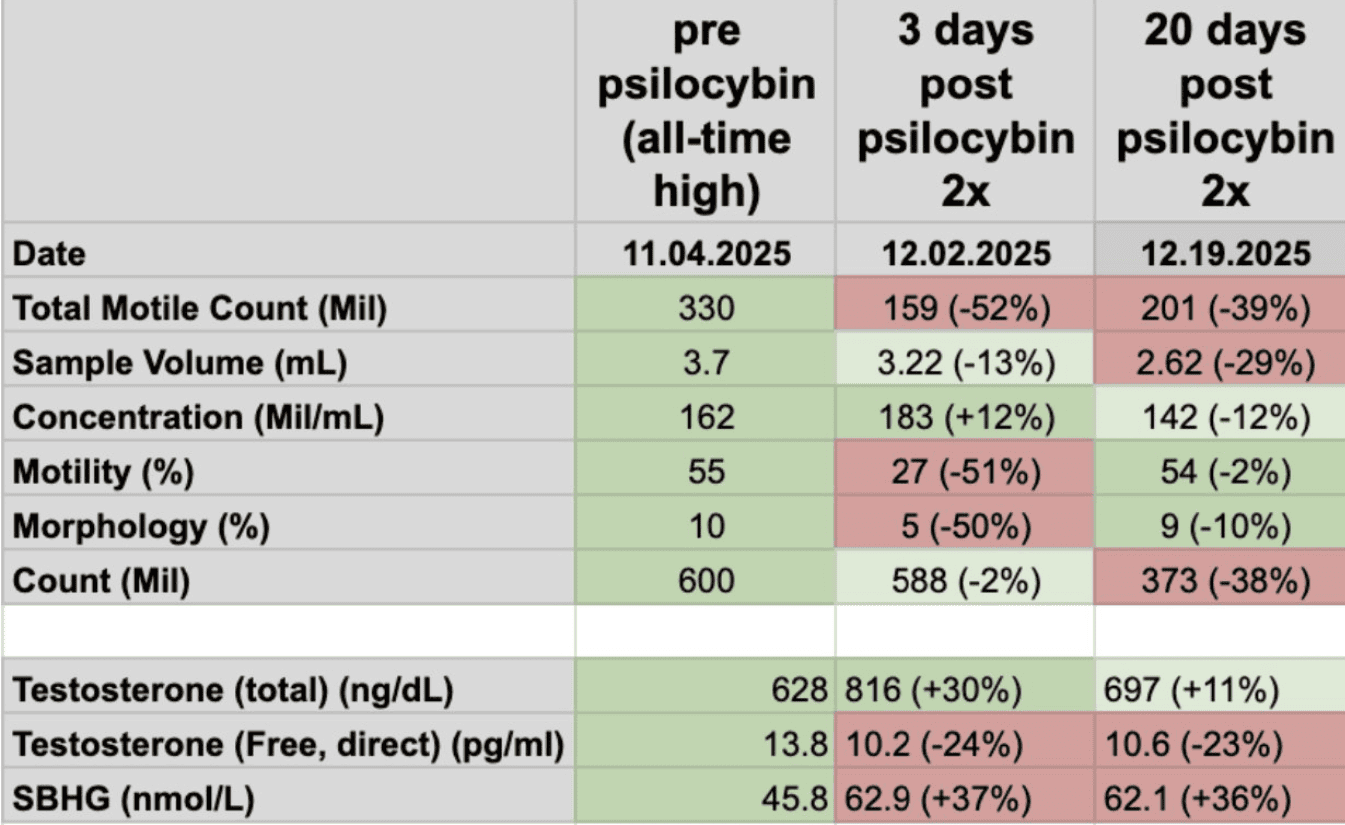
Johnson had been investigating whether psilocybin could serve as a longevity therapy. By his own assessment, the answer appears to be yes, with a notable asterisk attached. The experiment involved two doses, a 25mg first dose followed by a 28mg second dose, and his related markers took a measurable hit at both checkpoints.
Three days after the second dose, the numbers told a stark story. Motility had dropped by 51 percent, total motile count had fallen by 52 percent, and normal morphology had decreased by 50 percent. Total count, by contrast, barely moved, falling just 2 percent. At the 20-day mark, the picture shifted in an unexpected direction.
Motility had largely recovered, landing within 2 percent of his pre-psilocybin baseline. However, total count had now declined by 38 percent, a delayed effect that dragged the total motile count down to 39 percent below baseline despite the motility recovery.
Johnson pointed to a hormonal explanation for part of the disruption. While his total serum testosterone rose by 30 percent in the days following his second dose, his sex hormone-binding globulin (SHBG) surged by 37 percent.
Since SHBG binds to testosterone and reduces how much of it the body can actually use, his free testosterone, the biologically active portion, dropped by 24 percent and 23 percent at the three-day and 20-day marks respectively.
Social media commenters offered their own theories on the mechanism. Biohacker and X user Mitohacker pointed to an earlier observation: “The free testosterone drop is what matters here. SHBG up 37% while total T rose 30%, but his December data showed estradiol tripling after the first session. Elevated estradiol drives hepatic SHBG production, which is the more likely explanation than direct…”
Another commenter, Colby Serpa, suggested the temporary down-regulation of 5-HT2A receptors could be a factor, along with downstream estrogenic effects from other serotonin pathways: “5HT1A can modulate prolactin as well. Likely concurrent variables.”
Johnson himself offered a potential biological mechanism in his post, noting that human sp*rm express multiple serotonin receptors, including 5-HT2A, and that psilocybin binds to that receptor with high affinity.
He acknowledged that while general evidence exists for psychoactive compounds influencing fertility markers via the hypothalamic-pituitary-adrenal axis, there is no published human clinical study specifically linking psilocybin to diminished male fertility. “This is a first-in-human observation,” he wrote.
Not everyone on X was ready to file this under groundbreaking science. User alramina offered a pointed critique: “n=1 self-experimentation posted as ‘first-in-human observation’ is doing an enormous amount of heavy lifting. You went from elite sp*rm count to still-above-average sp*rm count on a two-data-point trendline with zero controls, and the framing implies clinical significance.”
Thomas Carlson echoed the concern about confounding variables: “Unless you live in a bubble there are confounding variables. So many other factors like sun exposure, body temperature, solar EMR, subclinical viral insult, or even an overly aggressive jerkoff session could have played a role in the state of your sp*rm.”
Others were more philosophical about what the data actually meant. User Daedalus asked whether the sp*rm that survived showed superior individual quality, a question Johnson did not address directly.
David Benefield offered a contrarian read: “What if the mushrooms make it so the weaker sp*rm can’t make it through, effectively pruning the less evolutionarily advantageous sp*rm, while making aggregate numbers look less appealing?”
Michael Stan found reason for appreciation in the disclosure itself: “I appreciate the transparency Bryan. Most people don’t publish data that complicates their own narrative. That takes honesty. What I find interesting is the recovery pattern. The fact that motility normalized but total count stayed suppressed at 20 days tells you something.
