
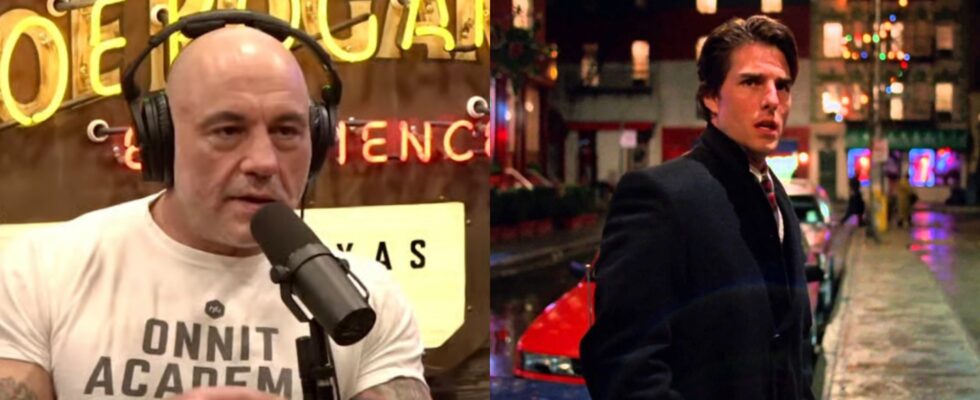
The rumor has followed “Eyes Wide Shut” for more than two decades, gaining fresh momentum after surfacing on Joe Rogan’s podcast: that Stanley Kubrick’s final film was quietly gutted after his passing, its darkest secrets locked away by a studio unwilling to let audiences see what he actually intended. Now the filmmaker’s own daughter has stepped in to lay out, in detail, what she does and doesn’t know.
Released in 1999, “Eyes Wide Shut” starred Tom Cruise and Nicole Kidman as a married couple navigating jealousy, temptation and hidden desire. The film ran 159 minutes, but according to a theory that has circulated for years and found new life on Rogan’s show, Kubrick’s true cut ran 179 minutes, a full 20 minutes longer.
That missing footage, the story goes, revealed the secret society at the center of the film to be a child-s3x ring, with Cruise and Kidman’s characters offering up their daughter. The theory goes further still, tying Kubrick’s d3ath to knowledge he supposedly held about Jeffrey Epstein or a similar network, and claiming Warner Bros. stripped the material out once he was no longer alive to stop them.
Kubrick passed away of a heart attack in his sleep at home on March 7, 1999, just six days after screening a final version of the film for his family and its stars. That timeline sits at the heart of the theory, and it’s also exactly what Vivian Kubrick, his daughter, chose to address head-on.
“You know, this is as good a time as any to finally address the missing 20 minutes from Eyes Wide Shut. It’s a story that has been circulating for many years, so let me tell you what I actually know and don’t know,” she wrote.
Her answer, in short, is that she has never found anything to back the story up. “There has been a lot of speculation that some 20 minutes were removed from Eyes Wide Shut after he di3d. This will be very disappointing to many people, but I certainly did not hear anything about a missing 20 minutes at the time, nor have I heard anything since that would confirm such a section ever existed. I guess you could stop reading right here. But if you’re interested in the details, please read on.”
She was candid about the limits of her own vantage point in those days. Living in Los Angeles at the time and working on a score for another film, she flew to England for her father’s funeral, then had to return almost immediately to finish her contracted work.
“Of course, I was not in a position to know everything that may have happened before or immediately after my father’s d3ath. At the time, I was living in Los Angeles, writing the score for a different movie. I flew to England, utterly traumatized, to be there for the preparations for my father’s funeral and burial. But I had to return to LA the day after his burial, stricken with grief and exhaustion, to complete the score I was contractually obligated to finish, which I barely managed. So I wasn’t there, in more ways than one, for whatever discussions may have followed.”
What she did hear about, she said, was a much smaller and far less dramatic change made for commercial reasons.
“The only alteration I heard about at the time was the use of CGI, computer-generated figures, to obscure some of the nudity in the orgy scene, which Warner Brothers wanted in order to secure an R rating for the film. But I did not hear that any scenes were removed.”
Vivian also walked through where the film stood technically when her father passed.
“When my father di3d, Eyes Wide Shut had reached picture lock and was moving through the final stages of post-production. It had just been shown to the studio heads, I assume with a temporary music track, while the final sound mix and some of the music work were still to be completed.”
She pushed back on the idea that a lost cut could simply be sitting in a digital vault somewhere, explaining how editing worked in that era.
“This was 1999, in the era of physical film distribution. The film was edited on Avid, but that should not be confused with the kind of permanent digital archive people imagine today. The Avid material consisted of standard-definition video transfers made from the rushes, 720 × 576 pixels, and used for editing. They were working copies, not a high-resolution digital preservation of the original negative. There wasn’t a high-resolution digital version of every take sitting on a server somewhere, as people might reasonably imagine today.”
According to Vivian, the physical elements that did exist followed a fairly ordinary path once the picture was finished.
“There were, of course, all the 35mm rush prints, as well as the original camera negative containing the outtakes. Eventually, long after the film was finished and released, the 35mm rush prints and the original negative of outtakes were incinerated. The original master negative of the finished film and the intermediate film elements made from it were, of course, kept in storage.”
She also noted that her father had a longstanding habit that predated this particular controversy entirely, one meant to keep studios from tampering with his work down the line.
“For context, my father always had his outtakes incinerated once a film was finished, specifically to prevent the studio from later re-editing his work or creating alternative versions.”
Once a negative is physically cut to match a locked edit, Vivian explained, there’s no simply putting it back together.
“Once the picture was locked, the original camera negative would have been physically cut to match the final Avid edit. Once the negative itself had been cut, you couldn’t simply undo those cuts and rearrange the film: each cut destroyed a frame at both the head and tail of the scene. The master negative of the finished film was then used to make interpositives, from which internegatives were made, and those internegatives would have been used to make the 35mm theatrical release prints. The original negative of the outtakes never went through that process because, of course, those scenes were not part of the finished film.”
Anticipating the obvious counterargument, that the Avid files themselves might still hold the answer, she addressed it directly.
“Someone might say, ‘But then, if the missing 20-minute edit exists, it would be preserved on the Avid!’ But editing the film on Avid does not mean all of that material was preserved indefinitely. This was not an era in which every piece of editorial media was automatically retained on servers for decades, and I have no knowledge of whether any of the Avid editorial material from the production still exists.”
“That’s a question for the University of the Arts London. They hold the official archive of my father’s surviving papers, production materials and other records, spanning his entire career, including Eyes Wide Shut. But to my knowledge, there is no surviving cache of Avid rushes from the film.”
Still, she was careful not to overstate her own certainty. “So even if 20 minutes had in fact been removed after his d3ath, I seriously doubt we should expect a surviving video or digital copy, unused negative or other obvious physical record of it to be sitting somewhere today. But the absence of such material cuts both ways: it does not prove that those 20 minutes ever existed in the first place.”
Her conclusion was direct. “That is as far as I can honestly go. I never heard of a missing 20 minutes at the time, I have never subsequently seen or been shown any evidence that such a section existed, and I know of no surviving material that establishes that it did.”
She acknowledged one real gap in her account, the roughly day and a half right after her father’s passing, when she simply wasn’t present.
“I cannot tell you what may or may not have happened during the 30-some hours immediately after my father’s d3ath; I was not there. But unless substantive evidence emerges, and I do not regard stories from certain people who, in my opinion, are inventing them after the fact as evidence; people often want to sensationalize their part in a story, if indeed they even had a part, the story that 20 minutes were removed from Eyes Wide Shut after his d3ath remains, to my mind, an actual conspiracy theory, not an established fact.”
And she pointed to her own long involvement in guarding her father’s legacy as the strongest reason she believes she would know if something had truly gone missing.
“Finally, this much I’m certain of: if indeed 20 minutes had been removed, I definitely would have found out about it eventually. Once the fog of agony had lifted, I involved myself very closely in protecting my father’s work and took that responsibility extremely seriously.”
In follow-up posts, Vivian went further, dismissing a specific detail that has floated around alongside the missing-footage claim, the idea that her father had been overheard insisting he wouldn’t alter the film. She called that account a “total fabrication.” She also reiterated her central point once more for clarity: Warner Bros. digitally added material to the orgy sequence “to secure an R rating” but “did not remove scenes from the film.”
Her account lines up closely with what editor Nigel Galt has said publicly about the film’s final days. Galt worked directly with Kubrick through the last stretch of post-production and described a filmmaker who was, by his telling, pleased rather than embattled in his remaining time.
“I can tell you that nothing in the film that happened, and this includes after his d3ath, involved anything that Stanley wasn’t aware of, or wasn’t aware that was going to happen. The difficulty that happened with Stanley’s sudden demise, and this was, remember, three days after I showed the film in New York: shown it to Terry Semel and Bob Daly at Warners and then, same night, showed it to Tom and Nicole, when I got back to London, Stanley was jubilant with the reaction. And we had a long, long-ish conversation, and the only thing that had to be done was mundane editing stuff. We had establishing scenes to put in the film, you know, exterior buildings, and that was it.”
Galt was equally blunt when addressing the theory’s wilder claims.
“There was nothing missing. That cut is Stanley’s cut the day he di3d. And nothing was over-edited. There was no Illuminati. I mean, I don’t know where these things came from, these ideas or concepts, because they’ve always built up around Stanley. It’s just the fact.”
