
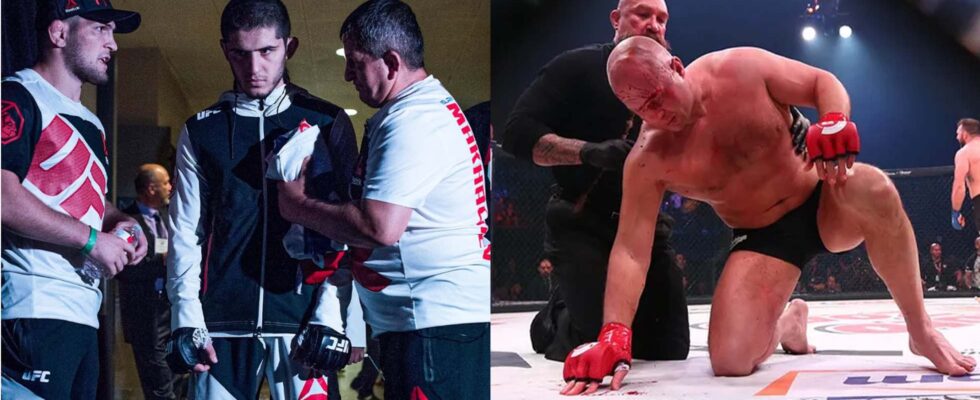
Few voices carry as much weight as that of Abdulmanap Nurmagomedov. Before the highly anticipated match between MMA legend Fedor Emelianenko and American heavyweight Ryan Bader, Nurmagomedov made a bold prediction that raised eyebrows across the combat sports community. He stated unequivocally that Fedor would face significant difficulties in the contest and his foresight proved tragically accurate.
Speaking candidly in an interview prior to the bout, Abdulmanap Nurmagomedov expressed serious concerns about Fedor’s preparedness. “I gave an interview before Fedor’s match where I predicted that this bout would be very difficult for the Russian athlete,” Nurmagomedov recalled in his book. “I said then that he needed to come out at least 70 percent ready compared to the form he was in during his match against Mirko Cro Cop. A minimum of 70 percent condition If less then why even step into the cage?”
This wasn’t casual speculation from a distant observer. Nurmagomedov’s assessment came from decades of experience at the highest levels of combat sports, having trained world champions and understanding intimately what separates victory from defeat at the elite level.
The match unfolded exactly as Nurmagomedov had feared. What fans witnessed that night was not the Fedor of old—the seemingly invincible MMA star who had dominated the heavyweight division for years. Instead, they saw an athlete whose best days were behind him, facing an opponent in his prime. The conclusion was swift and decisive validating every concern Nurmagomedov had voiced.
“What we feared happened for Fedor’s fans,” Nurmagomedov observed afterward.
For Nurmagomedov, Fedor’s loss represented more than just one MMA star’s defeat—it exemplified a universal truth about athletic competition and human ambition.
“I think this was a lesson for all of us—a lesson that even the most decorated professionals must still strive for development without sparing themselves,” he explained. “At any age and under any circumstances.”
This philosophy formed the cornerstone of Nurmagomedov’s coaching methodology. Throughout his career, he demanded that athletes maintain their standards regardless of past achievements. Resting on laurels, in his view, represented the beginning of decline.
“Even if a person is very talented and has all the makings of a future champion—gifted by the Almighty or having inherited certain qualities from parents—this is excellent, but if you don’t add proper training and discipline then everything will go down the wrong path and therein lies the danger,” he stated.
Nurmagomedov had witnessed countless MMA stars with extraordinary natural ability who never reached the heights they should have simply because they lacked the discipline and work ethic necessary for sustained excellence.
Nurmagomedov’s assessment of Fedor’s situation wasn’t personal criticism—it was professional observation rooted in respect for what proper preparation demands.
“If I were preparing Emelianenko for the match against Bader then Fedor would have won,” he stated with characteristic confidence in his book.
“This is guaranteed,” Nurmagomedov emphasized. Sending an unprepared MMA star into competition, regardless of their legacy, violated everything he believed about the sport and the duty owed to athletes.
Abdulmanap Nurmagomedov’s reputation as a demanding trainer was well-earned and proudly maintained. His methods, grounded in Soviet-era sports science and refined through decades of practical application, produced results that spoke for themselves. By 2018, the year he cited as his best in terms of what he had achieved what in combat sports coaching: two world champions in combat sambo, plus four world champions in MMA—with one champion earning their belt and three others successfully defending theirs.
“If he had gone out prepared—or he wouldn’t have crossed the threshold of the octagon at all. This is guaranteed,” Nurmagomedov had said before the match.
The five methods of development and training that Nurmagomedov outlined throughout his career—conviction, personal example, encouragement, demands and compulsion—all pointed toward creating athletes who understood that consistent excellence requires consistent effort. There are no shortcuts, no substitutes for proper preparation and no exceptions made for legendary status.
Fedor Emelianenko went on to lose one more time to Ryan Bader – in his retirement bout in 2023, several years following the passing of Abdulmanap Nurmagomedov.
