
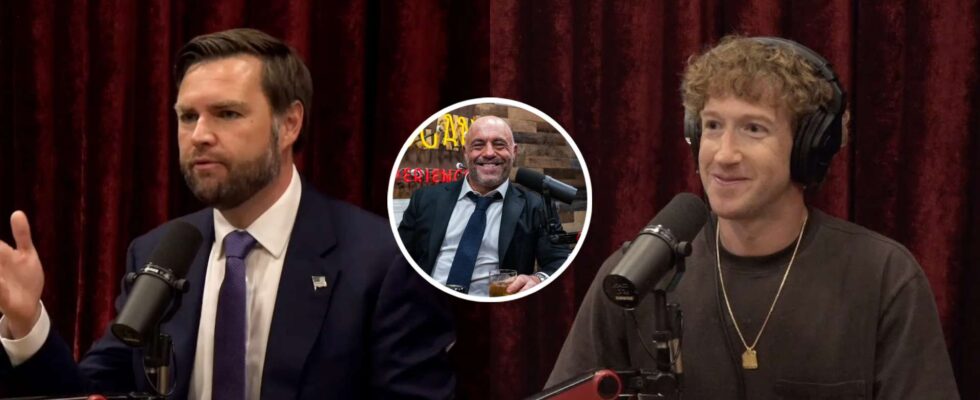
Joe Rogan discussed the standards he wants to apply to guests during an episode of The Joe Rogan Experience featuring Francis Foster and Konstantin Kisin. The conversation focused on misinformation, online incentives, political loyalty, and the responsibility that comes with reaching a large audience.
Guest Konstantin Kisin stated that social media has made it increasingly difficult to establish basic facts.
“You have to really do a lot of research now to even know the basic facts of anything,” he said. “So if you see something on X or Facebook or whatever, I am hesitant to believe it now off the top.”
Rogan agreed, saying, “I read stories all day that I know are fake immediately.”
He argued that fabricated stories can serve political purposes even when they generate no direct financial return. “If the goal is just propaganda then they don’t care about the money,” Rogan said. “What we want to do is mess up up the waters. We want to muddy up the waters so nobody knows what is real.”
The discussion then turned to influencers who rely on provocation. Rogan said outrage has become financially valuable because it drives attention and interaction.
“You could just have a contrarian take that’s preposterous and just gets you angry the moment you read it,” he said. “That’s engagement and that’s what these people want.”
Rogan emphasized that his concern is not disagreement itself, but dishonesty and bad-faith conduct. “I think as long as you’re getting people that are honest, that are good faith conversationalists,” he said, “and I think that is an issue and I don’t want to do anymore.”
He continued: “I don’t want to have on these people that I think are full of [ ], that are propagandists, that are loyal to a party to the point where they’ll just distort facts or obfuscate or talk over you when you’re trying to make points.”
Rogan also drew a distinction between inviting someone on for a meaningful conversation and bringing on a guest solely to create confrontation.
“I’m not interested in talking to people that I think are just outright liars unless I have some obligation to expose them,” he said. “I like to talk to people that I’m interested in talking to.”
Later, he described the broader responsibility of having a large platform. “If you abandon that feeling of responsibility just because you want the outrage clicks,” Rogan said, “it’s like you’re just a part of the problem.”
