
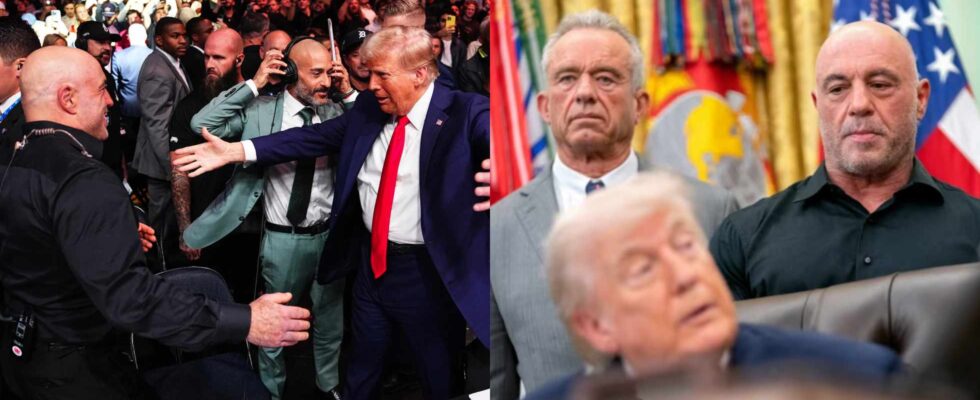
The 2024 presidential race was widely labeled the “podcast election,” a recognition of the enormous reach that figures like Joe Rogan commanded among voters who had largely tuned out traditional media. According to sources, younger men in particular were thought to have responded to long-form conversations on platforms that felt less scripted than cable news or campaign rallies.
Scott Galloway captured the prevailing view when he wrote after that election, “The political power of podcasting is only beginning to be felt.”
Two years later, as the country heads into the 2026 midterms, that prediction appears to have taken an unexpected turn. The same voices that amplified Donald Trump’s message during his successful campaign have grown quieter, more skeptical, or both.
Rogan, whose October 2024 interview with Trump became a cultural moment has spent much of the past year distancing himself from the administration he once appeared to champion.
According to Bloomberg’s Ted Mann, who published an analysis on October 28, Rogan’s importance in 2024 stemmed not only from the size of his audience but also from his connection to a specific group of voters.
“Rogan’s benefit to Trump’s political campaign wasn’t just the size of his audience, but the chord he strikes with a cohort of younger, male voters,” Mann wrote. “Those voters, who helped power Trump’s win, are now souring on the administration, if not disengaging altogether.”
Rogan himself has become one of the administration’s most visible critics within the sphere of influence that helped elect Trump. Throughout 2026, he has repeatedly criticized the president over the decision to launch military action against Iran, a move Rogan argues contradicts Trump’s campaign positioning as an opponent of foreign intervention.
In July he said on his show, “This war is not something anybody that’s conservative wanted. Most people don’t want it, except supporters of Israel. They’re the only people that seem to be thinking it’s a good idea in this country.”
He went further, framing the conflict as a betrayal of the principles Trump had run on. “Most people are horrified by the idea, because Trump was elected, one of the pillars that he stood for, apparently, was that he doesn’t want any more wars,” Rogan said.
The criticism has extended to domestic policy as well. Rogan has repeatedly questioned the operations of Immigration and Customs Enforcement, particularly the rapid recruitment and deployment of agents he described as militarized and unaccountable.
In an October conversation with actor Michael Douglas, who asked whether Rogan regretted his role in elevating Trump, the podcaster acknowledged that some promises had not materialized.
“What Trump stood for, some of it turned out to not be real,” Rogan said. “Like one of them was the ‘No wars.’ Well, look, we’re at war with Iran, so that wasn’t real.”
He credited the administration with progress on border enforcement but criticized the methods used. “It’s nuts to just give someone a $50,000 signing bonus. You train them for seven weeks and then give them guns, and you have a militarized force running through the city streets and put a mask on your face,” Rogan said. “You’re setting a precedent if you allow a militarized police force with no identification, with masks on, to enter into cities; of course, people are going to say this is an overstep. Of course it seems crazy.”
In June, Rogan expressed frustration over the administration’s handling of the Jeffrey Epstein files, portions of which remain redacted. “Well, sometimes it’s like, you just get fed up,” he said. “Like, where are these Epstein files? Who is this? Why is this redacted? Where is it?”
By September, Rogan was openly criticizing Trump’s supporters and reflecting on his own political identity. “Trump supporters are nuts, man,” he said. He elaborated: “I have very left-wing views on a lot of things. I also recognize when government is taking over our lives. And what we were sold with the Trump administration would be that it would drain the swamp. Obviously, it’s not been ideal in that regard.”
Despite the criticisms, Rogan’s relationship with the administration has not been entirely severed. He appeared alongside Trump at the White House in April when the president signed an executive order promoting research into ibogaine, something Rogan has advocated for.
He also attended the UFC event held on the White House lawn in June for Trump’s 80th birthday, though he had previously criticized the decision to stage the event outdoors.
“I would have never wanted to do it, I would have said we can’t do it, they have to be in a controlled environment,” Rogan said. “We can’t have somebody win or lose because they’re outside and it’s muggy.”
Rogan has not used his platform to promote vulnerable Republican candidates ahead of the midterms. Instead, his 2025 interview with Democratic candidate James Talarico continues to circulate online. Other podcasters who were outspoken during the 2024 cycle have similarly retreated from the political spotlight, reflecting what observers describe as disappointment with the administration and pessimism about Republican prospects.
Mark Halperin, speaking on his show 2WAY, questioned why Trump and Vice President JD Vance have not appeared on major podcasts during the current cycle.
“Why aren’t the president and the vice president on Rogan? Why aren’t they on Andrew Schulz? Maybe because they don’t think the atmosphere would be favorable, as it was two years ago,” Halperin said.
Meanwhile, left-leaning podcasts have shown greater energy during the 2026 cycle, though no single appearance has generated the level of attention that Trump’s visit to Rogan’s show commanded in 2024. Dan Pfeiffer, co-host of Pod Save America, noted that statewide races require different approaches from presidential campaigns.
“Candidates running statewide are going to have different attention strategies than presidential candidates,” Pfeiffer said. “Your target voters in the midterms have different news diets than those in a presidential.”
Most Democratic Senate candidates in battleground states have appeared on Pod Save America this year, some multiple times. Gubernatorial candidates have also made frequent appearances. Michigan Democratic candidate Abdul El-Sayed appeared on Pod Save America,
Ezra Klein observed that media attention and polling performance appear disconnected during the current cycle. “There is almost no connection between who the candidates are who are everywhere, on social media and my feeds, and who are the candidates who are doing particularly well or poorly, at least in polls,” Klein said.
The shift shows an evolution in the role of podcasts within the political media environment. Major shows now distribute content across audio and video platforms, with clips circulating widely on Instagram and other social networks. The line between podcasts and traditional media has blurred, making it harder to isolate their influence.
As voters prepare to cast their ballots on November 3, the effectiveness of different media strategies will become clearer. What remains evident is that the political landscape that powered Trump’s 2024 victory has shifted, and the voices that once amplified his message are no longer speaking in unison.
