
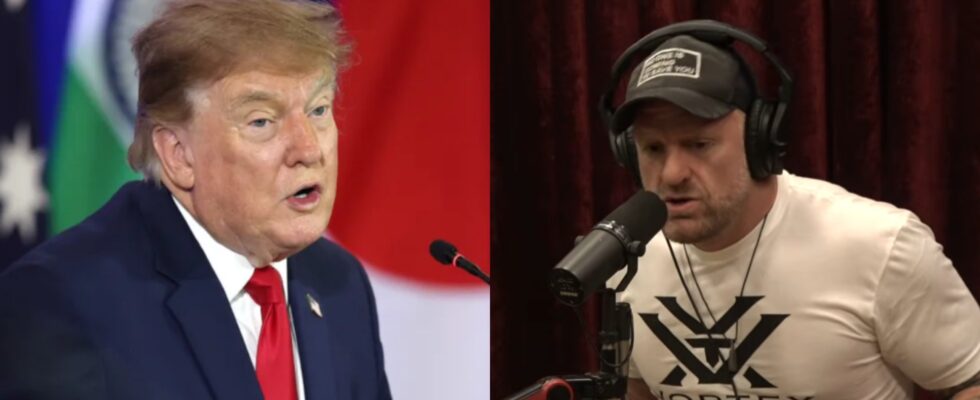
Former Army Ranger Greg Anderson has criticized the Trump administration’s handling of the conflict in Iran, questioning the circumstances surrounding a strike that reportedly hit an Iranian school and raising broader concerns about American military intervention overseas.
Anderson, who completed 14 deployments during his military career shared his views during a recent appearance on The Joe Rogan Experience. Speaking with Rogan, the former soldier questioned the justification behind military operations in the region and challenged the way civilian casualties are discussed.
Discussing the reported school strike and the wider military campaign, Anderson questioned claims about the targets of American and Israeli military operations.
“If they’re blowing up all of these houses, what do they keep saying? It’s Hamas. We’re blowing up Hamas. We’re ending Hamas. I’ve spent enough time in warfare. You know what you find when you’re ending bad guys? Bad guys on the streets. They have chess rigs on and [arms] and they’re DRT. Do we see any of those pictures coming out of Gaza?” Anderson asked.
Rogan raised questions about how the school strike happened, suggesting that investigators needed to establish whether it was the result of faulty targeting or something more deliberate.
He asked, “What was that a strike that was conducted by AI? That’s a question. So, was that bad coordinates or… The darkest thought is that it was on purpose because it was the children of the people that were the head of the IRC.”
The former Army Ranger also brought up the 1988 destruction of Iran Air Flight 655, when a US Navy guided-missile cruiser attacked an Iranian civilian passenger aircraft over the Persian Gulf, ending all 290 people aboard.
Anderson questioned the explanations offered by American officials following the incident.
He noted, “US Navy shot down an Iranian civilian airliner. They said, ‘Oh, well, it went off its pre-programmed flight path, so we considered it a threat.’ And then all that stuff, I mean, you can look right at the radar, the flight path, everything. They’re like, ‘Actually, it didn’t deviate at all. What are you talking about?’ Oh, well, we deemed it a threat, so we attacked it out of the sky.”
He pointed out that the aircraft was travelling from Iran to Dubai and carrying families, including 66 children.
Anderson then recalled a statement attributed to former President George H.W. Bush following the incident.
“You know what Bush Senior said? This is public. You can look all this up. Bush Senior said, ‘Mistake or not, Americans don’t apologize to Iranians,'” Anderson recalled.
Anderson’s criticism extended beyond the individual strike, with the veteran questioning the broader reasoning behind American military interventions.
He argued that the justification for confronting Iran closely resembled the rhetoric used before the invasion of Iraq, particularly claims about preventing hostile governments from acquiring weapons of mass destruction.
“The same playbook for what they said about Saddam is basically verbatim what they’re saying about Iran. We can’t let them have weapons. We can’t let them have weapons of mass destruction,” he noted.
Reflecting on his own experiences during deployments in Iraq, Anderson offered a particularly blunt assessment of American foreign policy.
“I have arrived at a point where I truly believe the US government is the worldwide terrorist. I just really truly believe that,” he stated.
He also recalled an assignment in Ramadi, where his unit was responsible for protecting a State Department diplomat tasked with helping establish a new provincial government.
“We were charged with the security of a State Department diplomat. And that State Department diplomat’s job was to teach the new US appointed governor of the Anbar province how to be a governor and rule in a style of a western democracy. Are you kidding me?”
Anderson also discussed how years of military deployments have shaped the perspectives of veterans, particularly those who served in special operations. He suggested that frustration with prolonged military involvement overseas was widespread within the veterans community.
“That’s why the Republicans lost the midterms. I’m immersed in the veterans community. All the special operations guys that I know are tired of war.”
He then reflected on the amount of his life spent serving in the military and the perspective he gained from those experiences.
“I was deployed from 21 to 29. That’s a big chunk of my life that I dedicated to it. Now, I don’t have like a sob story or any of that because I mean, life happens, right? It is what it is. But I can also look back and be honest with what that experience was and then critique it.”
Anderson made it clear that his military background had not made him less willing to question the decisions made by the government. Instead, he believes his experiences have given him a different perspective on the human cost of warfare.
Towards the end of the discussion, Anderson took aim at the casual way civilian deaths are sometimes dismissed as an unavoidable part of military operations.
He argued that people who have never experienced combat often underestimate what collateral damage actually means for those caught in the middle of a conflict.
“Us as Americans should have a problem with that. I’m so sick of people saying like collateral damage is part of war. It’s like you got your MAGA hat on, you’re fat, you’re sitting on the couch. What do you know about warfare? What do you know about collateral damage? Have you ever looked at casualties like this? Because I have. And it should affect you as a human being. And if it doesn’t, there’s something wrong with you.”
