
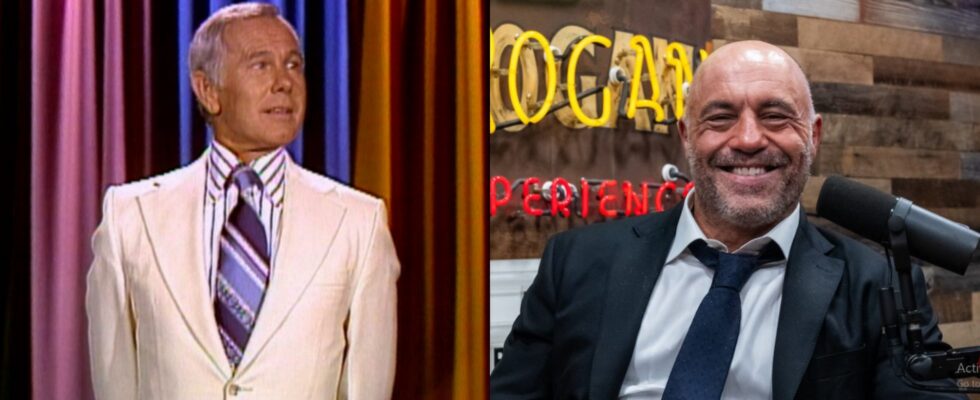
Twelve years after walking away from The Tonight Show, Jay Leno is not watching late-night television so much as watching it from a distance, with the calm detachment of someone who saw the wave break before anyone else noticed the tide going out.
The 76-year-old comedian, now hosting Jay Leno’s Garage on YouTube, has plenty of opinions about what went wrong with the format he helped define for more than two decades. But his most provocative take has nothing to do with network television at all.
“Podcasts really are the new talk shows,” Leno stated in an interview. “Joe Rogan is the new Johnny Carson.”
It is the kind of statement designed to land with a thud in certain living rooms. Rogan, the UFC commentator and host of The Joe Rogan Experience, occupies a very different cultural space than the patrician Carson, whose Tonight Show defined American late-night for 30 years.
But Leno’s logic is hard to dismiss.
“Joe talks to everybody about everything,” he said. “There’s no FCC to step in and say what you can and can’t say, so you really do get an unfiltered idea of what everybody thinks.”
For Leno, that freedom is the whole point. The structural collapse of traditional late-night, he argues, was not about talent or politics or even the internet. It was about commercials.
“Too many commercials” is how he puts it, bluntly. He recalls that rule changes in the mid-1980s allowed networks to quietly expand ad time after 11:30 p.m., and by the time he left The Tonight Show in 2014, what had once been 48 minutes of programming had shrunk to around 42, fragmented by more frequent breaks.
“When I turn on late-night now, regardless of how I’m watching, if I see Jake from State Farm again, I’m gonna sh0ot myself in the f*cking head,” he said. “The host comes out, does the monologue, then it’s right away over to six minutes of commercials. You come back, the host talks about who’s coming up, ‘We’ll be right back.’ All cut up. Enough already.”
The contrast with what broadcasting and YouTube now offer is, to Leno, self-evident.
“Why watch that when I can switch over to broadcasting or YouTube and watch an hour with Harrison Ford talking off the top of his head, as opposed to just having a few minutes with the guest?” he said. “Johnny used to have real conversations. I tried to have real conversations. That seems to be gone, and the audience knows it.”
The deeper issue, though, is not just ad load. It is the disappearance of appointment television as a cultural ritual. There was a time when you had to be in front of your set at 11:30 p.m. to find out what Letterman or Carson thought about the day’s headlines. That shared, simultaneous experience created urgency.
Now, with everything available on demand, that urgency is gone. “People used to say, ‘Oh, let’s see what David Letterman or whoever had to say about the president’s thing today,’ and you and the whole world simultaneously at 11:30 knew what they thought,” Leno said. “Now you can look it up anytime, and whenever you watch it, if you miss it, that’s OK.”
Young people, he notes, have no real relationship with the broadcast networks at all.
He said, “They don’t know CBS, NBC or ABC, Channel Four; they know Channel 682 or whatever. They just go to YouTube. Which is amazing. If you had predicted YouTube would be the most popular channel in the world 10 years ago, I think people would have said, ‘What are you talking about?’ But it is now.”
Leno is speaking from experience. After Jay Leno’s Garage left CNBC in 2023, the show moved entirely to his own YouTube channel, and he has embraced the format with the pragmatism of someone who has been negotiating his own contracts for decades without an agent or manager.
He describes saving $30 million in commissions after his agency dropped him just before he landed The Tonight Show in 1992, and he still handles his own deals today.
“The nice thing about doing your own negotiations,” he said, “you find out exactly how people feel.”
