
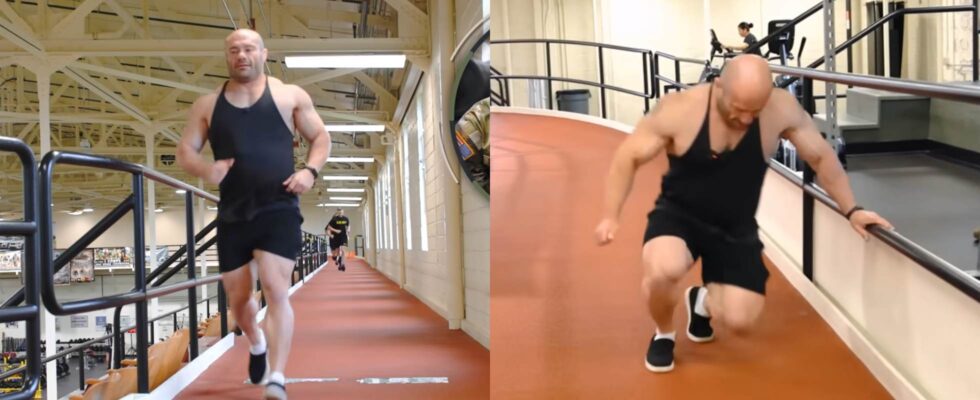
When fitness influencer Eric Bugenhagen caught a video of renowned bodybuilding scientist Dr. Mike Israetel attempting an Army fitness test, he had a lot to say.
Specifically, the two-mile run portion of the test became the catalyst for what Bugenhagen called a life-changing message about conditioning, mindset, and what it really means to train hard.
Dr. Mike showed up to the fitness test wearing ladies slip-on shoes from Target, which Bugenhagen compared to showing up to a baseball game without cleats. But the footwear was only the beginning.
When it came to the two-mile run, with a minimum passing standard of 20 minutes and 44 seconds, Dr. Mike barely made it through two-thirds of a mile before stopping entirely. He was not even visibly out of breath. He simply quit.
Bugenhagen, who recently came off patellar tendon surgery and a series of other injuries including a pulled groin and a bicep tendon issue, ran a full mile himself for the first time in years and clocked in at 8 minutes and 34 seconds with essentially no running training at all.
His point was direct: “If you can’t run a mile, that is 100% symbolic that you can’t push yourself.”
The message Bugenhagen delivered was aimed squarely at the bodybuilding community’s long-standing fear of cardio. The idea that running a single mile will melt away hard-earned muscle, he argued, is not just wrong but embarrassing.
“If you’re concerned you’re gonna lose too much size running a mile, your body is screaming to lose that size,” he said.
Bugenhagen drew a comparison between running a hard mile and the legendary Tom Platz leg set, noting that the intensity and duration are surprisingly comparable. He urged lifters to consider sprinkling short 30-second to one-minute sprints between their regular sets, pointing out that it would not cost them any muscle and would instead sharpen work capacity and insulin sensitivity.
He also noted that Arnold Schwarzenegger used to run to the gym and to the beach as part of his conditioning for bodybuilding competitions, something today’s athletes rarely consider. The modern trend of slow, leisurely walks as the only cardio, Bugenhagen said, misses the point entirely.
For Dr. Mike, a man who regularly advocates for intelligent, science-based training, being unable to complete two-thirds of a mile in an organized fitness test raises a real question about what hard training actually means.
Bugenhagen made clear this was not about mocking Dr. Mike personally. Rather, it was a mirror held up to an entire culture that celebrates loading a barbell while treating a simple mile run as something to fear.
“If you can’t run a mile,” Bugenhagen concluded, “you have no room to preach about hard training.”
