
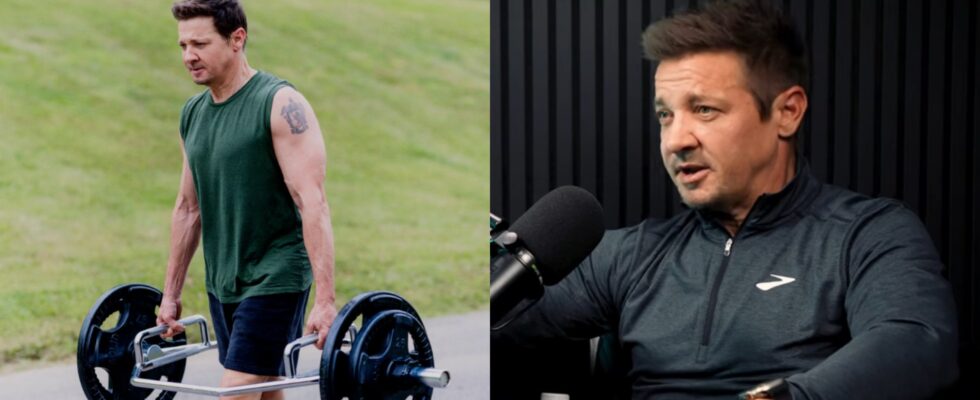
In a conversation with Chris Williamson on the Modern Wisdom podcast, Hollywood actor Jeremy Renner opened up about the hormone therapy and peptide protocols he adopted following his near-fatal snowcat accident in January 2023.
Renner revealed that his testosterone levels had dropped significantly during recovery, which led to medical intervention.
“I had to do hormone replacement stuff because my testosterone was at 200,” he said. “I had to get that up because I was going to get some energy. So then I get in the gym instead of falling asleep in the gym.”
He continued, “That helped getting regulating that because again I’m 54 and at that time, you know, I didn’t, no one tells you how to get old, but I guess my testosterone was super low and that affects a lot of things in your body. Especially your energy.”
When asked directly about the peptides he uses, Renner listed several ones he incorporates into his routine.
“Thymosin Alpha, Thymosin Beta, BPC, BPC-157, Mots-c,” he said. “And there’s TB-500. There’s, guys, just a long, long list of stuff.”
Rather than using everything continuously, Renner explained that he cycles these in phases.
“There’s a whole list of different peptides and I rotate them in and out,” he said. “It’s not like I do them all the time. I just kind of rotate them just like supplements. I do the same thing with supplements. I rotate them in and out of my life.”
He stated, “It’ll go for a stretch of two months or three months on, three months off, or that kind of thing, you know, just to get your body to regulate, challenge it, let it sort of produce its own HGH, its own testosterone, all those type of things. Really, really great to work on your body from a cellular level.”
He also discussed his daily use of NAD, describing both the method of administration and its effects.
“I do that every day,” he said. “Subq. Yeah, subq and also IM. And I don’t do it through the IV because it just takes too long to go through that, you know. It’s not nice.”
Renner acknowledged that the experience isn’t entirely comfortable, especially at the injection site.
“I also feel like the light version of it in the… can do your stomach,” he said. “Oh gosh. But it’s only for 10 seconds. It’s nice once it goes.”
He framed his use of peptides and hormone therapy as part of a broader recovery philosophy, one that avoids long-term reliance on pharmaceutical pain management.
“I certainly don’t take pills,” he said. “I do injections of peptides, amino acids, vitamins. Maybe I try some natural anti-inflammatories, things like that. I think everybody’s got to deal with inflammation.”
Renner continued, “I think there’s a lot of great science that’s coming out. I get a lot of access to people that have been dealing with it for a long time and also been doing it for a long time. But none of that matters. What matters is what your body says. I listen to my body.”
Finally, Renner made it clear that this approach isn’t temporary, it’s now a core part of his lifestyle.
“My garage is filled with workout equipment, hyperbaric chamber, my red light, all these things,” he said. “My fridge. I brought a sack with my peptides and things. I’m committed to my health and my wellness. It is a central part of my being and it has to be and I like it and I love it and I want it to be.”
