
Aljamain Sterling has a simple question for California State Athletic Commission Executive Director Andy Foster: if minimum pay protections are worth advocating for in boxing, why aren’t they worth advocating for in MMA?
The former UFC bantamweight champion raised the issue after reposting a clip of Foster discussing the revival of the Muhammad Ali Boxing Reform Act, which is currently making its way through the Senate.
“Here’s my concern with this,” Sterling wrote. “If this is the case and his stance on minimum pay for those guys making a few hundred bucks, then why are we not also trying to do that in MMA? It’s literally the same thing.”
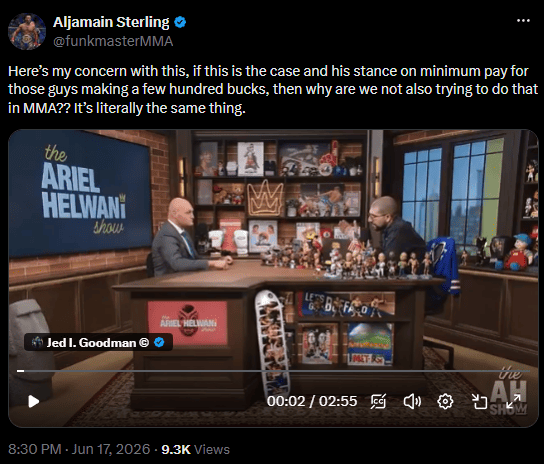
It’s a fair challenge to direct at Foster, who has become one of the most outspoken commission officials supporting the legislation.
Speaking with Ariel Helwani, Foster made no effort to hide his optimism about the bill.
“I think it’s a good bill. I think it gives athletes choice. I think it’s going to pass,” Foster said.
He acknowledged that the Senate has had a full agenda, which may have slowed the process.
“I’m not trying to speak probably above my authority level or my experience level, but they’re busy,” Foster explained. “I don’t think boxing’s at the top of their plate right this second. But I think they’re going to get to it and I think it’s going to pass.”
For Foster, the most important aspect of the legislation is not the sanctioning-body reforms that have attracted much of the attention. Instead, he pointed to the proposed minimum purse protections for lower-level athletes.
“In this country we have a lot of these dollar contracts happening. A lot of them,” Foster said. “And that’s not good for anybody. That’s bad for boxing.”
Under the proposal, boxers would earn a minimum of $200 per round. That means a boxer competing in a four-round preliminary bout would make at least $800, with medical insurance provided on top of that amount.
“That’s the first time that anybody’s actually put in some kind of minimum wage type thing for boxing,” Foster noted.
He also rejected the notion that the bill would create an excessive concentration of power within the sport.
“To act like this is going to be a takeover or whatever of the sport, I don’t see that happening,” Foster said. “I think the sanctioning bodies are going to be fine.”
In fact, he suggested the legislation could encourage a healthier consolidation among sanctioning organizations, making championship titles more meaningful and credible.
When Helwani asked whether similar protections could eventually apply to MMA stars, Foster pointed to existing regulations in California and several other states where boxing and mixed martial arts are governed under the same framework.
“When you see $200 minimum for boxing, it’ll apply to mixed martial arts as well,” Foster said. “And I think you’re going to see that happen all across the country, which will bring up the lower-income athletes.”
That response, however, appears to be exactly what Sterling takes issue with.
Tying MMA minimum pay standards to boxing legislation as a secondary consequence is very different from actively pushing for reforms specifically aimed at MMA athletes.
Sterling’s criticism highlights what he sees as an inconsistency: a commission official passionately advocating for athlete protections in one combat sport while remaining relatively passive on similar issues in another sport that now generates significantly more revenue and global attention.
