
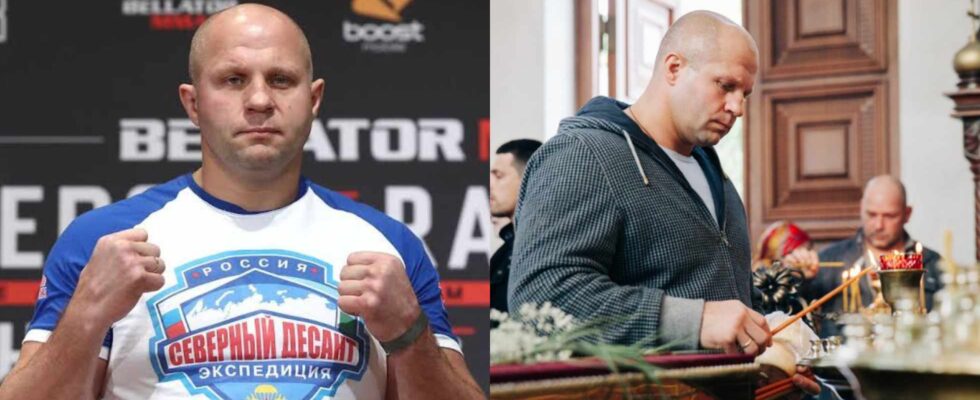
Fedor Emelianenko opened up about the experiences that shaped him both as an athlete and as a person during an interview with Ushatayka.
The Russian heavyweight legend reflected on his early sambo career, the demanding training environment that helped forge him into one of the greatest heavyweights in MMA history, and the profound influence of his Orthodox Christian faith.
Discussing his formative years, Emelianenko recalled training alongside Dagestani athletes and acknowledged how difficult it could be being one of the few Orthodox Christians in that environment.
“It was hard for me. I was one of the few Orthodox Christians among the Dagestani guys, and I had to survive in that environment.”
Despite those challenges, Fedor credited the environment and his training partners with helping develop the toughness that eventually became a defining characteristic of his combat career.
Much of the conversation centered on Vladimir Voronov, who began coaching Emelianenko when he was still in his early teens and remained an important figure throughout his career.
Fedor remembered his coach as an extremely disciplined figure, particularly when it came to training. Morning sessions began at exactly 6:30 a.m., and there was little room for excuses.
Voronov initially had doubts about Emelianenko’s decision to transition into fig hting, but those doubts eventually disappeared as the heavyweight began achieving success.
The interview also provided a rare glimpse into the spiritual side of Emelianenko, who spoke extensively about his Orthodox Christian faith.
Fedor discussed his admiration for Pyotr Mamonov, the musician who later became known for his deep Orthodox faith. Emelianenko described Mamonov as an example of how dramatically a person’s life can change through religion.
“I follow Pyotr Mamonov very closely. I believe that everything he said reflected a man with a high level of spiritual life. Look at who he was and who he became. I would call him a modern saint.”
Emelianenko explained that Mamonov’s transformation resonated with him because of the musician’s difficult past.
“That’s because he, well, let’s say, he went through all the circles of h*ll. And when the Lord touched him, when he came to God, he became a different person.”
Fedor also spoke about his practice of reading the lives of Orthodox saints, describing the experience as something much more personal than simply studying historical religious figures.
“There’s an expression that when you read the life of a saint, you get to know him, and he introduces you, well, he already knows you, of course, but he introduces you, as if this meeting with you is taking place, and he prays for you before the Lord.”
[Editor’s Note: Quotes have been translated and edited for better clarity and readability.]
