

The intersection of transgender athletes and American politics has become one of the most potent wedge issues in recent elections, with campaigns spending unprecedented amounts on advertising despite a surprising gap between perception and reality.
In a comprehensive bipartisan poll conducted by Pablo Torre Finds Out and The Bulwark in partnership with YouGov, surveying 1,417 American adults, the data reveals how successfully conservative campaigns have weaponized this issue, even as the actual number of transgender athletes competing has effectively reached zero.
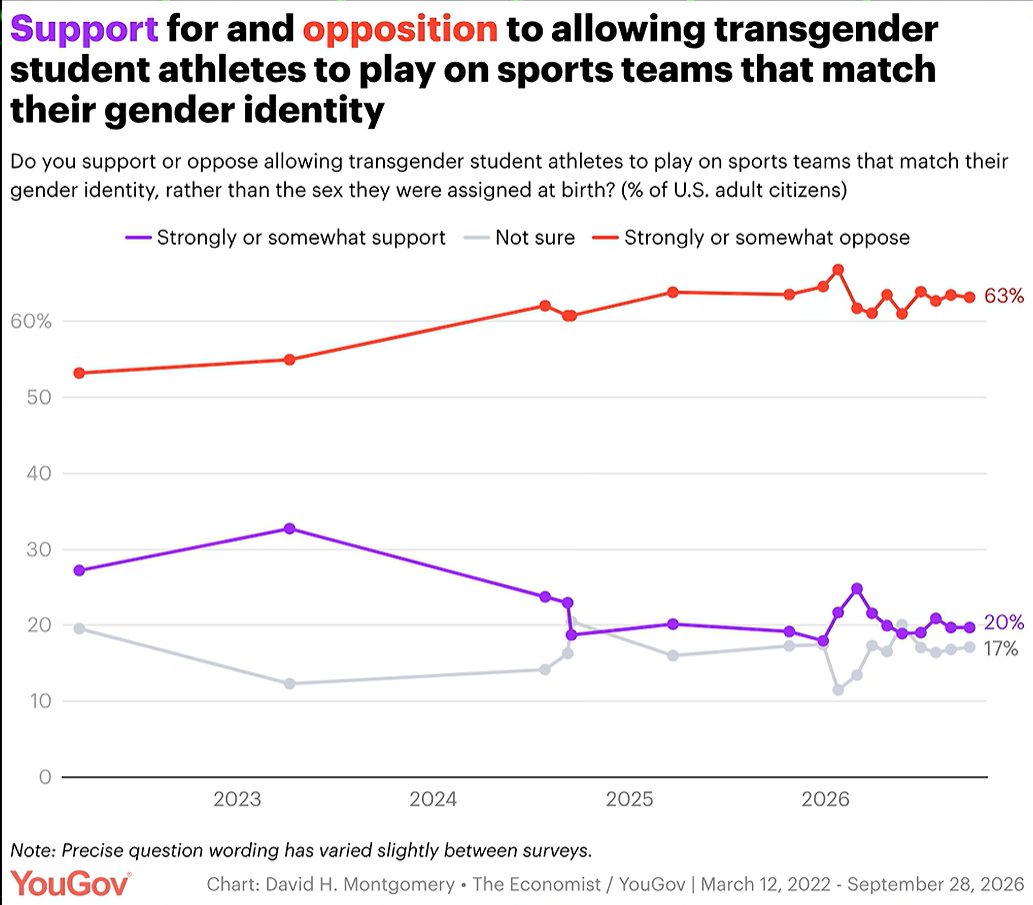
When asked whether they support or oppose allowing transgender student athletes to play on sports teams matching their gender identity rather than their birth-assigned gender, the results were decisive: 51% strongly oppose, 11% somewhat oppose, 11% somewhat support, and 12% strongly support. That’s 62% total opposition, validating exactly why Republicans continue running this playbook.
“They see it as a winning issue and they’re right,” said Tim Miller, former Republican operative and co-host of The Bulwark podcast. The issue has proven so politically effective that even Democratic candidates in red states have begun adopting anti-trans athlete positions.
YouGov senior data journalist David Montgomery noted the trend has intensified since 2022. “Back in 2022, about 50% opposed and 30% support. And now overall, it’s more like a 60/20 issue.”
While Republican opposition remained consistently high with little room to move, independents have shifted dramatically, falling from moderately opposed to strongly opposed by approximately 20 percentage points.
Perhaps most striking is the chasm between American perceptions and actual reality. When asked what percentage of NCAA athletes identify as transgender, a combined 15% of respondents believed more than 5% of college athletes are transgender. With over half a million NCAA athletes competing, this translates to Americans believing approximately 27,500 transgender student athletes exist.
The actual number, according to NCAA President Charlie Baker’s 2024 testimony before the Senate Judiciary Committee? “Less than 10.”
Following recent policy changes aligned with the current administration’s executive orders, the NCAA spokesperson confirmed that the number of student athletes currently competing in women’s sports who identify as transgender is now “effectively zero.” Only 3% of poll respondents chose this accurate answer.
“Think about how much money this cycle will have gone to ads about trans sports in all these races,” Sam Stein, managing editor of The Bulwark and former White House correspondent observed. “We’re talking like what? Tens, maybe hundreds of millions spent litigating an issue that doesn’t exist anymore.”
The polling reveals the paradox at the heart of this political strategy. The entire messaging framework depends on victimhood and loss.
“The entire theory actually of this political position is we are losing. We are losing our scholarships, we’re losing our girls to these boogeyman. We are targets,” Torre explained. “And if the targeted people actually is a blowout win for you, well, then that’s not as animating from a turnout or a culture politics perspective.”
Yet campaigns continue pouring resources into the issue precisely because it works with voters, regardless of whether the problem they’re addressing exists. Miller noted an emerging countertrend in states like Texas, where even conservative voters are beginning to question the constant focus.
“There’s this viral post going around from a conservative poster on Reddit talking about how my kid didn’t even know what transgender was until you started playing this ad constantly during commercials.”
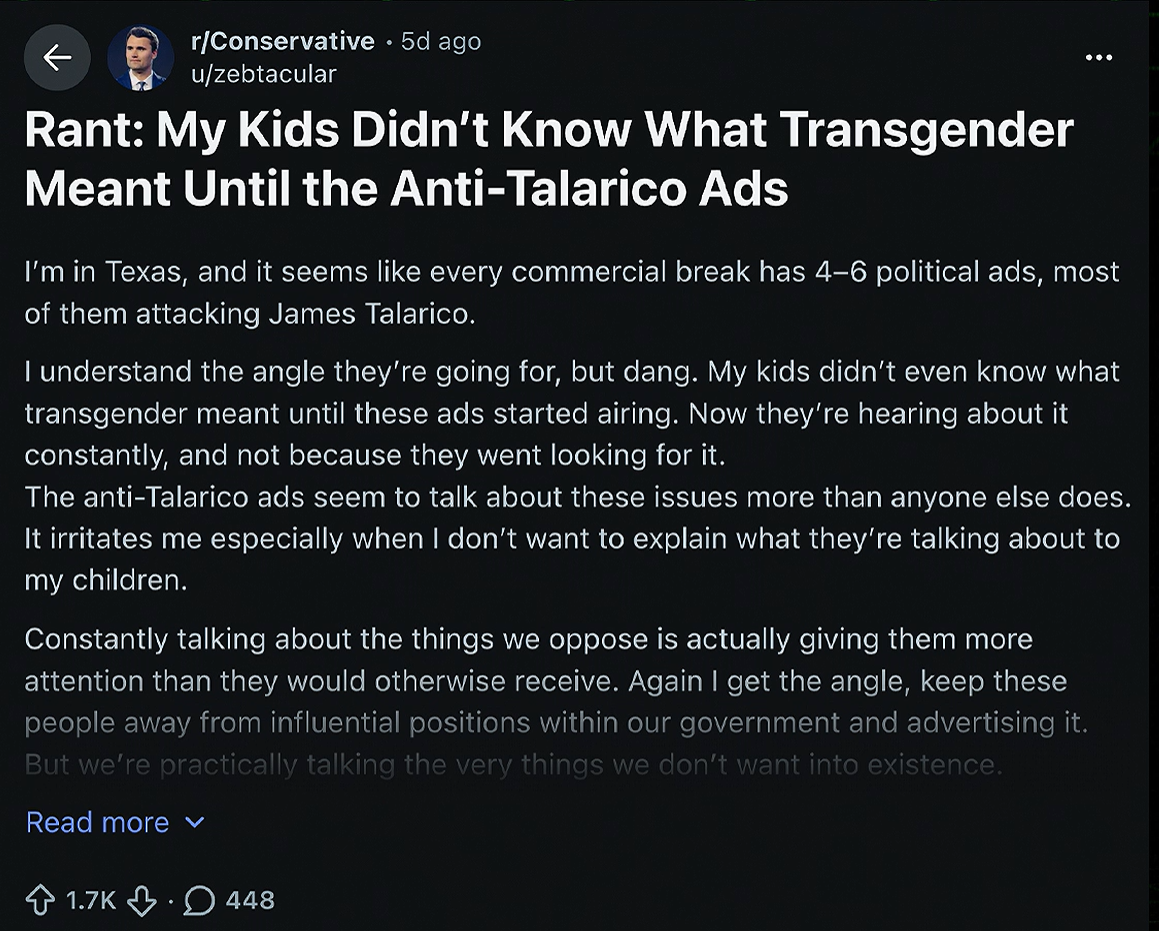
Tim Miller characterized it bluntly: “It also just shows what the purpose of this was totally, which is to win the culture war, to advance political power. This was a W for them. They started this culture war and the results of it is there aren’t any transgender athletes in women’s sports. They’re spending more money on ads on this topic this cycle than in 2024.”
The poll demonstrates that while the political messaging succeeds in shaping attitudes, Americans remain skeptical of obvious trolling attempts. When asked about former NBA player Enes Kanter Freedom’s declaration of eligibility for the WNBA as a protest against transgender inclusion policies, 47% disapproved compared to only 30% who approved. Even among a sample where more than 60% oppose trans athlete inclusion, the stunt fell flat.
“Imagine how pathetic your gambit has to be to take a sample of people where there is plus 60% agree with you on the merits of the issue and then you engage in a troll to appeal to those people and they look at you and you seem so pathetic and annoying that by a 17% margin the people who agree with you on the issue say that your gambit is unnecessary and you should go away,” Torre noted.
The research ultimately exposes how political campaigns have successfully manufactured concern over a statistically negligible phenomenon, transforming it into a defining cultural battleground despite mounting evidence that the issue itself has been resolved through policy changes.
