
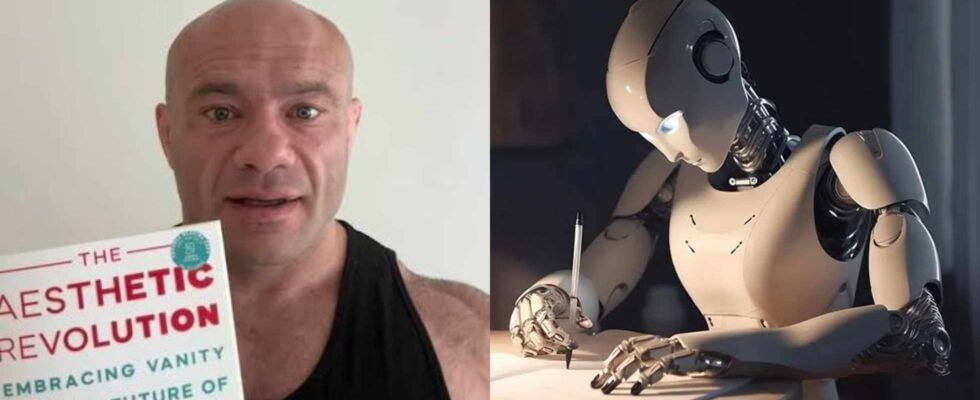
Dr. Mike Israetel recently addressed the controversy surrounding his use of artificial intelligence in writing his latest book. During an appearance on The Iced Coffee Hour podcast, Israetel spoke candidly about the backlash he received and defended his decision to incorporate AI technology into his creative process.
When asked directly about criticism that his book appeared to contain AI-generated content, Israetel didn’t hesitate.
“It’s totally true,” he confirmed. “As a matter of fact, I posted on X in detail about what was true about it way before the book was published.”
Israetel explained his specific methodology, revealing that he used a now-deprecated model called GPT 4.5 for what he described as “smoothing of prose.” His process involved writing his own content first, then using the AI tool to refine the language.
“What I would do is write my prose and be like I don’t know about this. Can you reword this in a way that sounds to me like it would have more of the following emotive features,” he said. “And it would do a great job and I’d be like this sentence I don’t love this I’m keeping. This is great. And it was a collaborative effort.”
He emphasized that while AI assisted with verbal refinement, the intellectual content remained his own.
“Every idea in that book is my own and I used AI for like what I would call like verbal smoothing unbelievably unapologetically,” Israetel stated.
The fitness expert addressed concerns that he might be misleading readers by taking credit for AI-generated work. He pointed to his extensive body of work that predates AI technology entirely.
“I have a little ace in the hole. I have a bunch of my work videos and tons of books and tons of interviews and textbook chapters and all this other stuff that precedes the birth of AI whatsoever,” he explained. “So if somebody is to accuse me of like not having my own original ideas, things like AI is trained on a bunch of my original ideas.”
Israetel also revealed that he used AI-generated images in the book, specifically mentioning Gemini’s model for illustrations. When the hosts brought up reports that some images contained errors, such as a woman with four arms, Israetel responded pragmatically.
“If your role is to go through people’s published works and spot check and try to find little tiny inconsequential errors, you have a great career for you on YouTube,” he said. “You’re not actually contributing anything to any body of knowledge. Every book that you’ve ever read, you can find errors in.”
He compared these oversights to typos in books from major publishing houses, noting that human editors also miss mistakes. Israetel pointed out that the AI models available when he wrote the book lacked the context window to scan the entire manuscript at once, which would have caught such errors.
Regarding the criticism of AI use, Israetel suggested that much of the negative response stems from unfounded concerns about the technology itself. “A lot of people have opinions about AI which aren’t grounded in any sort of logic. Just having a lot of feelings about AI, a lot of negative feelings about AI. That is going to age like spoiled milk,” he said. “It is going to age like negative opinions about the internet from the late 90s.”
He drew a parallel between AI assistance and traditional editorial processes. “I had a team of editors from a major publishing company go through after the AI did and make way more changes than the AI ever made,” Israetel noted. “So like if editors can go like, literally a team of five editors can go through every book you’ve ever read, that’s a big book. Teams of editors work through that. How is that really different from AI doing the same thing? I’ve never been cogently explained that. I don’t think there’s an explanation.”
Israetel expressed full confidence in his expertise and willingness to defend his work publicly. “I will debate anyone so long as it is worth my time and theirs face to face on anything in the book, any of my expert area,” he declared. “I go on podcasts all the time. You find an AI script around here. I don’t.”
His ultimate position centered on the practical value of the end product rather than the tools used to create it. “The reason you read a book and the book is good is because it has good information in it. It does not matter at all who what wrote the book,” Israetel argued. He made clear his intention to continue leveraging AI technology to its fullest extent. “AI is god send amazing greatest technology we’ve ever had. I’m using it full stop to its maximum potential.”
When asked whether there should be boundaries between human and AI creation in fields like writing, music, or art, Israetel framed it as a market decision.
“Whatever it is that is demanding your work, people will pay for some work that you’re making. It is entirely in that consumer’s purview to determine if they want your unfiltered work, a combination work, or the work of AI,” he said.
As a consumer himself, Israetel said he focuses solely on quality. “I just could not begin to give it. What I want is the end product. If I read a book that’s amazing and someone’s like, do you know AI wrote that book? I’d be like, I can’t wait to read all the books AI has to write.”
