
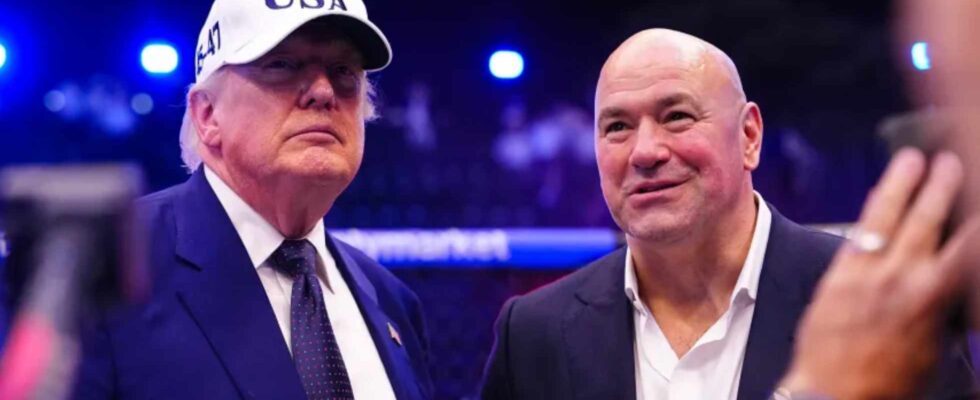
Standing before a crowd in his hometown of Las Vegas, UFC CEO Dana White took to the podium to introduce President Donald Trump at a rally centered on two domestic economic proposals: the No Tax on Tips program and a new initiative called Trump accounts.
For White, the moment carried a personal weight that went well beyond politics.
“I grew up in this town,” White told the crowd. “After I graduated high school, I worked at the Golden Nugget. I was a valet, I was a bellman, and I lived on tips. I know what it’s like when every dollar matters and I know what it feels like when you work hard all day and you’re hoping those tips were good because that’s what pays the bills. And that’s why this issue was very personal for me.”
White framed the No Tax on Tips proposal as a straightforward matter of fairness for service workers, invoking the casino employees, servers, and bartenders who form the backbone of the Las Vegas economy.
“The No Tax on Tips program is about letting hard-working Americans keep more of that money that they’ve earned,” he said. “Whether you’re a server, a bartender, a valet, or one of the thousands of incredible casino employees who keep this city running, you’ve earned that money. I’ve spent my whole life around hard-working people. When I leave someone a tip, I want that money going to them, not the government.”
He also touched on a second policy he was there to champion. “For the first time, every newborn American child will have the opportunity to begin building wealth from day one,” White said, describing Trump accounts as investments in the next generation. “These accounts aren’t just about investing money. They’re about investing in our kids.”
Dana White introduces Trump at Vegas rally. Talks ‘No Tax on Tips’ and ‘Trump Accounts’ pic.twitter.com/dutakvCSri
— Jed I. Goodman © (@jedigoodman) August 6, 2026
The appearance was the latest chapter in a public alignment between White and Trump that stretches back decades, long before either man occupied the national spotlight they do today. White has spoken openly about how Trump gave the UFC a foothold in Atlantic City during the organization’s early years, when the sport was still searching for credibility and willing venues. Trump hosted events at the Taj Mahal and, by White’s account, showed up from the first match of the night and stayed until the last.
“Every good thing that ever happened to me in my career from there on out, always the first guy to reach out and say, ‘Congratulations. I always knew you’d do it,'” White recalled in a separate interview on Boardroom. “And we created a friendship. We became friends.”
That bond is what ultimately brought White to the Republican National Convention last year, and by extension, to the rally podium in Las Vegas. In describing how Trump extended the RNC invitation, White gave a glimpse into the dynamic between the two men.
“This is what he said when he called me, and this is the type of person he is,” White recounted. “He’s like, ‘If you don’t want to do this, I completely understand, but I would be honored if you would speak at the Republican convention.'”
Despite the increasingly public nature of his appearances alongside Trump, White has consistently characterized himself as someone operating outside political circles by disposition.
“Back then, I didn’t even know who the governor of the state was,” he said. “I wasn’t into politics and I’m still really not, to be honest with you.”
That framing, however, has not gone unchallenged. Sports journalist Ariel Helwani has argued that White’s public actions, regardless of personal intent, carry undeniable political weight.
“Dana White has convinced you and tricked you into thinking that none of this is political,” Helwani said on his show. “Him speaking at the convention is not political? He’s tricked you into thinking that. By virtue of you standing there, it is a political statement that you are making. You are in favor of one brand over the other, one party over the other, and you have great influence.”
Helwani was careful to frame his critique as one of context rather than condemnation. “I’m not saying it’s good or bad,” he said. “He’s allowed to go out as an owner of a sports league and do whatever the hell he wants. But don’t insult us by saying that’s not political.”
For White, at least on this occasion, the message was less about party lines and more about the memory of counting tips at the end of a long shift in a city built by people who do exactly that.
“The President promised to make it a priority to do what’s best for you, your family, and our country,” he told the crowd. “Both of these much-needed programs accomplish that, and that’s why I am so proud to be here today.”
With that, he introduced the President of the United States.
