
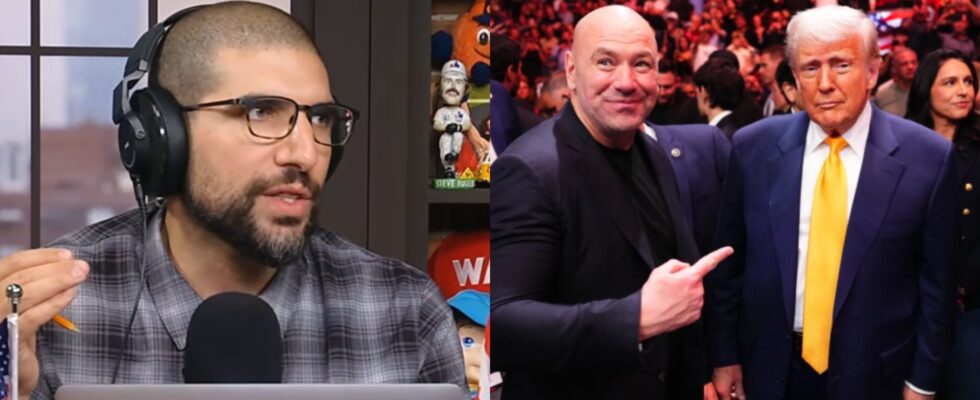
A viewer question on a recent episode of The Ariel Helwani Show accused host Ariel Helwani of allowing political activism to compromise their journalistic integrity, particularly in their coverage of the UFC’s proposed White House card.
The viewer argued that framing the event through a political lens was a disservice to MMA fans and suggested the two could not be both political activists and genuine reporters at the same time.
Helwani pushed back immediately, rejecting the premise of the criticism.
“It’s patently absurd to just go lalala, this has nothing to do with politics,” he said. “I don’t think any of us has said boycott, it’s good, it’s bad. But to not make any sort of correlation between the place in which this card is happening, the event in which it is promoting, the fact that it just so happens to be a Sunday night and not a Saturday and, oh by the way, it’s Donald Trump’s birthday. Are you kidding me?”
Panelist Petesy Carroll, who noted that he is not American and does not vote in U.S. elections, framed his stance as a matter of basic context rather than political advocacy.
“If they’re doing an event on the lawn of the White House, like what do you want me to talk about?” he said. “You’re going to have to talk about the fact that it’s happened at the White House. You’re going to have to talk about why it’s happened at the White House.”
Helwani then turned to a specific example involving featherweight champion Ilia Topuria, arguing that the geopolitical context surrounding the matchup naturally invites political discussion.
“Ilia represents the great country of Spain,” he said. “The president of Spain is not a big fan of the current president of the United States. He is competing an American on the White House lawn on Trump’s birthday in celebration of the 25th anniversary of the United States. I do think it’s a fair question to say, hey, do you think you’ll be the bad guy?”
Addressing the issue of UFC leadership and politics, Helwani also pointed directly to Dana White and his public political appearances.
“Dana White has convinced you and tricked you into thinking that none of this is political,” he said. “Him speaking at the convention is not political? He’s tricked you into thinking that. By virtue of you standing there, it is a political statement that you are making. You are in favor of one brand over the other, one party over the other, and you have great influence.”
Despite the strong language, Helwani repeatedly emphasized that he was not passing judgment on White’s actions, only challenging the idea that they were apolitical.
“I’m not saying it’s good or bad,” he said. “He’s allowed to go out as an owner of a sports league and do whatever the h*ll he wants. But don’t insult us by saying that’s not political.”
Carroll closed the discussion by drawing a historical comparison to the iconic 1974 bout between Muhammad Ali and George Foreman at the Rumble in the Jungle, arguing that context is often what makes a fight memorable.
“What’s the most famous match of all time?” he said. “It’s the Rumble in the Jungle in Zaire. What’s the context of that match without the context of that happening in Zaire? The context is very important when it comes to events. It makes them big, it makes them special, and it makes them talked about for the rest of time.”
