
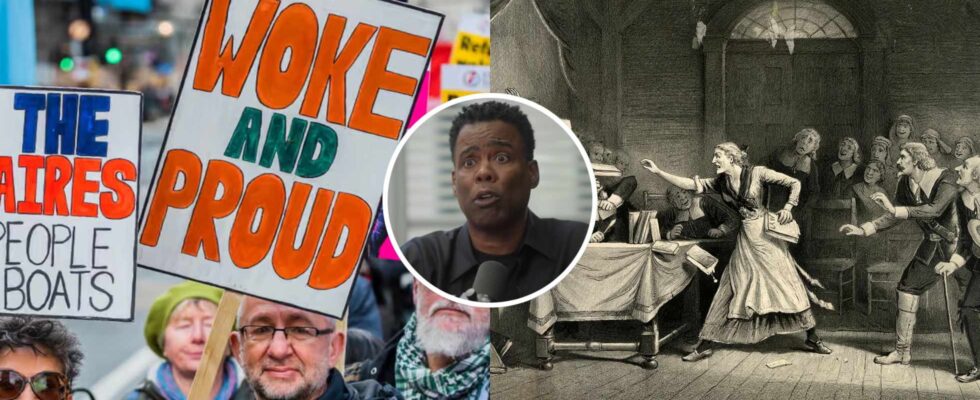
Chris Rock has never been one to shy away from difficult conversations, and in a recent interview with The New York Times, the comedian offered a critique of contemporary cancel culture.
During a conversation with interviewer David Marchese, Rock drew a provocative historical parallel when discussing what some have termed the “woke 1.0 era” following George Floyd’s death.
“The Salem witch hunts, I’m sure the first three witches they caught were actually witches,” Rock said. “But then you open up a witch office and now you got to start lying. Now you gotta make stuff up because you got overhead.”
The comparison suggests that while initial efforts to address injustice may be warranted, institutionalizing these movements can lead to excesses. Rock expanded on this theme by framing the issue in religious terms.
He explained, “The problem with wokeness we’re in the Old Testament right now. And the Old Testament has no forgiveness. The Old Testament didn’t work. So they had to write a remix called the New Testament.”
Rock was careful to acknowledge the value of advocacy for marginalized communities.
“It is great that marginalized people have a voice. It is great to advocate for anybody that feels marginalized,” he stated. His concern centers on what he sees as the movement’s lack of room for redemption.
Rock discussed his grandfather, a preacher who served time for taking someone’s life yet returned to lead his congregation. He also referenced a friend who went through his own public controversy.
“If you’re only friends with your friends when they’re good, they’re not your friends,” Rock observed.
He criticized what he sees as the media’s tendency toward binary thinking. “Everything’s black and white,” he said, recounting experiences from his youth in Brooklyn where he was placed in police lineups despite being uninvolved in any wrongdoing.
Rock used this to illustrate how trauma can cloud judgment, arguing that an accusation doesn’t necessarily equal truth, even when made in good faith.
