

Anti-aging entrepreneur Bryan Johnson has confirmed that neither Joe Rogan nor Andrew Huberman has invited him onto their podcasts, despite appearing to be an ideal guest for both shows.
The tech millionaire believes his outspoken criticism of AG1, a major sponsor for both podcasters, explains the absence of invitations.
“It’s accurate that neither Rogan nor Huberman has invited me on their pods,” Johnson wrote on social media in response to speculation about the topic.
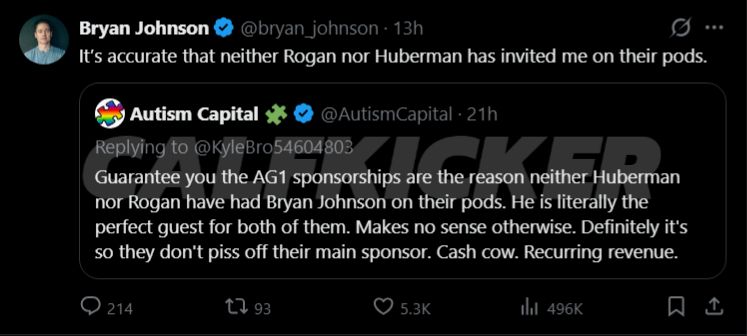
The confirmation came after industry observers questioned why Johnson, who focuses extensively on longevity science and personal health optimization, hasn’t appeared on two of the most influential health and wellness podcasts.
Some estimates suggest Huberman earns between $20,000 to $50,000 weekly from AG1 advertising, potentially totaling around $2 million annually. Rogan’s compensation from the supplement company reportedly reaches approximately $10 million per year.
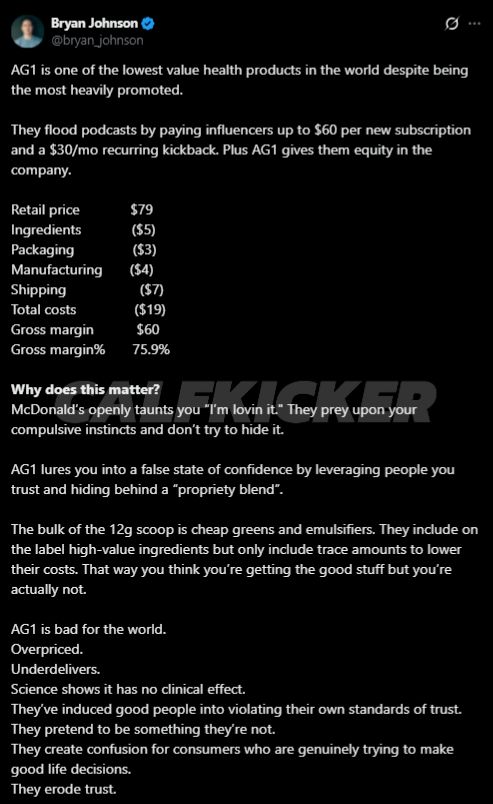
Johnson has become one of AG1’s most vocal critics, recently calling the supplement “one of the lowest value health products in the world despite being the most heavily promoted.”
His assessment followed his review of a clinical trial funded by AG1 itself, which he argues demonstrates minimal health benefits.
“They just completed a clinical trial and the results show no clinical benefit,” Johnson stated in a post that received over 1.4 million views. “This has been obvious for years. AG1 has no real product substance and is fundamentally an influencer heist.”
The trial in question, a four-week study involving 30 participants, found no significant changes in blood biomarkers compared to placebo. These included complete blood counts, comprehensive metabolic panels, and lipid profiles. Digestive quality-of-life scores also showed no statistically significant improvement, with a p-value of 0.058 falling just short of the threshold typically required for scientific significance.
Microbiome analysis revealed only modest shifts in bacterial populations, with no increase in overall microbiome diversity compared to the placebo group. While AG1 enriched certain probiotic species including L. acidophilus and B. bifidum, the study noted these changes could potentially fall within normal placebo-driven variability.
Johnson contrasted these findings with research on simpler alternatives. He highlighted studies on chicory inulin at 12 grams daily, costing approximately $20 per month, and resistant starch at 30 grams daily, priced around $35 monthly. Both represent substantial savings compared to AG1’s $79 monthly subscription.
The chicory inulin study demonstrated global microbiota shifts including enrichment of butyrate-producing bacteria like Bifidobacterium and reductions in pro-inflammatory species. The resistant starch trial in older adults showed significant increases in beneficial Bifidobacterium, reductions in inflammatory bacteria, and improvements in blood glucose and insulin resistance markers.
“Two simple alternatives, 75% and 56% less expensive, outperform AG1 in randomized clinical trials,” Johnson stated.
Beyond the science, Johnson criticized the business model behind AG1’s market dominance. According to his analysis, the company pays influencers up to $60 per new subscription plus a $30 monthly recurring payment. Some influencers also receive equity in the company.
He broke down the economics: “Retail price $79, Ingredients ($5), Packaging ($3), Manufacturing ($4), Shipping ($7), Total costs ($19), Gross margin $60, Gross margin% 75.9%.”
Johnson argued that AG1’s marketing approach differs fundamentally from openly indulgent products. “AG1 lures you into a false state of confidence by leveraging people you trust and hiding behind a ‘propriety blend,'” he wrote. “The bulk of the 12g scoop is cheap greens and emulsifiers. They include on the label high-value ingredients but only include trace amounts to lower their costs.”
AG1 defended its research in response to Johnson’s criticism. “This year-old study doesn’t say what you’re claiming. It showed improved nutrient status and digestive quality of life, consistent with multiple randomized, placebo-controlled AG1 trials,” the company stated.
Johnson pushed back on this defense. “You pay influencers money to promote. Not because it’s worth $79, but because you all get rich. Trying to defend a legitimate science stance is silly. It’s disingenuous to people sincerely trying to improve their health. The health benefits of AG1 are worth $30, max.”
Dr. Rhonda Patrick, a biomedical scientist, has previously characterized AG1 as essentially a multivitamin rather than a true greens supplement. “Calling Athletic Greens one or ag1 a high quality greens powder is a little misleading. I think it’s more of a multivitamin,” she said. “There’s very minuscule amounts of the quote unquote superfood complex and the quote unquote nutrient extract and the probiotics that are in that blend. The amounts are so minuscule that there’s absolutely no way that you should be considering this a greens supplement.”
The controversy occurs as AG1 attempts to pivot from influencer-driven marketing toward scientific credibility. CEO Kat Cole announced the company cut its marketing budget by 40% to invest in clinical research, committing over $10 million to four double-blind, randomized, placebo-controlled trials. An additional $20 million investment in clinical trials has been planned.
Critics have questioned some methodological choices in AG1’s research, including the use of maltodextrin as a placebo. Studies have shown this can negatively impact gut health, potentially making AG1 appear more beneficial by comparison.
Johnson himself sells competing supplements through his Blueprint brand, including a product called Longevity Mix. He has invested $25 million of his own money into the venture, which he describes as operating at breakeven to keep prices low.
“I rarely ever speak about Blueprint products because I get hit so hard with people calling me a grifter,” Johnson wrote. “When people inevitably call me a grifter, please inform them that I am a gifter, not a grifter. I have published everything I do, for free, in the open.”
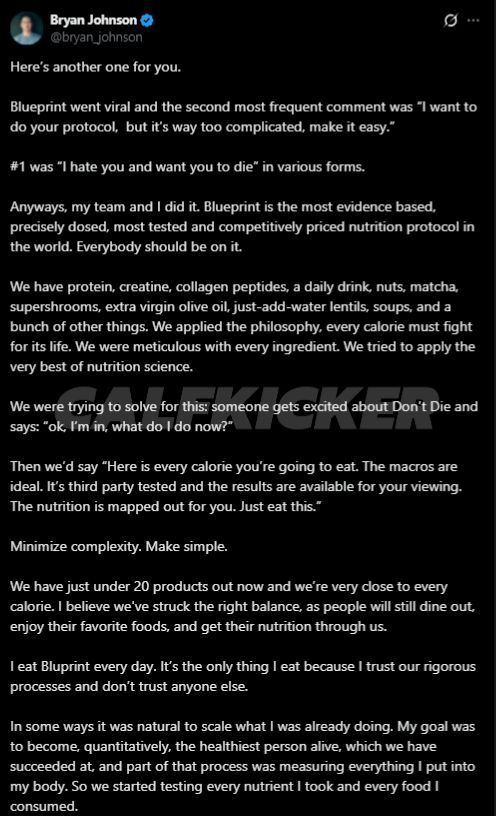
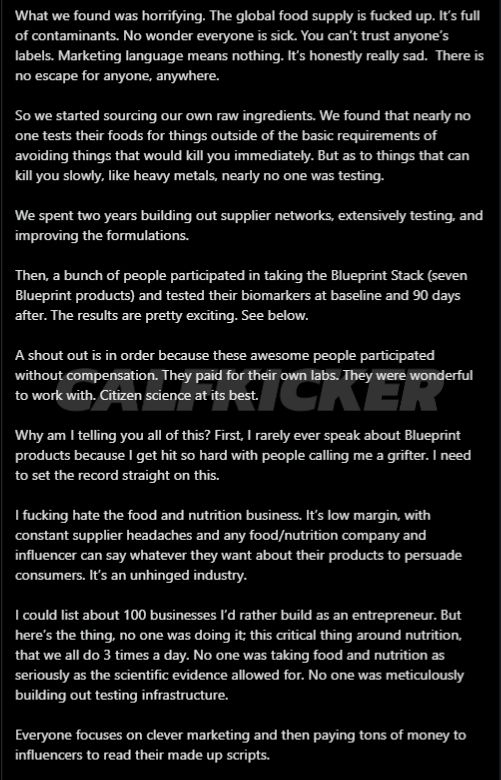
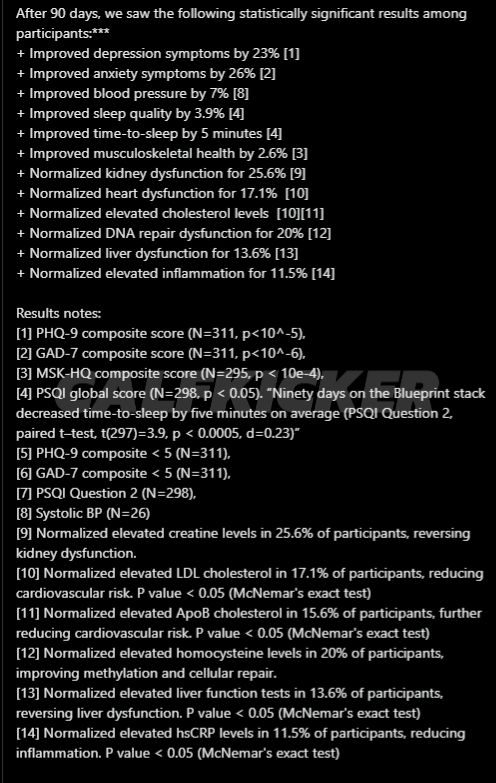
Johnson conducted his own study with participants who voluntarily consumed Blueprint products for 90 days. The results showed statistically significant improvements in several health markers, including a 23% improvement in depression symptoms, 26% improvement in anxiety symptoms, and 7% improvement in blood pressure.
Despite reduced marketing spending, AG1 reported a 40% increase in sales on Black Friday, suggesting strong consumer loyalty. The company has shifted away from traditional influencer partnerships toward partnerships with nutrition students and expanded into retail channels including Costco.
Whether Johnson will eventually appear on either podcast remains uncertain.
