

Anti-aging entrepreneur Bryan Johnson has publicly recommended that people cancel their AG1 subscriptions after reviewing the supplement company’s own clinical trial data. His criticism centers on what he describes as minimal health benefits that don’t justify the $79 monthly price tag.
“They just completed a clinical trial and the results show no clinical benefit,” Johnson wrote in a social media post that has garnered over 1.4 million views. “This has been obvious for years. AG1 has no real product substance and is fundamentally an influencer heist.”
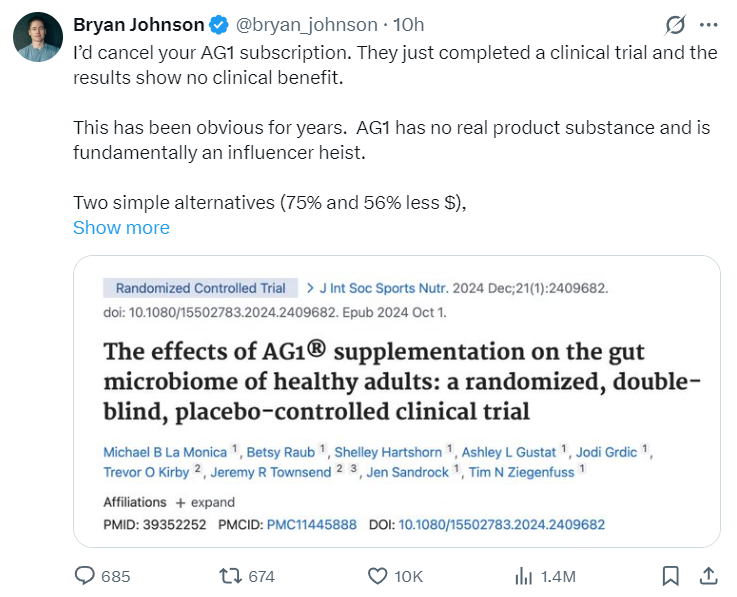
Johnson’s critique comes at a time when AG1 (formerly known as Athletic Greens) has been attempting to pivot from influencer-driven marketing toward scientific credibility.
The company recently announced it had cut its marketing budget by 40% to invest in clinical research, committing over $10 million to four double-blind, randomized, placebo-controlled trials.
However, Johnson points to the published results of one AG1-funded study, which showed limited impact on health markers.
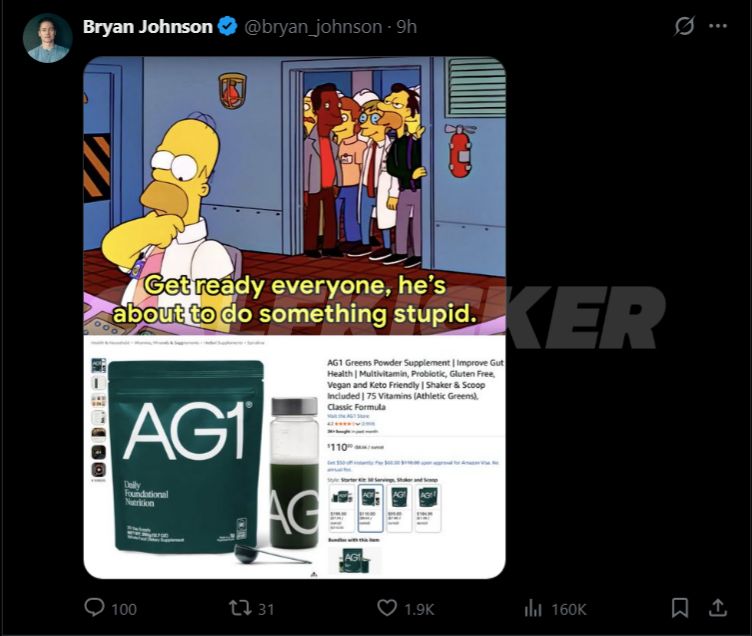
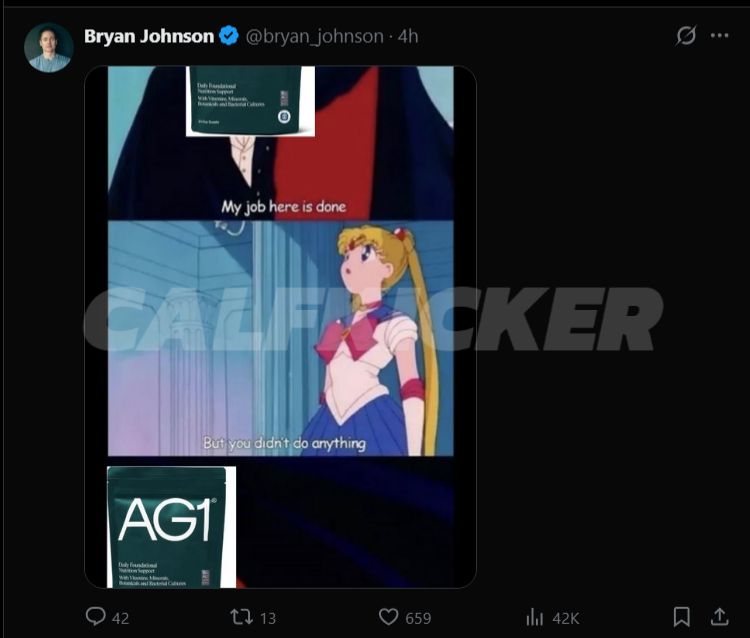
According to the research published in a peer-reviewed journal, the four-week trial involving 30 participants found no significant changes in blood biomarkers compared to placebo, including complete blood counts, comprehensive metabolic panels, and lipid profiles. The study also showed no statistically significant improvement in digestive quality-of-life scores, with a p-value of 0.058 falling just short of statistical significance.
The microbiome analysis revealed only modest shifts in bacterial populations, with no increase in overall microbiome diversity compared to the placebo group. While AG1 enriched certain probiotic species including L. acidophilus and B. bifidum, the changes were described in the study as potentially falling within normal placebo-driven variability.
Johnson contrasted these findings with studies on simpler, less expensive alternatives. He highlighted research on chicory inulin at 12 grams daily, which costs approximately $20 per month, and resistant starch at 30 grams daily, priced around $35 monthly. Both represent substantial savings compared to AG1’s $79 monthly subscription.
The chicory inulin study, conducted with constipation patients, demonstrated global microbiota shifts including enrichment of butyrate-producing bacteria like Bifidobacterium and reductions in pro-inflammatory species.
The resistant starch trial in older adults showed significant increases in beneficial Bifidobacterium, reductions in inflammatory bacteria, and improvements in blood glucose and insulin resistance markers.
“Two simple alternatives, 75% and 56% less expensive, outperform AG1 in randomized clinical trials,” Johnson stated.
AG1 responded to Johnson’s criticism, defending their research. “This year-old study doesn’t say what you’re claiming. It showed improved nutrient status and digestive quality of life, consistent with multiple randomized, placebo-controlled AG1 trials,” the company wrote.
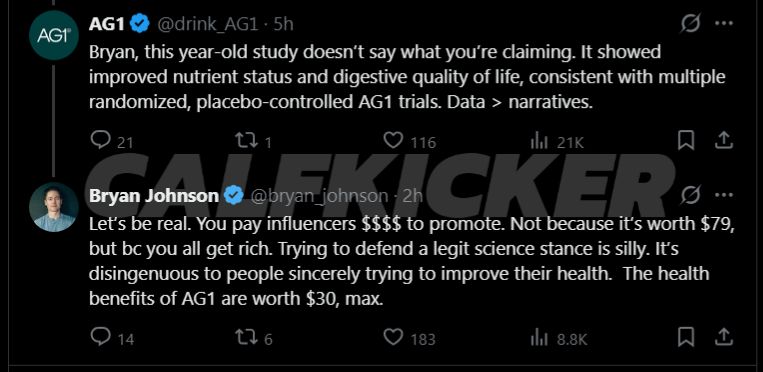
Johnson pushed back on this defense, suggesting that AG1’s business model relies more on influencer promotion than genuine health value. “You pay influencers money to promote. Not because it’s worth $79, but because you all get rich. Trying to defend a legitimate science stance is silly. It’s disingenuous to people sincerely trying to improve their health. The health benefits of AG1 are worth $30, max.”
Previous investigations revealed that the company promoted benefits based on unpublished, non-peer-reviewed studies. Critics have also questioned the use of maltodextrin as a placebo in AG1’s trials, noting that this substance has been shown to negatively impact gut health in a majority of studies, potentially making AG1 appear more beneficial by comparison.
Dr. Rhonda Patrick, a biomedical scientist, has previously characterized AG1 as essentially a multivitamin rather than a true greens supplement. “Calling athletic greens one or ag1 a high quality greens powder is a little misleading. I think it’s more of a multivitamin,” she said in a video response.
She continued: “There’s very minuscule amounts of the quote unquote superfood complex and the quote unquote nutrient extract and the probiotics that are in that blend. The amounts are so minuscule that there’s absolutely no way that you should be considering this a greens supplement.”
AG1 CEO Kat Cole has emphasized the company’s renewed commitment to research, announcing plans to invest an additional $20 million in clinical trials. The company has also shifted away from traditional influencer partnerships, instead creating partnerships with nutrition students and expanding into retail channels like Costco.
Despite reduced marketing spending in 2025, AG1 reported a 40% increase in sales on Black Friday, suggesting the brand maintains strong consumer loyalty. Whether this stems from genuine product benefits or the lasting impact of years of influencer endorsements remains a point of debate.
For Johnson, the conclusion is clear. He views AG1 as overpriced relative to its demonstrated benefits and believes consumers would be better served by simpler, evidence-based alternatives.
