

Former UFC heavyweight and podcast host Brendan Schaub’s wife Joanna Zanella Schaub has entered the wellness space. She recently started making posts promoting peptide therapy to her Instagram followers.
The move comes as her husband has openly discussed his own struggles with declining viewership and career trajectory.
The timing raises eyebrows. Brendan recently appeared on the Joe Rogan Experience to discuss his own use of peptides for healing a bicep tear, revealing he opted for injectable stuff rather than surgical repair.
“I tore my bicep like a month ago probably. But I’m on a bunch of s**t,” Schaub told Rogan during the conversation.
When Rogan questioned the injury’s appearance and whether surgical intervention was necessary, Schaub confirmed it was a minor tear and detailed his peptide regimen.
“I’ve just been injecting… name something,” he said. The compounds included BPC 157, TB 500, and IGF-1, a stack that Rogan enthusiastically endorsed as effective for tissue repair.
Schaub went further, mentioning blue scorpion venom among his treatments. “Apparently it helps with healing,” he offered when pressed by Rogan about its benefits. He later confirmed the recovery was successful, stating, “I got back on the bench last week and had no problems.”
Now Joanna appears to be capitalizing on the peptide conversation, though her focus differs markedly from her husband’s athletic recovery approach.
Her recent Instagram post features overlaid text declaring “37 year old Body” and “Feeling better then ever,” followed by “TAKING PEPTIDES AND BALANCING ALL MY HORMONES.” The post lists GHK-Cu, NAD, SS-31, and MOTS-C as her chosen stuff.
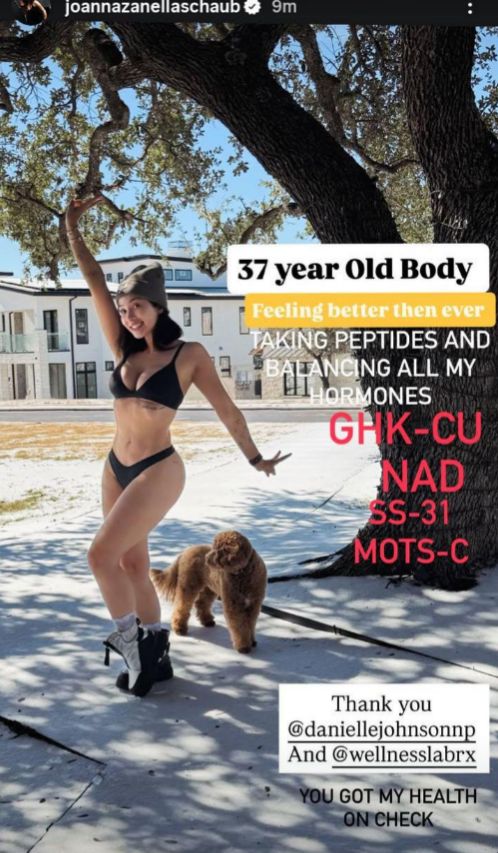
These peptides target different outcomes than those used by Brendan. GHK-Cu, a copper-binding tripeptide, has research supporting its role in wound healing, collagen synthesis, and skin rejuvenation. It’s commonly found in anti-aging skincare formulations and appears in both topical and injectable forms.
NAD precursors like NMN and NR have gained popularity in longevity circles for their potential role in cellular energy and metabolism, though human research remains limited and user experiences vary considerably.
SS-31, also known as elamipretide, targets mitochondrial function by binding to cardiolipin in the inner mitochondrial membrane. Research has explored its applications for kidney disease and cardiac dysfunction, while users report energy improvements primarily at higher doses.
MOTS-C, a mitochondrial-derived peptide, activates metabolic pathways and has shown promise in animal studies for improving glucose metabolism and exercise capacity.
The nature of this content push is difficult to ignore. Observers note that the Schaubs have developed a pattern of recreating trending content, attempting to capture audiences already engaged with established content. This approach extends to their social media presence, where they often replicate skits that have already achieved traction elsewhere.
Brendan has acknowledged that his comedy career stalled after ticket sales dried up, forcing him to search for alternative revenue streams. His primary podcast TFATK once commanded more than a million views per episode but now frequently struggles to reach 100,000 views despite his increased visibility as an online personality.
Peptides occupy a regulatory gray zone, with many lacking FDA approval for the uses being promoted. While some like GHK-Cu have substantial research backing their benefits, others remain largely supported by anecdotal reports rather than rigorous human trials.
