
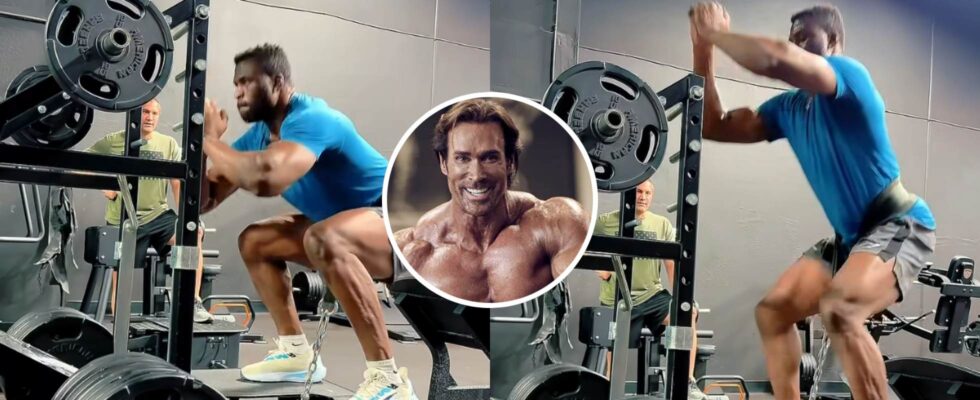
During a recent appearance on The Ariel Helwani Show, four-time Mr. Universe champion Mike O’Hearn weighed in on footage of Francis Ngannou performing a belt squat ahead of his match on the Netflix card.
After watching the clip of Ngannou squatting more than 810 lbs (367 kg) on a belt squat machine, O’Hearn acknowledged the heavyweight’s power but made it clear he was not a fan of the exercise variation itself.
“He’s impressive to me,” O’Hearn said, before adding, “but it’s a belt squat.”
O’Hearn then explained why he believes the movement is fundamentally different from a traditional barbell squat.
“They’re taking the pressure off the spine,” he said. “I’d rather him get under the bar itself.”
According to O’Hearn, avoiding spinal loading during compound lifts can actually limit long-term strength development.
“When you start running away from spinal pressure, you’re actually weakening the body,” he said. “You’re not strengthening it. Your body gets stronger, your whole body gets stronger, with pressure.”
For O’Hearn, the belt squat reflects a shift in modern training philosophies that he disagrees with. Rather than reducing spinal load to make exercises safer or more comfortable, he believes the body adapts and becomes stronger through handling that pressure directly.
He pointed to his own training style as an example, noting that he still performs traditional barbell squats and regularly works with 600 lbs (272 kg) during training sets.
O’Hearn also tied the discussion into one of the core ideas he has preached for years: the importance of connective tissue development. Throughout the interview, he repeatedly emphasized that true strength is built through tendons and ligaments just as much as muscle size.
“Real man strength is connective tissue density,” O’Hearn said.
In his view, exercises like belt squats may heavily target the legs, but they fail to build the kind of full-body durability and resilience that comes from supporting heavy weight through the spine and core.
He contrasted that philosophy with the approach he has followed since his teenage years, crediting heavy compound movements for helping him stay healthy throughout his career.
“I love the work,” O’Hearn said. “I don’t mind doing it.”
