
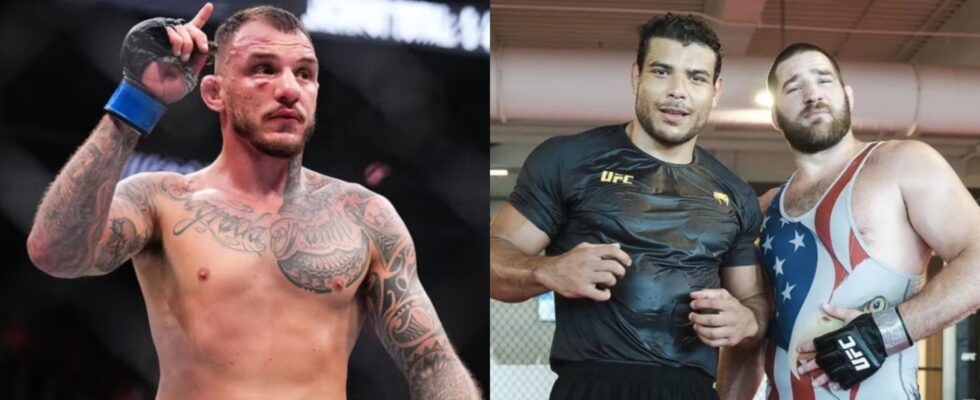
Renato Moicano has made it clear that he plans to test free agency once his current UFC contract expires, with three matches remaining on his deal. The lightweight contender recently shared his thoughts on athlete pay, the risks of challenging the UFC publicly, and why he believes the economics of MMA make meaningful change difficult.
Discussing Sean Strickland and Paulo Costa’s recent complaints about their UFC compensation, Moicano questioned whether either athlete stood to gain anything by airing their grievances publicly.
He said, “Strickland has much more popularity than I do. I don’t think it will have any effect for him. And Borrachinha, do you think he has more popularity or less than I do? More popularity. And to me, it was a huge mistake for him to lay his cards on the table on Twitter like that.”
For Moicano, the problem is not necessarily that athletes are demanding better pay, but how they approach negotiations with a promotion that holds considerable leverage over them.
“You should only pick a dispute that you have a chance of winning. And none of those guys have a chance of winning a dispute against the UFC. That’s the truth,” he explained.
“Opening negotiations, revealing how much you earn, because you end up putting a weapon in the UFC’s hands, you know? The UFC even if they want to pay, sometimes they can’t because then they end up losing.”
Moicano also pointed to Francis Ngannou’s departure from the UFC as an example of how difficult it can be for athletes to win a public battle against the promotion. Ngannou left the organization in 2023 and subsequently pursued opportunities outside MMA, including boxing, but Moicano believes even the former heavyweight champion failed to win his match with the UFC.
“Show me one athlete who won that dispute. I think not even Ngannou, who is now asking to come back. I think not even Ngannou, who fared the best and made money, but still lost the dispute with the UFC.”
Despite criticizing how Strickland and Costa have handled their complaints, Moicano acknowledged that the UFC holds a significant advantage over its athletes. He believes athletes would have a better chance of negotiating improved compensation if they could organize collectively.
“The UFC is in a privileged position in relation to the athletes. I have no doubt about that. I think a union should voluntarily be created so athletes could come to an agreement to negotiate, because negotiating like this is hard.”
However, Moicano does not expect the situation to change easily. He argued that the UFC’s dominant market position makes it difficult for individual athletes to negotiate from a position of strength, particularly without a viable competitor offering comparable opportunities.
“The UFC is 35 years old, or something like that. As long as there is no economic solution for this and competition, athletes’ salaries will stay the same, because they have a kind of monopoly… It’s just that economically it’s still unfeasible. The UFC is the big player. It has the largest market share.”
Moicano’s assessment of the business also extended to aspiring athletes. While MMA remains an attractive career for many, he offered a blunt warning about the financial realities of trying to make it professionally.
“Even for you who wants to be an athlete, I say it’s not worth it. Don’t invest your career in being a athlete. Don’t do it. Because it’s an illusion. It’s not worth it because you won’t make it.”
With three matches left on his current UFC contract, Moicano intends to complete his obligations before exploring what other opportunities might be available. His comments suggest he is prepared to accept the uncertainty that comes with entering the market as a free agent.
“I want to fulfill these three matches of mine and be free. I want to test myself in the market. I want to do these three matches and be free.”
He also understands that his decision may not sit well with the UFC, but he appears willing to take that risk.
“They’ll want to screw me over, for sure. But that’s fine, that’s just life.”
Despite the potential complications, Moicano insisted that he is not worried about what comes next. He credited his Christian faith for giving him confidence in the face of uncertainty.
“I’m not afraid at all. You know why? Because I believe in Jesus Christ. God will provide.”
