
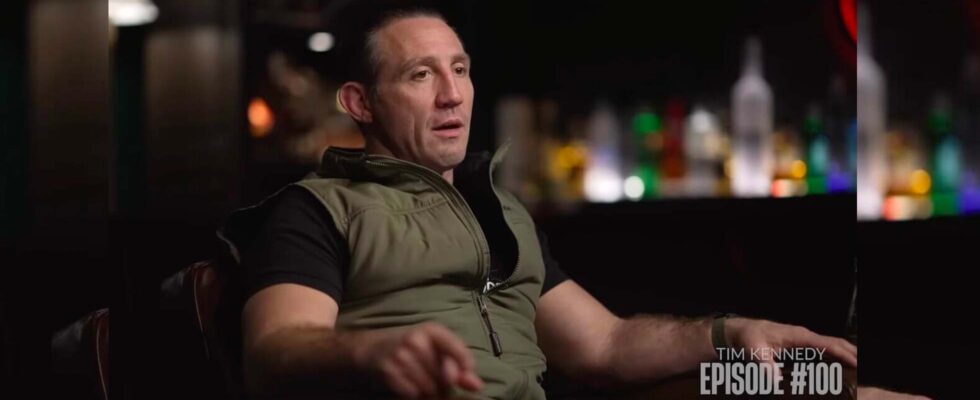
The reports started trickling out about Tim Kennedy’s medical crisis through Vallhall Vft, a veteran who appeared on the Todd Atkins Network. He laid out details that, if accurate, mean former UFC competitor and Green Beret Tim Kennedy is now struggling to keep his leg after a contracting assignment overseas went badly wrong.
Vallhall set the scene for an incident that unfolded far from the cameras and crowds Kennedy built his name in front of:
“He was in the Congo. He was (hit) on 17 September. He was in a three-man element.”
According to the account, Kennedy was not alone when things went sideways:
Of the three men on that assignment, two were left with serious wounds, and one, the New Zealander, did not make it.
Vallhall said Kennedy had at least one wound to the leg, and that he applied a tourniquet himself, a decision that likely kept him alive even as it created a new, separate problem:
“Now we’re going to go to a little bit of assumptions, but if he had a tourniquet on for that long, the great thing about a tourniquet is it stops the bleeding. The bad thing about a tourniquet is it stops all the bleeding. And you’re going to need blood flow to your extremities before you have some really, really big problems later on.”
Speaking from personal experience, Vallhall described just how unbearable even a short stretch with a tourniquet can be.
Given how much longer Kennedy reportedly had one in place, Vallhall didn’t sugarcoat what that likely meant:
“So for as long as Tim had that tourniquet on, I assure you he was not happy. Unless at some point it just goes numb.”
“I can tell you from the hour I had it on, it would just be a living he ll to have that on for five hours.”
The men were eventually extracted, but Vallhall made clear that getting out of the Congo didn’t mean Kennedy was out of danger. Infection was the next looming threat, though Vallhall said that, at least based on what he’s heard from people close to the situation, it hasn’t become an issue. Kennedy‘s leg, however, remains a genuine concern:
“He’s not completely out of the woods when it comes to his leg. That is something that is still on the table.”
Vallhall was careful to separate the facts still coming into focus from the parts that don’t require any more confirmation:
“Whatever you think of Tim Kennedy, whatever you think of him being there, some of these things we will need more information before you should form an opinion. But I do believe everyone can agree to this. Whatever just happened to Tim is horrible. It’s horrible to happen to a person.”
The toll it could take on Kennedy physically weighed heavily in the conversation:
“If he loses his leg, it would be sad, because Tim was, let me tell you, we’ve never, never argued. The man was an athlete. And the man was exceptional at what he did. And for him to lose a leg would just add insult to injury. And he was a Green Beret who served his country.”
Vallhall closed with a request that the focus stay where it belongs, on the men who were hurt and the one who didn’t make it home:
“Tim Kennedy deserves our prayers tonight, and the SAS member who lost his life, the family, deserves our prayers tonight. And the third member who’s injured.”
He noted he couldn’t yet confirm every detail about that third contractor, though he was fairly confident about his background:
“I say a foreigner. He’s not an American as far as I know. I’m certain about the Kiwi. I believe the other one was from Europe, but I will wait and confirm that. But I am 99% certain he was not an American, and I believe he was from Europe. Yeah, he’s also had a life-altering event happen to him.”
This news lands at an odd moment for Kennedy, whose public story has already been under a microscope well before anyone heard the word Congo attached to his name. Reporters digging into his background have spent months pulling apart claims he’s made for years about his education, his record in law enforcement and his military career, and the picture that emerges doesn’t match the one Kennedy has sold on podcasts and in his book.
Take his schooling. Kennedy has long said he graduated high school at 15 or 16, a detail that fits the prodigy narrative he’s built around himself. School records instead show he finished his mother’s homeschool program in 1998, when he was already at least 18. He’s also claimed an associate’s degree by 17, yet Cuesta College’s own records place that milestone in May 2000, when he was 20. The gap widens further with his claim of pursuing a graduate degree in psychology by 2001. He didn’t actually complete his bachelor’s degree until 2003, from Columbia College of Missouri, a school with no record of him ever enrolling in graduate coursework at all.
His law enforcement résumé has fared no better under scrutiny. Kennedy has described finishing the Allan Hancock College police academy as an Honor Graduate with top marks across the board, but the school says the only recognition on file is a fitness award, nothing academic or tactical. Despite describing work as a deputy supporting academy training, neither California’s nor Texas’s peace officer licensing agencies have any record of him ever serving as a sworn officer.
Even his current ventures haven’t escaped the pattern. Kennedy has claimed his Apogee Cedar Park students outperform their peers on college applications, yet the program’s own director says there’s no high school track at all, just classes for children ages 4 to 14. He’s also claimed 200 affiliate Apogee schools exist under his banner, though recent counts put the real number closer to 86, and a large share of those listings have no address or are simply labeled as future launches. A supposed federal interoperability liaison role spanning agencies like the Department of Defense and the National Security Council hasn’t checked out either; the Office of the Director of National Intelligence says it has no knowledge of Kennedy holding any such position.
Then there’s the matter of his military decorations. Kennedy has acknowledged misstating parts of his service record and has walked back an implication that he earned a Bronze Star with Valor. The Maryland National Guard has since opened its own inquiry into his public statements about his service.
None of that history changes what’s now being reported out of the Congo, but it does explain why so many people are reserving judgment until more facts surface.
