
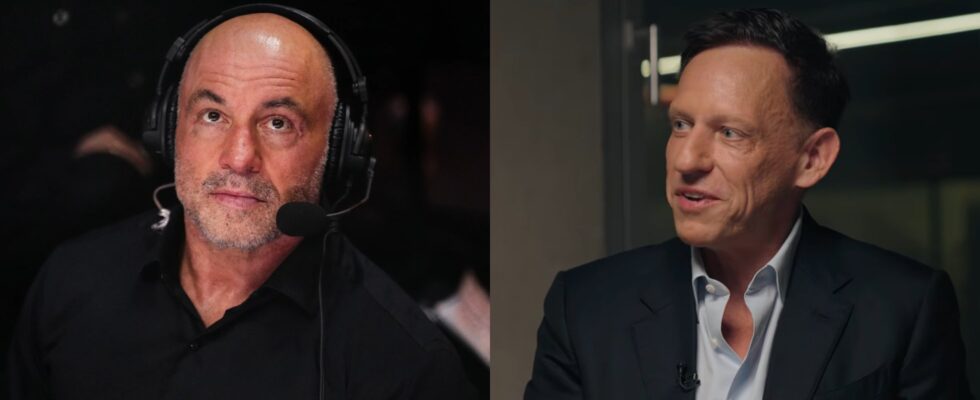
In a conversation with Mathias Döpfner, tech investor and entrepreneur Peter Thiel offered a provocative take on how Western society has lost its way: not through moral failing, but through widespread incompetence.
His most striking claim: “If you’re evil, you’re not bad. You’re actually maybe kind of good.”
The statement sounds outrageous until Thiel explains the linguistic distinction he’s making. “What is the antonym of good?” he asks. “The moral antonym is evil. The functional antonym is bad.”
A Ferrari might be considered evil because it’s gas-guzzling and excessive, but a Trabant which is the notoriously unreliable East German car, is simply bad. It doesn’t work. The Ferrari whatever its moral status at least functions.
Thiel’s point cuts to what he sees as the central problem facing Western democracies: a fixation on moral debates while fundamental competence erodes.
“We have all these good versus evil debates and we’re just full of badness,” he says. “Most of the time those things are not even evil. They’re not even good. They’re just merely bad.”
Drawing on literary history, Thiel contrasts two versions of the Faust legend. In Christopher Marlowe’s 16th-century telling, Faustus is a charlatan practicing fake science and he goes straight to hell.
In Goethe’s version, Faustus makes a pact with the devil and acquires knowledge through morally questionable means. But it ultimately gets redeemed because he actually accomplishes something.
“I want to be very clear, I think it’s better to be good than evil,” Thiel clarifies. “But perhaps I prefer Goethe’s Faustus to Marlowe’s Faustus.”
This framework helps explain Thiel’s longstanding concern about technological stagnation in the West. For two decades, he’s argued that progress slowed dramatically after the 1970s, limited primarily to software and computers while advances in the physical world like mechanical engineering, aerospace, nuclear energy, ground to a halt.
The arrival of artificial intelligence has finally shifted this picture. “Perhaps AI is bigger than the internet and at least has the potential to reaccelerate growth,” he says.
Yet even this breakthrough reveals Western dysfunction. While AI development races forward in the United States and China, Europe has fallen dramatically behind. Thiel notes that American corporations have accelerated their AI adoption with urgency, while European companies maintain an attitude of “don’t do tomorrow what you can save for the day after.”
Thiel’s diagnosis extends beyond economics to politics. He worries that establishment parties across the West have failed to address fundamental problems of growth and opportunity, creating space for extreme movements.
In Germany, he notes that 47% of voters aged 16 to 24 supported Die Linke in recent Berlin elections. “Eventually the young people are the people who will be deciding things in your society,” he warns.
His solution isn’t to moralize about these trends but to focus on what actually works. When discussing the debate over AI safety, whether to slow development out of concern for potential dangers, Thiel acknowledges risks but rejects the precautionary principle.
“If you do nothing, if there is no progress on any dimension, I don’t think our societies work at all,” he argues. The middle class expects their children to do better than themselves, and when that intergenerational progress breaks down, “the whole society starts to derange in very strange ways.”
This brings Thiel back to competence over morality. Western societies face a choice: they can continue having abstract debates about good and evil while their institutions decay, or they can focus on building things that actually function.
“If you’re in a world where 99% of the businesses, companies, people, political leaders are totally incompetent, that’s the problem we should actually be talking about,” he says.
Peter Thiel has long been part of Joe Rogan’s wider intellectual and business circle. The “walled garden” idea came up when Ron White recently asked Rogan why people online continued to target the Comedy Mothership. Rogan explained that the criticism reminded him of a warning he had received years earlier from a philosopher he knew.
“It’s a walled garden. Someone warned me about that a long time ago,” Rogan said. “This philosopher guy that I know. He said, ‘You got to be careful because like it looks like you guys are having too much fun and other people can’t get in and they feel like it’s a walled garden. They want to [] on it.’”
